
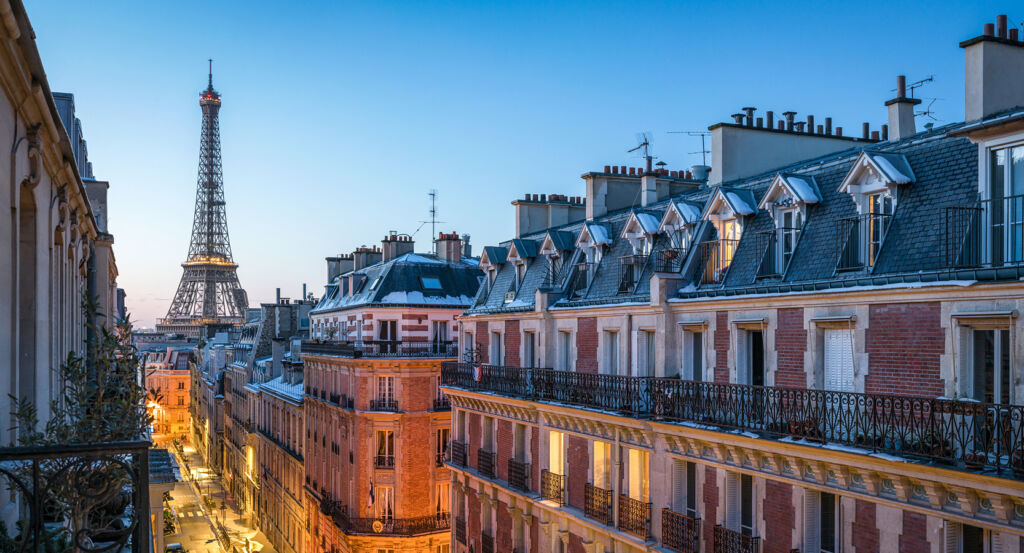
Why you should experience J.K. Place Paris in Paris, France.
J.K. Place Paris is an Italian-inflected luxury hotel where Saint-Thomas-d'Aquin's cultivated Left Bank character, Parisian collecting culture, Florentine design and residential hospitality converge inside a former diplomatic building near the Seine.
Set along Rue de Lille near Rue de Solférino and just steps from Musée d'Orsay, the five-star hotel opened in 2019 as hotelier Ori Kafri's first J.K. Place outside Italy following properties in Florence, Capri and Rome. Florentine architect Michele Bönan shaped the interiors as a private Parisian residence, combining African chairs, vintage Hermès drawings, geometric rugs, custom furniture and hundreds of objects collected with Kafri during monthly visits to Parisian flea markets over more than three years. The contemporary house contains only 29 individually designed rooms and suites, giving Bönan sufficient space to develop three living rooms, generous bathrooms, dressing areas and salon-like communal spaces. Casa Tua adds a glass-roofed Italian dining room while the subterranean J.K. Spa combines an indoor swimming pool, two private treatment rooms and a Technogym-equipped gym, allowing Italian hospitality, Parisian collecting and contemporary wellness to operate within the same intimate address.
What you should know about J.K. Place Paris.
J.K. Place Paris is best known for opening in 2019 as Ori Kafri's first J.K. Place outside Italy, transforming a former government and diplomatic building at 82 Rue de Lille into a 29-room five-star hotel designed by Florentine architect Michele Bönan after the pair spent more than three years collecting hundreds of furnishings, artworks and decorative objects from Parisian markets. Ori Kafri had developed the J.K. Place philosophy with Michele Bönan through earlier Italian properties, making Paris the first opportunity to transplant their private-house model beyond Italy while allowing Bönan to reinterpret the concept through French antiques and the material culture of the Left Bank. Michele Bönan assembled the Rue de Lille interiors through objects including African chairs, vintage Hermès sketches, geometric rugs, a mirrored David Hicks chest and red leather Jacques Adnet wall lights originally designed for Hermès, with many pieces sourced through Marché aux Puces de Saint-Ouen. J.K. Place organized the resulting 29 accommodations as individually designed rooms and suites with high ceilings, generous bathrooms and walk-in dressing areas, while three interconnected living rooms extend the residential premise into the public interiors. Casa Tua introduced the restaurant concept already established in Miami and Aspen to Paris, while J.K. Spa added an indoor swimming pool, two private treatment rooms and a Technogym gym beneath the house.
Ori Kafri anchors the hotel's collecting narrative through his longstanding collaboration with Michele Bönan, whose monthly sourcing trips through Paris over more than three years assembled the antiques, furniture and decorative objects that distinguish the Rue de Lille property from the earlier J.K. Place addresses. Michele Bönan carries that narrative into individual rooms through French and international design references, including Jacques Adnet lighting, David Hicks furniture, vintage Hermès works and pieces acquired at Marché aux Puces de Saint-Ouen. Chef Ivan Ferrara develops J.K. Place Paris's Italia character through Casa Tua, where the Miami and Aspen restaurant concept centers the Paris house on Italian cuisine beneath a glass roof. Noble Panacea extends the authored program into J.K. Spa through skincare developed from research by Nobel Prize-winning chemist Sir Fraser Stoddart, while Technogym provides the equipment for the adjoining J.K. Gym.
How to fold J.K. Place Paris into your trip.
J.K. Place Paris works as the anchor for an afternoon tracing nineteenth-century art, decorative culture and aristocratic collecting through the western Left Bank.
Begin at Musée d'Orsay, where Victor Laloux designed the former Gare d'Orsay for the 1900 Exposition Universelle, creating a railway terminal whose vast metal structure and coffered vault now frame French artistic production from 1848 to 1914. Continue to Musée national Eugène-Delacroix, occupying the apartment and garden studio Eugène Delacroix moved into in 1857 while completing his murals for nearby Saint-Sulpice, preserving the painter's final home alongside works, letters and objects connected with his career. Conclude at Musée Rodin, established inside the Hôtel Biron after Auguste Rodin began occupying rooms there in 1908 and later donated his works and collection to the French state on the condition that the residence become a museum devoted to his art. The progression moves from Laloux's railway architecture through Delacroix's private studio into Rodin's residence and collection, creating a study of architecture, artists and collected objects closely aligned with Michele Bönan and Ori Kafri's own approach to J.K. Place Paris.
Where your story begins.
Foresyte Travel reveals places that feel extraordinary long before you arrive.
Experience premium editorial crafted for luxury travelers.














































































































