Why you should experience Kastellet Church in Copenhagen, Denmark.
The Norwegian Church at Kastellet is one of Copenhagen's most understated treasures, a small, timber-clad sanctuary that radiates warmth, humility, and northern grace.
Tucked quietly near the star-shaped ramparts of Kastellet, this modest chapel feels worlds away from the city's rhythm. Its red-painted wooden façade and sharply pitched roof evoke the fjords and forests of Norway, standing as a gentle reminder of shared Scandinavian spirit. Step inside, and the air changes, sunlight filters through simple windows onto pale wooden pews, and the faint scent of pine mingles with candle wax. The space is small but luminous, designed to cradle. Every surface carries the imprint of care: hand-carved trim, iron hinges shaped like leaves, and a carved cross that catches the light just so. Built by and for the Norwegian community in Copenhagen, the church feels like an embrace from home, not grand, but profoundly sincere. In a city celebrated for its architecture, this little church stands out precisely because it whispers.
What you should know about Kastellet Church.
The Norwegian Church at Kastellet tells a quiet story of exile, resilience, and belonging that reaches back more than a century.
Formally known as Sjømannskirken i København (The Norwegian Seamen's Church in Copenhagen), it was founded in the late 19th century to serve Norwegian sailors who spent months at sea and sought familiarity when they came ashore. The building itself, a hybrid of chapel and cultural center, was constructed in 1958, replacing an earlier mission house near Nyhavn that had grown too small for its expanding congregation. Its design reflects Norwegian style architecture: steep gables, exposed timber beams, and restrained ornamentation that favors function over flourish. During the Second World War, the Norwegian Church community played a discreet but vital role in supporting exiled sailors and refugees, offering food, shelter, and spiritual guidance in times of uncertainty. Few visitors realize that the church remains active today, functioning both as a religious center and a gathering place for Norwegians living abroad, hosting cultural events, Christmas markets, and concerts that celebrate Norway's maritime heritage. Though modest in scale, its symbolism runs deep: a home port for those far from home, anchored in the heart of another nation's capital.
How to fold Kastellet Church into your trip.
The Norwegian Church works as a moment of calm at the northern edge of Kastellet, a pause between fortification and reflection.
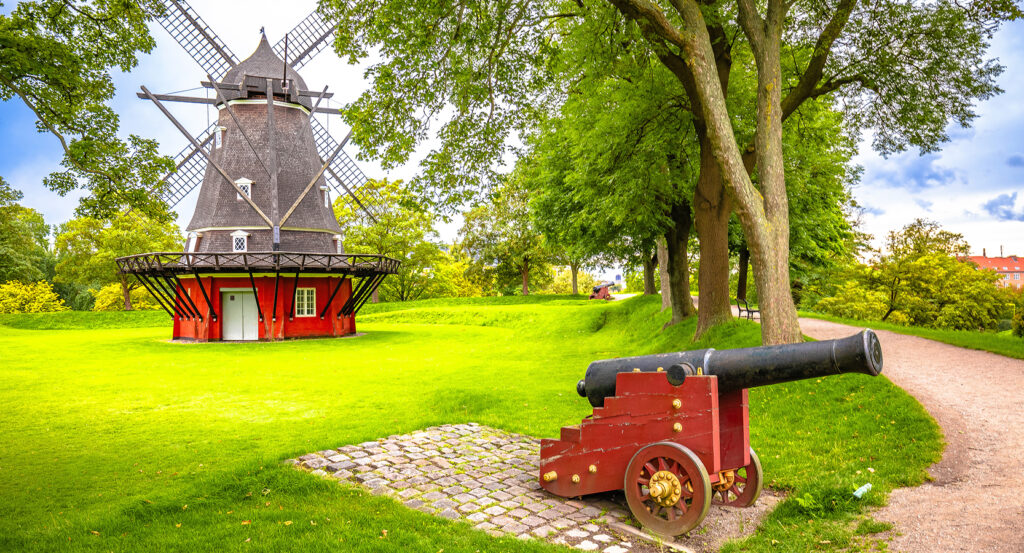
Enter Kastellet through the King's Gate and follow the inner path along the ramparts until the red wooden structure appears through the trees, its form both familiar and foreign amid the Danish landscape. Step inside if open; the interior feels like a cabin in the mountains, warm, fragrant, and intimate. Take a seat for a few quiet minutes, letting the stillness settle around you. If you visit during one of the church's cultural events or Sunday services, you'll often hear hymns sung softly in Norwegian, their melodies floating through the open doorway and across the moat. Outside, the grassy embankments provide perfect spots to sit and watch the breeze ripple through the flags of Denmark and Norway that often fly side by side. Combine your visit with a walk around Kastellet's ramparts or a stop at St. Alban's Church and the Gefion Fountain nearby, each landmark offering its own form of serenity. The Norwegian Church at Kastellet isn't about spectacle; it's about connection, a quiet tribute to shared heritage and the enduring warmth of Nordic fellowship.
Where your story begins.
Foresyte Travel reveals places that feel extraordinary long before you arrive.
Experience premium editorial crafted for luxury travelers.