Why you should experience Kastelsmøllen in Copenhagen, Denmark.
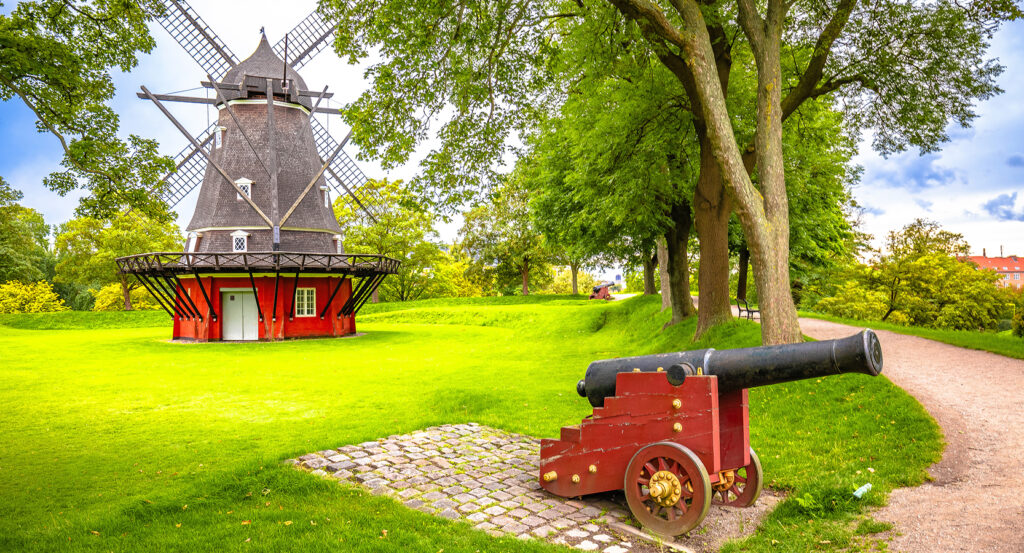
Kastelsmøllen, or The Windmill of Kastellet, in Copenhagen is more than a relic of the past, it's the fortress's heartbeat, a humble yet commanding symbol of endurance turning gently against the northern sky.
Perched atop one of Kastellet's grassy bastions, the wooden mill rises like a sentinel of simpler times, its dark timbers and wide sails cutting a striking silhouette over the red barracks and green ramparts below. Built in 1847 to replace an earlier structure destroyed by storms, the windmill once supplied grain for soldiers stationed within the fortress, a quiet engine of sustenance amid centuries of military discipline. Today, its sails turn only for ceremony, but the spirit of motion remains. From a distance, the windmill seems frozen in time, yet when sunlight glints on its blades or a breeze ripples through the moat below, you sense life continuing in cycles, the same air that once drove defense now animating peace. It's one of Copenhagen's most quietly poetic sights: a reminder that beauty often survives by adaptation, not resistance.
What you should know about Kastelsmøllen.
Kastelsmøllen has stood at the crossroads of history, industry, and resilience for more than 175 years.
Its original purpose was entirely practical, a backup source of grain milling in case of siege, ensuring that Kastellet's garrison could remain self-sufficient. The current structure, designed in the Dutch style, replaced a predecessor from the 17th century and was engineered to withstand coastal winds sweeping in from the Øresund. Constructed from sturdy oak and pine, its sails once turned massive millstones that ground flour for both soldiers and nearby civilians. Remarkably, the windmill continued to operate through the 19th century and was only retired from service after World War II, when the fortress transitioned from active military use to heritage site. Few visitors realize that the mill's mechanisms are still functional, its internal gears and grinding stones meticulously restored during the 1980s. On special occasions, the Danish Army still opens the doors for demonstrations, turning the sails by hand as part of national heritage events. The windmill's survival is no accident; it's the product of the same disciplined care that defines Kastellet itself, a structure built for necessity but preserved for grace.
How to fold Kastelsmøllen into your trip.
Kastelsmøllen works as the quiet high point, both literally and emotionally, of your walk through the fortress.
After entering through the King's Gate, follow the earthen ramparts counterclockwise along the star-shaped walls until you see the wooden silhouette rising ahead. The climb to the bastion is gentle, and with each step, the view widens, red barracks below, the harbor shimmering beyond, and the Danish flag waving softly against the sky. Take a moment to circle the base of the mill: its timberwork bears the texture of time, each board weathered by salt wind and seasons. If you visit in spring or summer, the surrounding hill bursts with wildflowers, and the sails cast slow-moving shadows that ripple across the grass. Sit on the embankment for a few minutes, listening to the wind that still hums through the wooden frame, carrying echoes of a fortress long transformed into sanctuary. As you descend, look back, the mill stands solitary yet serene, a symbol of how Copenhagen remembers its past not with nostalgia, but with quiet pride. Kastelsmøllen isn't just a viewpoint; it's a meditation in motion, a story told in turns of wood and wind.
Where your story begins.
Foresyte Travel reveals places that feel extraordinary long before you arrive.
Experience premium editorial crafted for luxury travelers.