Why Key West Lighthouse matters.
Key West Lighthouse is a historic maritime beacon where Old Town's nineteenth-century residential heritage meets the evolution of American coastal navigation, hurricane engineering, and the preservation of Florida Keys maritime history.
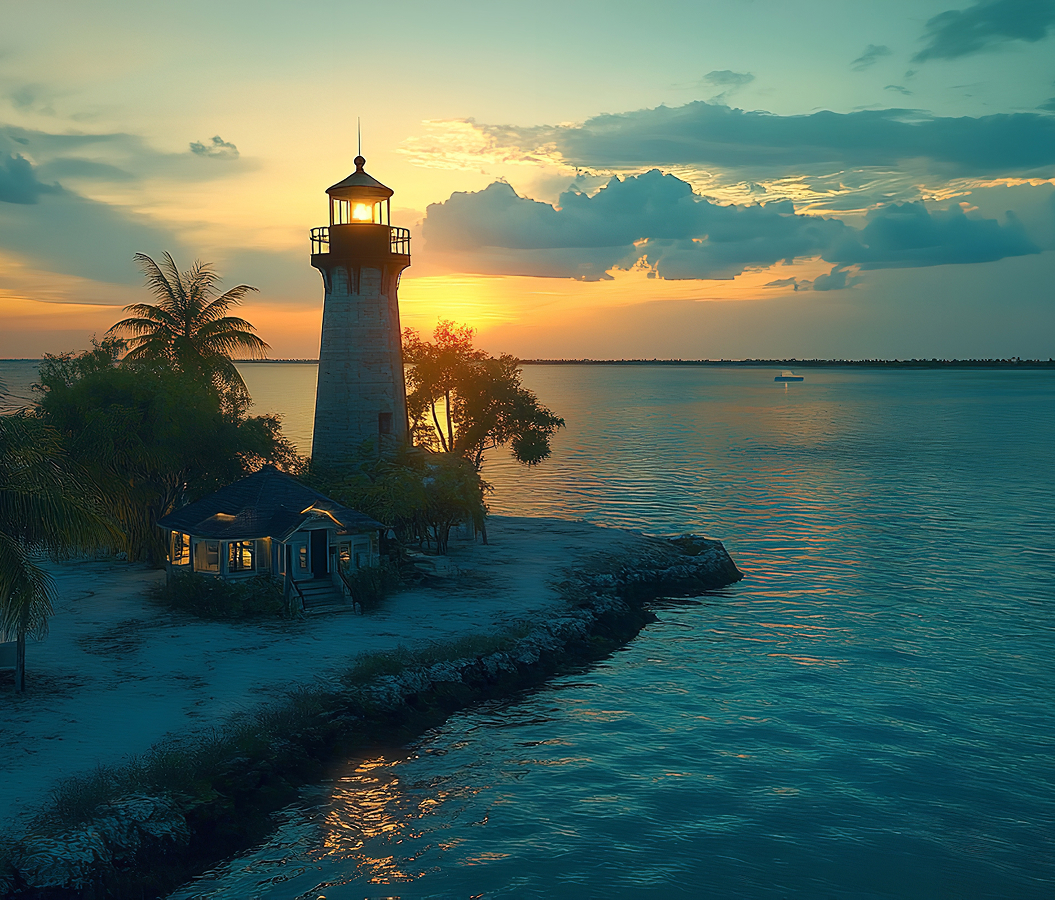
Occupying a landscaped compound along Whitehead Street in the southern portion of Old Town, Key West Lighthouse stands opposite the Ernest Hemingway Home and Museum, between the residential blocks surrounding Truman Avenue and the southern commercial district of Duval Street. Its whitewashed conical brick tower rises above the surrounding wooden houses and tropical vegetation, terminating in a black lantern room that preserves the distinctive silhouette of a nineteenth-century American lighthouse. A spiral staircase ascends through the narrow interior to an elevated observation platform, where the rooftops of Old Town, the harbor, the Atlantic shoreline, and the surrounding islands become visible across an uninterrupted panorama. The adjoining keeper's residence presents a contrasting domestic character, with white clapboard walls, green shutters, a broad porch, and furnished rooms that preserve the architectural traditions of tropical residential life. The result is a historic navigational station whose commanding vertical presence and intimate domestic surroundings connect the physical geography of Key West with the working lives of the families responsible for protecting vessels approaching the island.
What defines Key West Lighthouse.
Key West Lighthouse is best known for its development as an essential navigational aid during the expansion of American maritime commerce in the Florida Straits, surviving a succession of devastating hurricanes, technological changes, and generations of lighthouse keepers whose responsibilities extended across more than a century. The United States acquired Florida from Spain in 1821, bringing the strategically important waters surrounding Key West under American administration during a period of expanding commercial shipping and naval activity. The federal government established a naval presence on the island in 1823, recognizing the importance of the Florida Straits as a maritime passage between the Atlantic Ocean and the Gulf of Mexico. The surrounding coral reefs created substantial hazards for sailing vessels approaching the island, generating demand for a permanent navigational beacon near its southern shoreline. Congress authorized construction of the first Key West Lighthouse during the 1820s, and a sixty-five-foot tower was completed at Whitehead Point in 1825. The original station entered operation in 1826, introducing a permanent federal navigational facility during the island's formative years as an American port. Former coastal pilot Michael Mabrity became its first keeper, drawing upon his maritime knowledge to supervise the operation of the beacon and its associated equipment. His wife, Barbara Mabrity, assisted with the demanding responsibilities of maintaining the light, beginning a family association with the station that would extend across several generations. Michael died of yellow fever in 1832, leaving Barbara responsible for their six children and the continued operation of the lighthouse. Federal authorities appointed her keeper, placing a woman in a position of considerable technical responsibility during an era when American lighthouse administration was overwhelmingly male. Her duties included cleaning reflectors, maintaining the lamps, replenishing their fuel, and ensuring the beacon operated during darkness and periods of poor visibility. The station's original lighting apparatus used multiple oil-burning lamps positioned before polished reflectors, concentrating their illumination into a signal visible to approaching vessels. Barbara maintained the installation through destructive tropical storms in 1835, 1841, and 1842, developing extensive practical knowledge of the dangers facing coastal navigation. The Great Havana Hurricane struck Key West in October 1846, producing catastrophic flooding and destroying much of the island's built environment. Storm surge undermined the original lighthouse, causing its collapse and killing fourteen people who had sought shelter within the structure. Barbara survived the disaster and continued her association with the federal lighthouse service during the reconstruction effort. The government selected a replacement site farther inland on higher ground, reducing the installation's direct exposure to destructive coastal flooding. Construction began in 1847, and the replacement tower entered service on January 15, 1848, restoring a permanent navigational signal to the southern approaches of Key West. The new structure initially stood fifty feet above its foundation and used thirteen oil lamps with twenty-one-inch reflectors, maintaining the established approach to lighthouse illumination during the middle nineteenth century. The introduction of a third-order Fresnel view in 1858 substantially improved the efficiency of the beacon, concentrating light through precisely shaped glass prisms developed from the optical principles advanced by French physicist Augustin-Jean Fresnel. The view system represented an important technological improvement in maritime navigation, increasing the effectiveness of lighthouse illumination through a carefully engineered arrangement of refracting and reflecting surfaces. Key West retained its importance during the American Civil War, when the island remained under Union control despite Florida's secession. Barbara continued tending the beacon during the conflict, preserving a federal navigational service at a strategically important southern port. Her lengthy tenure concluded in 1864, ending more than three decades of direct responsibility for the lighthouse following her husband's death. The Mabrity family's connection with the station continued through descendants who succeeded one another as keepers, creating an unusually sustained tradition of hereditary service within the American lighthouse system. John Carroll, who married Barbara's granddaughter, assumed responsibility in 1870 and maintained the installation through another period of maritime expansion. William A. Bethel subsequently became keeper in 1889, continuing the family association into the final decades of the nineteenth century. The growth of Key West created a new engineering problem as taller buildings and mature trees began obstructing the lighthouse beam. Federal authorities responded in 1894 by extending the tower twenty feet, raising the focal plane to improve visibility across the surrounding harbor approaches. The resulting structure retained its conical masonry form and developed the elevated profile associated with the surviving lighthouse. Technological modernization continued during the early twentieth century as the lighthouse service adopted improved fuels, automated operating systems, and electrical illumination. Automation in 1915 ended the requirement for continuous residential supervision, concluding a period during which members of the Mabrity family had maintained the station for most of its staffed history. The United States Coast Guard subsequently assumed responsibility for federal lighthouse operations following the incorporation of the Lighthouse Service into the Coast Guard in 1939. Improvements in electronic navigation, coastal signaling, and maritime communications gradually reduced the operational importance of traditional staffed lighthouses. The Coast Guard decommissioned Key West Lighthouse on December 1, 1969, concluding more than 140 years of federal navigational service associated with the original and replacement installations. The property subsequently passed into county stewardship, and the Key West Art & Historical Society developed its preservation and public interpretation. Restoration undertaken during the late twentieth century prepared the tower and adjoining historic buildings for public access, transforming the former navigational installation into a museum devoted to the maritime development of the Florida Keys. The lighthouse's historical importance rests on its sustained relationship with American territorial expansion, maritime engineering, the dangers of tropical hurricanes, and the exceptional service of the families who maintained navigation through the reef-lined waters surrounding Key West.
Barbara Mabrity's professional legacy provides the foundation for understanding the daily responsibilities, domestic arrangements, and technological requirements that distinguished lighthouse keeping from other forms of nineteenth-century maritime employment. The surviving keeper's quarters were constructed in 1887, replacing an earlier dwelling and introducing a substantial residential building designed to accommodate the personnel responsible for the station. Its domestic organization incorporated separate living accommodations for lighthouse families alongside shared household facilities, creating an arrangement that connected federal employment with the practical requirements of family life. The residence's broad porch and operable shutters supported ventilation in the tropical climate, and its wooden construction followed the residential traditions established across Key West during the nineteenth century. The building's furnished interiors preserve household objects, period furniture, photographs, and personal artifacts associated with successive generations of keepers. These collections reveal the substantial domestic responsibilities that accompanied the operation of a navigational station, including cooking, cleaning, childcare, household maintenance, and the organization of supplies. Lighthouse families lived within a regulated federal workplace, and the boundary between domestic responsibilities and professional duties remained exceptionally close. The station required continuous attention to the cleanliness and operating condition of its optical apparatus, whose effectiveness depended on the precise transmission of light through polished surfaces. Salt carried inland by maritime winds contributed to corrosion and surface contamination, increasing the importance of regular maintenance. The lantern room demanded careful cleaning and inspection, and its elevated position exposed workers to intense sunlight, changing weather, and the physical demands of climbing the tower. Fuel storage introduced another operational responsibility, requiring careful handling of combustible substances used to maintain illumination through extended periods of darkness. The station's ancillary buildings supported these functions through dedicated storage areas and service facilities associated with lighthouse maintenance. The transition from reflector-based illumination to Fresnel optics also changed the technical responsibilities of the keepers, introducing more elaborate glass components whose alignment and cleanliness were essential to the performance of the beacon. The optical system depended on the relationship between the light source and surrounding prisms, directing illumination outward through a concentrated beam whose effectiveness exceeded that of conventional reflectors. The surviving museum collection extends this technical history through the display of a first-order Fresnel view originally associated with Sombrero Key Lighthouse, another major navigational installation in the Florida Keys. Sombrero Key's offshore location required a substantially different engineering solution, with its lighthouse constructed above the reef rather than on the island's inhabited landmass. The large view provides a physical comparison between the optical equipment developed for different categories of navigational stations, demonstrating the considerable scale of nineteenth-century lighthouse technology. The museum's interpretation also develops the personal history of the Mabrity descendants who maintained the beacon after Barbara's retirement. Mary Carroll briefly assumed responsibility following her husband John's death in 1889, continuing the family's tradition of female participation in federal lighthouse service. William Bethel succeeded her and maintained the station until 1908, when his wife Mary Elizabeth Bethel became keeper. Her service extended into the final years of staffed operation, preserving the family's association with the station through the transition toward automated navigation. The Coast Guard subsequently honored Barbara Mabrity through the naming of a 175-foot Keeper-class coastal buoy tender commissioned in 1999, extending her historical recognition into the modern maritime service. The vessel's designation commemorated her sustained professional responsibilities and the importance of women in the development of American lighthouse operations. Preservation of the Key West station involved the restoration of the keeper's quarters to an appearance associated with the early twentieth century, retaining the domestic character of the building during its final generations of residential use. The Key West Art & Historical Society developed interpretive exhibitions centered on the belongings, working conditions, and family histories of the station's personnel, creating a museum whose subject extends beyond the architectural structure of the tower. Its collection of historic photographs provides visual evidence of the changing station grounds, the development of the surrounding neighborhood, and the equipment used during different periods of operation. The museum's presentation connects the engineering of maritime illumination with the physical and personal demands placed upon the people responsible for maintaining it. The combination of surviving domestic architecture, optical technology, and family history gives Key West Lighthouse a particularly substantial educational character, preserving the technical achievements and human responsibilities that sustained American coastal navigation before the widespread adoption of electronic systems.
How Key West Lighthouse fits.
Key West Lighthouse works as the maritime-history centerpiece for an exploration connecting the island's nineteenth-century literary residences, its religious architecture, and the preservation of its multicultural burial traditions.
Begin at Ernest Hemingway Home and Museum, the historic residence associated with the American novelist's productive years in Key West during the 1930s. The substantial limestone house was constructed in 1851 for maritime salvage operator Asa F. Tift, whose commercial activities belonged to the wrecking industry that supported the island's nineteenth-century economy. Hemingway and his second wife, Pauline Pfeiffer, acquired the property through a purchase arranged by Pauline's uncle Gus Pfeiffer in 1931. The writer established a working studio above a detached carriage house, completing substantial literary projects during his years on the island. His Key West period included the publication of Death in the Afternoon in 1932, Green Hills of Africa in 1935, and To Have and Have Not in 1937. The property subsequently became a public museum in 1964, preserving the writer's domestic surroundings, personal possessions, and the colony of polydactyl cats associated with his household. Continue to the Basilica of St. Mary Star of the Sea, the historic Catholic church whose development connects Key West with the religious institutions established during the island's nineteenth-century growth. The present church was completed in 1905 following the destruction of its predecessor by fire in 1901, introducing a substantial building designed by Jesuit Brother Cornelius Otten. Its architecture combines Victorian and Renaissance Revival influences through rusticated masonry, rounded arches, broad openings, and stained-glass windows suited to the tropical climate. A large stained-glass image of Our Lady Star of the Sea was installed in 1907, developing the building's religious symbolism through European decorative craftsmanship. The adjoining Grotto of Our Lady of Lourdes was designed by Sister Louis Gabriel and dedicated on May 25, 1922, following her experiences of destructive hurricanes during her years in Key West. Constructed from natural rock collected across the island, the grotto became an important place of prayer associated with the community's hopes for protection from tropical storms. Conclude at Key West Historic Cemetery, the substantial burial ground whose development preserves the social and cultural history of the island's diverse population. The cemetery was established in 1847 following the destruction of an earlier coastal burial ground during a devastating hurricane, prompting the city to select a more protected location on elevated land. Its nineteen-acre grounds developed through successive expansions, accommodating burial traditions associated with Bahamian mariners, Cuban cigar makers, Jewish families, Catholic residents, military personnel, and generations of Key West citizens. The cemetery contains an extensive collection of aboveground tombs, family vaults, ornamental monuments, and inscribed headstones whose architectural differences correspond to the island's varied cultural traditions. Separate burial areas developed for particular religious communities, including the establishment of a Catholic cemetery in 1868 and a Jewish section within the larger grounds. The cemetery's substantial population of interments preserves the names and family relationships of residents whose occupations, migration histories, and community institutions shaped the development of Key West. The progression moves from Ernest Hemingway Home and Museum's literary heritage through the Basilica of St. Mary Star of the Sea's religious architecture and culminates at Key West Historic Cemetery, connecting the island's cultural achievements with the institutions and communities that sustained its historical development.
Where your story begins.
Foresyte Travel reveals places that feel extraordinary long before you arrive.
Enjoy editorial crafted for luxury travelers.
Foresyte may earn a commission when you book.