
Why M-Eating Restaurant Mykonos Town matters.
M-Eating Restaurant is a chef-led Greek dining destination where Chora's Cycladic architectural heritage meets Panagiotis Menardos's island upbringing, classical culinary training and a contemporary interpretation of Mykonian cooking shaped by local ingredients and childhood traditions.
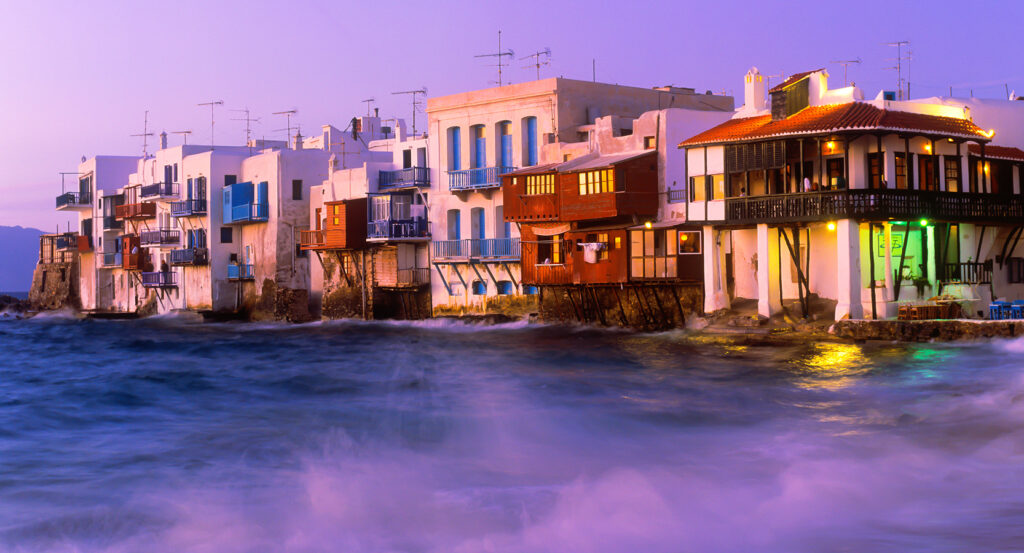
Tucked along Kalogera Street near Matogianni, M-Eating occupies the pedestrian heart of Mykonos Town between Tria Pigadia and the lanes approaching Little Venice, with Enoplon Dynameon Street, Agia Kyriaki and the waterfront neighborhoods of Kastro defining the surrounding historic district. The restaurant inhabits an early twentieth-century Mykonian residence whose whitewashed masonry, narrow openings and intimate proportions preserve the domestic architectural character of Chora. An open kitchen connects the main dining room with the culinary preparation, and an elevated terrace overlooks the surrounding pedestrian lanes. A secluded garden and carefully composed interiors establish contrasting dining environments, with natural stone, restrained furnishings and Greek wines complementing Menardos's interpretation of Cycladic ingredients. The result is a restaurant whose preserved island architecture, intimate dining spaces and chef-directed cooking connect Mykonos's culinary inheritance with contemporary Greek gastronomy.
What defines M-Eating Restaurant Mykonos Town.
M-Eating Restaurant is best known for Panagiotis Menardos's transformation of traditional Mykonian cooking into a contemporary culinary destination, drawing on his upbringing in the Cyclades and a professional career shaped by leading hotel kitchens across the island. Born in Maroussi, Attica, on August 5, 1980, Menardos grew up in Mykonos, developing an early familiarity with the island's food traditions through family meals and the agricultural commerce of its older streets. After graduating from the Lyceum of Mykonos, he pursued professional training at the School of Tourism Professions in Anavyssos, establishing the technical foundation for his culinary career. His decisive introduction to professional cooking came during an internship at Mykonos's Leto Hotel, where chef Giannis Georgoulis introduced him to the demands and creative possibilities of a restaurant kitchen. Subsequent experience under Periklis Touloupis at Grecotel Mykonos Blu and Ilias Tsikrikis at Mykonos Grand extended that training through different approaches to Mediterranean cooking. These formative years established the connection between hotel-level culinary technique and traditional Greek food that later distinguished his independent restaurant. Menardos subsequently partnered with Sofia to establish M-Eating 2012, converting an early twentieth-century Mykonian residence into a restaurant centered on the reinterpretation of local dishes. The project emerged during a period when the island's luxury restaurant culture was strongly associated with international cuisines, giving its emphasis on Cycladic ingredients a distinctive culinary direction. Menardos developed preparations around the flavors of his childhood, preserving their recognizable foundations through contemporary presentation and refined cooking techniques. A collaboration with his friend Dimitris Rousounelos contributed to San Mykonian Sun, an interpretation of traditional Mykonian strapatsada incorporating handmade lamb bacon. Another collaboration with chef Nikos Koukiasas produced a dessert inspired by the island's almond sweets, incorporating almond-flavored ice cream into a reinterpretation of the traditional confection. His wider culinary repertoire incorporated Cycladic octopus, Tinos artichokes, Greek cheeses and Mediterranean seafood, extending the restaurant's connection with regional agricultural and fishing traditions. By 2016, M-Eating had established a prominent position within Mykonos's developing contemporary Greek dining scene. Menardos also received a one-star distinction from the FNL Guide and contributed to professional culinary education through seminars devoted to Cycladic cuisine at IEK Praxis. A subsequent culinary development brought the restaurant toward comfort food inspired by earlier Greek cooking traditions, preserving its established emphasis on familiar regional flavors through a renewed menu. Preparations including Mykonian onion pie, pork with cabbage and almond-based desserts continued that relationship between inherited recipes and contemporary technique. M-Eating's development connects Menardos's island childhood, successive culinary mentors, independent entrepreneurship and regional collaborations with a sustained effort to advance the cooking traditions of Mykonos within a contemporary restaurant.
How M-Eating Restaurant Mykonos Town fits.
M-Eating Restaurant works as the evening destination for a walk through Chora connecting nineteenth-century domestic life, the preservation of Greek maritime heritage and the medieval religious architecture that developed around Mykonos's fortified waterfront.
Begin at Lena's House, a nineteenth-century Mykonian residence in Tria Pigadia that once formed part of a larger property belonging to sea captain Nikolaos Sourmelis. The house later became associated with Lena Skrivanou, its last resident, whose name remained attached to the property after its conversion into a museum. George and Ioanna Drakopoulos donated the residence and much of its original furnishings to the Mykonos Folklore Museum in 1970, preserving a domestic interior associated with the island's merchant and seafaring families. Furniture, embroidery, French engravings and historic household objects occupy rooms arranged around the original residential composition, with a small courtyard and dovecote extending the collection into the building's traditional architectural setting. Continue to Aegean Maritime Museum, established in 1983 through the initiative of Mykonian shipowner George M. Drakopoulos and his wife Ioanna before opening in 1985. The museum occupies a nineteenth-century Cycladic residence formerly associated with Captain Nikolaos Sourmelis, whose merchant vessel Enosis supported the Cretan struggle against Ottoman rule. Its collection traces maritime activity through ship models, navigational instruments, historical maps, documents and objects connected to Greek seafaring from antiquity into the twentieth century. The institution also undertook the restoration of the 1909 cable vessel Thalis o Milissios and the 1940 sailing vessel Evangelistria, extending its preservation work into functioning examples of historic maritime technology. The Academy of Athens honored Drakopoulos in December 1987 for his contribution to Greek maritime heritage. Conclude at Panagia Paraportiani, the whitewashed religious complex developed beside a secondary entrance to the medieval Kastro overlooking Mykonos's western waterfront. Its oldest component, the church of Agioi Anargyroi, originated during the late fourteenth or early fifteenth century, beginning a prolonged period of construction that continued through the seventeenth century. Four ground-level chapels dedicated to Agios Efstathios, Agioi Anargyroi, Agios Sozon and Agia Anastasia support an elevated sanctuary dedicated to the Virgin Mary. Successive additions joined these separate religious buildings into an irregular architectural composition whose rounded surfaces, intersecting arches and whitewashed volumes preserve the physical development of the medieval settlement. The progression moves from the preserved domestic furnishings of Lena's House through Drakopoulos's conservation of maritime heritage into Panagia Paraportiani's centuries-long architectural development, connecting the residential, commercial and religious traditions that shaped Mykonos Town.
Where your story begins.
Foresyte Travel reveals places that feel extraordinary long before you arrive.
Enjoy editorial crafted for luxury travelers.




















































































































