
Why Meiji Jingu Museum matters.
Meiji Jingu Museum is a restrained cultural institution where Yoyogi's sacred forest character meets imperial objects, Kengo Kuma's low-slung architecture and a collection tracing the people and events behind one of modern Tokyo's most consequential Shinto precincts.
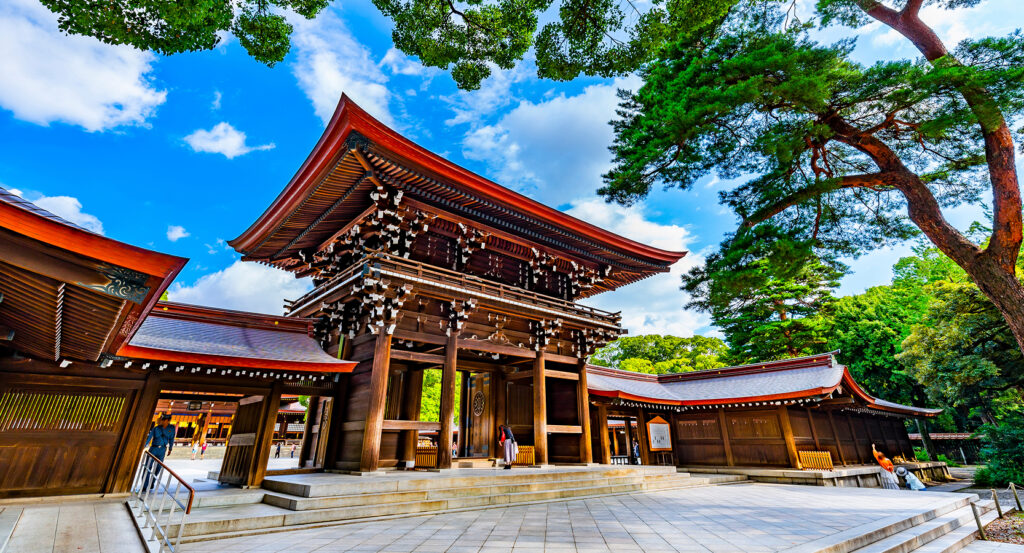
Set within Meiji Jingu near the southern approach and just steps from the broad route leading inward from Harajuku, the museum occupies a wooded clearing where its roofline remains deliberately subordinate to the surrounding canopy. Low eaves, divided roof forms and dark Yamato-bari exterior detailing reduce the apparent scale of the two-level building, allowing trunks and foliage to remain dominant around its perimeter. Slender structural members and broad glazing open interior sightlines back toward the forest, creating repeated visual connections between displayed objects and the precinct that preserves them. Timber furniture and interior elements fashioned from zelkova and camphor removed during construction carry portions of the original site directly into the completed building. The result is an architecture that makes the surrounding forest part of the museum encounter, joining historical objects to the landscape created alongside Meiji Jingu itself.
What defines Meiji Jingu Museum.
Meiji Jingu Museum is best known for bringing objects associated with Emperor Meiji and Empress Shoken into a purpose-built museum created as part of Meiji Jingu's centennial project and opened in October 2019. The collection had long been housed in the Treasure Museum, completed in 1921 as an early reinforced-concrete building modeled on the azekura storehouse tradition of the Shosoin in Nara. That building preserved personal possessions, books, writing implements, furnishings and ceremonial objects connected with the enshrined imperial couple, then received national Important Cultural Property designation in 2011. Its closure for restoration in 2017 coincided with preparations for a new institution capable of carrying the collection into Meiji Jingu's second century. Kengo Kuma designed the new museum with 3,200 square meters of floor area distributed across two levels, and Shimizu Corporation executed the construction. Kuma treated the surrounding forest as the architectural priority, lowering the eaves, breaking the roof into smaller tapered planes and segmenting the exterior through Yamato-bari cladding so the building receded among the trees. H-section steel supplied structural transparency, with cypress inserted between the flanges to temper the exposed metal throughout the interior. Zelkova and camphor removed during construction returned as furniture and interior components, turning unavoidable tree loss into a direct architectural connection with the precinct. The completed museum divided its program between a first-floor gallery devoted to the history and daily practices of Meiji Jingu and second-floor galleries devoted to treasures and changing exhibitions. Its 2019 opening shifted a collection established with the shrine's earliest museum architecture into a new building conceived around the mature forest that had grown beside it for a century.
The Six-Horse Imperial Carriage concentrates the museum's relationship with the Meiji state into a single ceremonial object. Manufactured in Britain and crowned by a gilded phoenix, the carriage carried Emperor Meiji and Empress Shoken on February 11, 1889, the day the Constitution of the Empire of Japan was promulgated. Their journey included the military review at Aoyama Parade Ground, territory later incorporated into Meiji Jingu Gaien, binding the vehicle to a constitutional ceremony and to another major commemorative landscape created after the imperial couple's deaths. Conservation returned the carriage to exhibition inside the new museum alongside far smaller possessions whose scale changes the encounter with the imperial household. Emperor Meiji's everyday desk retains faint discoloration on the scarlet felt covering its surface, and a pencil survives shortened through use with its point cut by the emperor himself. Edoardo Chiossone's portraits of Emperor Meiji and Empress Shoken add another dimension: the Genoa-born engraver entered Japanese government service in 1875 and produced imperial likenesses through the Western representational techniques he brought to the Ministry of Finance. These objects move between constitutional ceremony, daily work and state portraiture, giving the museum a concentrated material history of an imperial household positioned at the center of Japan's Meiji transformation.
How Meiji Jingu Museum fits.
Meiji Jingu Museum works as the anchor for a Yoyogi and Jingumae route through three nearby sites that move from an imperial garden predating the shrine through a major private collection of Edo-period print culture and into the ground where military occupation and the 1964 Olympics successively remade western Tokyo.
Begin at Meiji Jingu Inner Garden, whose history reaches beyond the shrine's 1920 foundation into the Edo estates of the Kato and Ii families and its later incorporation into the imperial Yoyogi property. Emperor Meiji ordered improvements 1893 for Empress Shoken, developing the grounds as a walking garden across naturally varied terrain; he later commissioned Kaku-un-tei as her rest house in 1900. Kiyomasa's Well feeds South Pond and the watercourse crossing beneath the southern approach toward the Shibuya River, and iris planting developed after the emperor directed that a stream and yatsuhashi bridge be created around the spring. The garden's association with the imperial couple became one of the principal reasons Yoyogi was selected for Meiji Jingu after their deaths, giving this older landscape a direct role in determining the shrine's eventual location. Continue to Ota Memorial Museum of Art, created from the collection of Ota Seizo V, a former president of Toho Insurance who began collecting ukiyo-e after developing an interest in the field during his university years. His holdings suffered losses during the Pacific War, yet he continued acquiring works until his death in 1977; his family first presented the collection in a temporary Ginza museum before opening the present Harajuku institution in January 1980. Its holdings now encompass 15,000 works, including 12,000 assembled by Ota himself, spanning painted ukiyo-e and woodblock prints by artists including Kitagawa Utamaro, Katsushika Hokusai, Utagawa Hiroshige and Katsushika Oi. Conclude at Yoyogi Park, where successive transformations compress much of twentieth-century Tokyo into one tract of ground. The Imperial Japanese Army used the area as Yoyogi Parade Ground, and Japan's first powered aircraft flight took place there in 1910. American occupation converted the site into Washington Heights after the Pacific War; its return preceded use as the athletes' village for the 1964 Tokyo Olympics, with a surviving accommodation building later retained inside the park. Yoyogi Park opened on October 20, 1967, and the former Olympic athletics ground also preserves the history of the 1964 Tokyo Paralympics through Oda Field, where opening ceremonies and competition took place. The progression moves from Meiji Jingu Inner Garden's role in fixing the shrine to Yoyogi through Ota Memorial Museum of Art's preservation of a major private ukiyo-e collection into Yoyogi Park's succession from military ground to American housing, Olympic village and metropolitan park, surrounding Meiji Jingu Museum with three distinct chapters in the cultural and physical formation of modern western Tokyo.
Where your story begins.
Foresyte Travel reveals places that feel extraordinary long before you arrive.
Enjoy editorial crafted for luxury travelers.
Foresyte may earn a commission when you book.

















































































































