Why Fountain of the Moor matters.
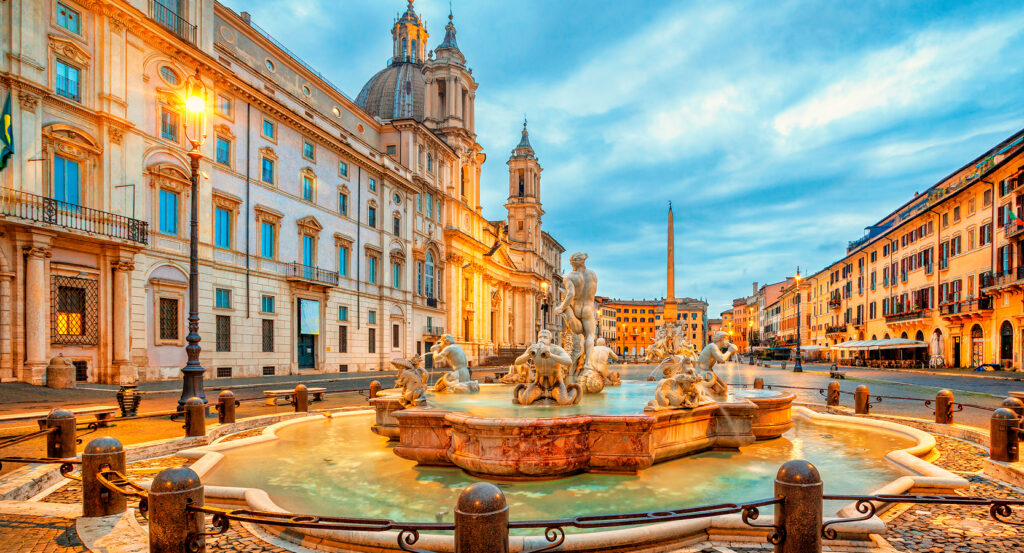
At the southern end of Rome's Piazza Navona, Fountain of the Moor, or Fontana del Moro, ripples with laughter and ferocity, a dance of water and myth frozen mid-motion.
Originally designed by Giacomo della Porta in 1575 and later transformed by Gian Lorenzo Bernini, the fountain captures Rome's genius for reinvention: classical harmony reborn through baroque drama. At its center, a mighty figure wrestles a dolphin, his body coiled in impossible balance, his face taut with both triumph and exertion. Around him, four tritons blow conch shells, their cheeks puffed as if summoning the sea itself into the square. The water arcs and splashes in graceful chaos, softening the marble's strength into movement. At first glance, the “Moor”, so called for his exotic features and dynamic stance, seems purely heroic. But linger, and you'll see that Bernini carved him as an allegory of humankind's eternal struggle with nature: power meeting grace, control giving way to flow. Under the Roman sun, it feels alive, not sculpture, but spirit embodied.
What defines Fountain of the Moor.
What most visitors never realize is that Fountain of the Moor is the echo of a century-long collaboration between eras, Renaissance order meeting baroque passion.
Della Porta's original basin was one of three fountains designed to anchor the elongated symmetry of Piazza Navona, itself built over the ancient Stadium of Domitian. Nearly a century later, Pope Innocent X commissioned Bernini to enhance the composition, and the result was transformation. Bernini's central figure, sometimes identified as Neptune, sometimes as a Moorish sea god, shifted the fountain's tone from ornamental to operatic. His genius lay in gesture, the twist of a torso, the angle of a wrist, the splash that seems to anticipate itself. The tritons were later replaced by sculptor Antonio Mari, preserving Bernini's dynamism while refining its detail. Even the marble was chosen for its warmth, not pure white, but sunlit cream, meant to glow under Roman light. The fountain isn't just a monument; it's a layering of style, a discussion across centuries about what beauty dares to become.
How Fountain of the Moor fits.
To fold Fountain of the Moor into your Roman experience, visit it as you would greet a friend, often, and from every angle.
Come in the early morning when the piazza is quiet, and the sound of water mingles with the first café cups clinking nearby. Watch how the fountain's reflections ripple against the façade of Sant'Agnese in Agone - Bernini's sculpted energy conversing across space with Borromini's architecture. At midday, stand close enough to feel the cool mist on your skin, the same spray that has touched emperors, artists, and wanderers alike. Return again at night, when lamplight turns the basin into liquid bronze, and the Moor's expression softens from defiance to contemplation. Circle the fountain once more before you leave the square; its rhythm will guide you back toward the center of Bernini's Fountain of the Four Rivers. Between them, you'll feel Rome's essence distilled, elegance meeting exuberance, history meeting heartbeat, marble turned into motion that never stops moving.
Where your story begins.
Foresyte Travel reveals places that feel extraordinary long before you arrive.
Enjoy editorial crafted for luxury travelers.
Foresyte may earn a commission when you book.