
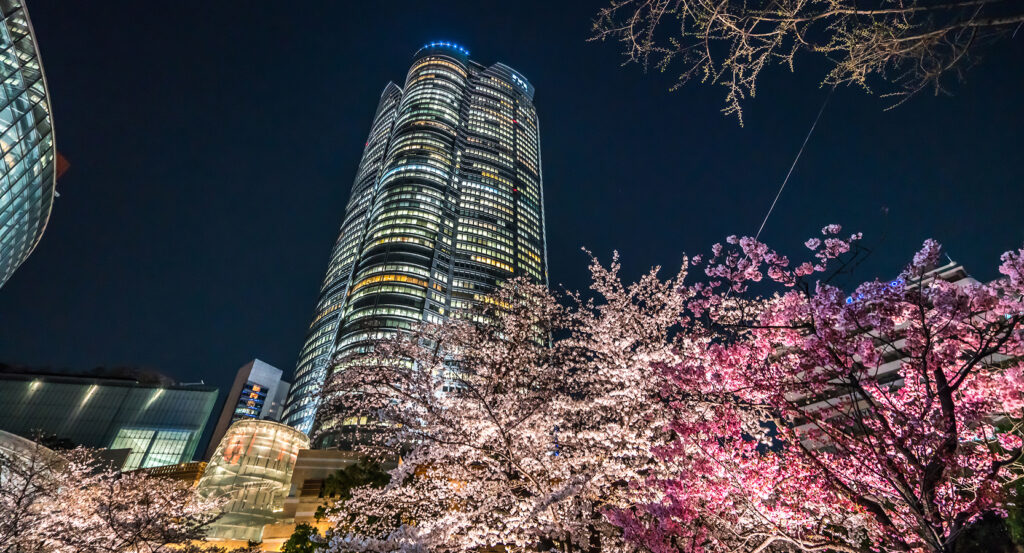
Why Roppongi Hills Mori Tower matters.
Roppongi Hills Mori Tower is a commanding skyscraper where Roppongi's cosmopolitan character meets grand high-rise architecture, panoramic metropolitan scale and an unusual concentration of contemporary culture at the summit of a working office tower.
Set along Roppongi-dori near Keyakizaka-dori and just steps from Roppongi Station, the 238-meter tower rises from the center of Roppongi Hills as a broad, silver-gray vertical mass whose elliptical profile changes substantially as the surrounding streets climb and descend around it. Its 54 above-ground floors culminate in the Mori Arts Center, placing exhibition spaces and Tokyo City View high above the office floors and lifting public circulation into the uppermost portion of the building. Arrival on the 52nd floor suddenly replaces the dense streets below with long metropolitan sightlines across Tokyo Tower, Shinjuku, Tokyo Bay and the immense field of buildings extending toward the horizon. The tower's position on elevated ground strengthens that visual reach, and the broad glazing turns Tokyo's irregular street networks, rail corridors and clusters of high-rises into an unusually coherent view of the capital's physical scale. The result is a skyscraper whose public summit transforms immense commercial architecture into a cultural vantage point, allowing Roppongi Hills Mori Tower to be experienced both as one of Tokyo's major high-rises and as a platform for seeing the metropolis it helped reshape.
What defines Roppongi Hills Mori Tower.
Roppongi Hills Mori Tower is best known for becoming the vertical centerpiece of Minoru Mori's 17-year effort to rebuild Roppongi 6-chome as a dense concentration of work, culture and metropolitan life. The project originated after TV Asahi approached Minato City about rebuilding its headquarters and was encouraged to consider the surrounding district, leading the broadcaster to consult Mori Building during the 1980s. Tokyo designated the area for redevelopment in November 1986, yet its fragmented ownership made consolidation extraordinarily complex: the district contained hundreds of rights holders, narrow roads and tightly packed wooden houses across terrain dropping 17 meters toward the south. A preparatory association emerged in 1990, the city plan followed in 1995 and the redevelopment association gained approval in 1998. The ownership transfer plan cleared the final path to construction in February 2000, with work beginning that April after close to 400 rights holders had committed to the project. Kohn Pedersen Fox Associates led the design of Mori Tower, working within an international architectural group assembled across the wider development. Concentrating immense floor area inside the central high-rise freed substantial ground for streets, plazas, pedestrian routes and greenery across the 11-hectare site, making the tower fundamental to Mori's model of building vertically to reorganize the ground below. Construction reached its topping-out milestone in April 2002, and Roppongi Hills was completed the following April. The finished development concentrated 760,000 square meters of floor area around Mori Tower and its surrounding buildings, turning the skyscraper into the physical mechanism through which a redevelopment negotiated across nearly two decades finally acquired metropolitan scale.
Culture occupies the tower's highest public floors through a deliberate inversion of the conventional skyscraper hierarchy championed by Minoru Mori. Mori Art Museum opened on the 53rd floor in October 2003 under founding director David Elliott, placing contemporary art above the corporate offices and establishing an institution focused on art and architecture from Japan, East Asia and the wider world. Richard Gluckman of Gluckman Mayner Architects designed the museum interiors, extending an architectural practice that had included projects for artists and institutions such as Andy Warhol, Dia Center for the Arts and the Whitney Museum of American Art. The Mori Arts Center Gallery and Tokyo City View occupy the level immediately below, creating a contiguous cultural zone across the tower's summit. This arrangement made altitude itself part of the cultural program: museum-going, temporary exhibitions and observation were concentrated at the point normally reserved for private executive functions in commercial towers. Mori Building subsequently connected that strategy with a broader transformation of Roppongi, where the arrival of the National Art Center, Tokyo, Suntory Museum of Art and 21_21 Design Sight strengthened the district's concentration of art institutions after Roppongi Hills opened. Roppongi Hills Mori Tower carries Minoru Mori's cultural ambitions in its vertical organization, using some of the building's most valuable real estate to position art and public access above the commercial engine that supports them.
How Roppongi Hills Mori Tower fits.
Roppongi Hills Mori Tower works as the anchor for a Roppongi and Azabu route through three nearby religious sites that carry the surrounding district backward from contemporary high-rise Tokyo into medieval warrior patronage, early American diplomacy and the Meiji commemoration of one of imperial Japan's most prominent military figures.
Begin at Sakurada Shrine, whose origins reach to 1180 and the emergence of the Kamakura warrior government. Minamoto no Yoritomo ordered its foundation in the Kasumigaseki area, and the shrine later moved as Edo expanded under the Tokugawa shogunate, eventually settling in its present Roppongi vicinity during the seventeenth century. Its history became entwined with the Bakumatsu period through Okita Soji, the celebrated Shinsengumi swordsman born into a family associated with the surrounding Azabu district, giving the shrine a connection with the political turbulence that accompanied the shogunate's final years. The precinct also enshrines Jurojin during the Minato Seven Lucky Gods pilgrimage, preserving a devotional tradition inside streets now dominated by offices, embassies and contemporary cultural institutions. Continue to Azabusan Zenpukuji, where a Buddhist institution with origins attributed to Kukai in 824 became one of the crucial settings of Japan's first sustained diplomatic relationship with the United States. The temple converted to Jodo Shinshu after the monk Ryokai encountered Shinran during the Kamakura period, then acquired an entirely different international role after Japan opened treaty relations in the nineteenth century. Townsend Harris established the first United States legation there in 1859, and the mission remained until 1875, placing an ancient temple inside the political negotiations through which Edo entered the international diplomatic system of modern Tokyo. Yukichi Fukuzawa and businessman Masuda Takashi also became associated with Zenpukuji, and Fukuzawa's grave lies within its cemetery. A giant ginkgo exceeding 750 years in age survives as a National Natural Monument, extending the site's physical continuity far beyond the diplomatic episode that made it internationally consequential. Conclude at Nogi-jinja Shrine, founded in 1923 beside the former residence of General Maresuke Nogi and his wife Shizuko. Nogi fought in the Satsuma Rebellion, First Sino-Japanese War and Russo-Japanese War before becoming head of the Peers' School, where his responsibilities brought him into the education of the future Emperor Hirohito. Nogi and Shizuko died on September 13, 1912, the day of Emperor Meiji's funeral, and the subsequent movement to commemorate the couple led to construction of the shrine eleven years later. The neighboring Nogi residence preserves another dimension of his life and remains part of a precinct rebuilt after wartime destruction. Positioned beyond the contemporary art institutions of Roppongi, the shrine closes the route with a site created directly from the political and commemorative culture of modern imperial Japan. The progression moves from Sakurada Shrine's connection with medieval warrior authority and the Bakumatsu through Zenpukuji's role in the opening of formal American diplomacy into Nogi-jinja Shrine's commemoration of a defining Meiji military figure, carrying Roppongi Hills Mori Tower outward into the older political histories embedded beneath the contemporary city surrounding it.
Where your story begins.
Foresyte Travel reveals places that feel extraordinary long before you arrive.
Enjoy editorial crafted for luxury travelers.
Foresyte may earn a commission when you book.

















































































































