
Why Suntory Museum of Art matters.
Suntory Museum of Art is a refined cultural institution where Akasaka's contemporary design quarter meets centuries of Japanese decorative art, Kengo Kuma's architectural restraint and a collection built around the relationship between beauty and daily life.
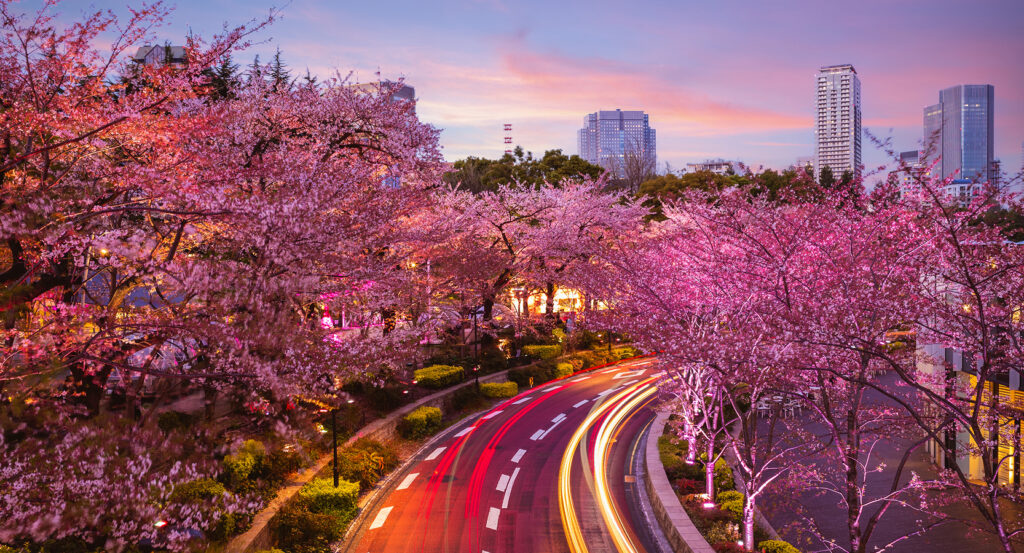
Set within Tokyo Midtown near Gaien Higashi-dori and just steps from Midtown Garden, the museum occupies the upper levels of the Galleria overlooking one of Roppongi's principal landscaped spaces. Vertical white-porcelain louvers soften the exterior boundary, with changing daylight passing through their narrow intervals before reaching interiors finished in wood, washi and pale surfaces. A muso lattice regulates views toward the garden, adapting a traditional sliding-lattice device to the scale of a contemporary cultural institution. White oak reclaimed from whiskey barrels appears underfoot, introducing a physical connection with Suntory's history. The result is a quietly immersive museum where filtered daylight, porcelain, timber and shifting garden views establish a measured setting for close encounters with Japanese art.
What defines Suntory Museum of Art.
Suntory Museum of Art is best known for building a major Japanese art collection around the principle of “Art in Life,” an idea established by Suntory president Keizo Saji when he founded the institution during Japan's rapid postwar economic expansion. The museum opened on November 20, 1961 on the ninth floor of the Palace Building in Marunouchi, with Saji serving as its first president. Collection building had already begun months earlier through acquisitions including the fifteenth-century Writing box with scenery of Mt. Ogura in maki-e, the Low desk with chrysanthemum design in maki-e and Namban folding screens attributed to Kano Sanraku. Its first exhibition opened the following day under the title Inaugural Commemoration Exhibition: Art in Life, immediately tying the collecting program to objects whose artistic achievement remained connected with use, furnishing and ceremony. A decisive acquisition followed in 1962 with the thirteenth-century Box with fusenryo design in mother-of-pearl inlay and maki-e, which received National Treasure designation in 1964. The museum expanded its public reach in 1967 through its first external exhibition at the Imai department store in Sapporo, then relocated from Marunouchi to Akasaka-Mitsuke in 1975. Suntory's broader cultural program developed alongside it: the Torii Music Foundation followed in 1969, Suntory Hall opened in 1986, and these initiatives later came together under the Suntory Foundation for the Arts established in 2009. The museum entered its third Tokyo home in March 2007 when it moved to Tokyo Midtown, returning its founding concept to a new architectural and cultural setting under the message “Art revisited, beauty revealed.” Its holdings have since grown to 3,000 works, allowing the institution founded by Saji in 1961 to sustain a collecting history spanning more than six decades.
The Box with fusenryo design in mother-of-pearl inlay and maki-e provides a concentrated expression of the collection's strength in Japanese lacquer, combining black lacquer, gold and silver maki-e and mother-of-pearl across a Kamakura-period toiletry box from the thirteenth century. Other early acquisitions established complementary lines of depth: the Muromachi-period Writing box with scenery of Mt. Ogura in maki-e belongs to the Igarashi School, and the Low desk with chrysanthemum design in maki-e received Important Cultural Property designation in 1962. Painting broadened the collection through Kano Sanraku's early seventeenth-century Namban screens, whose paired panels place Portuguese traders, ships and imported objects within the visual culture generated by Japan's encounters with Europeans. The Tale of Zenkyobo picture scroll entered the collection in 1967 and carries an attribution to Emperor Go-Kogon, extending the museum into medieval narrative painting. Tosa Mitsumochi's sixteenth-century Hie Sanno Festival and Gion Festival screens preserve another world through densely populated festival scenes associated with Kyoto. Glass provides a separate international strand, joining Japanese art with Eastern and Western glassware across the museum's holdings. Lacquer, painting, ceramics, textiles, metalwork and glass sustain Saji's founding premise through objects created not solely for contemplation but also for writing, storage, furnishing, dress, ritual and social ceremony.
How Suntory Museum of Art fits.
Suntory Museum of Art works as the anchor for a daytime route through three nearby institutions connecting Issey Miyake's campaign for a Japanese design center, General Nogi Maresuke's transformation into a commemorative figure and Kisho Kurokawa's final completed museum.
Begin at 21_21 Design Sight, which grew from Issey Miyake's decades-long argument that Japan needed an institution devoted to design. Miyake discussed the idea with Isamu Noguchi, Ikko Tanaka, Shiro Kuramata and Tadao Ando from the 1980s, then pushed it into public debate through his January 2003 Asahi Shimbun article “Time to Create a Design Museum.” The institution opened in March 2007 with Miyake, Taku Satoh and Naoto Fukasawa as directors and Noriko Kawakami as associate director; Tadao Ando translated Miyake's “A Piece of Cloth” concept into a low building whose folded steel roof descends toward Midtown Garden above galleries buried predominantly underground. Continue to Nogi-jinja Shrine, whose origin followed the deaths of General Nogi Maresuke and his wife Shizuko on September 13, 1912, the day of Emperor Meiji's funeral. Tokyo mayor Sakatani Yoshiro helped organize the Chuo Nogi-kai, permission to establish the shrine followed in 1919, and its enshrinement ceremony took place on November 1, 1923. Air raids destroyed the shrine buildings on May 25, 1945, and nationwide support financed their reconstruction for the fiftieth anniversary of Nogi's death in September 1962. Conclude at The National Art Center, Tokyo, conceived after decades of calls for a large exhibition facility and commissioned in 2000 from Kisho Kurokawa and Nihon Sekkei. Construction began in July 2002, reached completion in May 2006 and preceded the public opening on January 21, 2007. Its 14,000 square meters of exhibition area operate without a permanent collection, and Kurokawa's 21.6-meter-high atrium sits behind an undulating glass facade in the last art museum completed during his lifetime. The progression moves from Issey Miyake and Tadao Ando's campaign to institutionalize design through the commemorative history preserved at Nogi-jinja Shrine into Kisho Kurokawa's vast exhibition architecture, extending Suntory Museum of Art into the unusually dense network of art, design and cultural history surrounding Roppongi and Akasaka.
Where your story begins.
Foresyte Travel reveals places that feel extraordinary long before you arrive.
Enjoy editorial crafted for luxury travelers.
Foresyte may earn a commission when you book.

















































































































