Why Palazzo da Mula matters.
Palazzo da Mula is Murano's last great Gothic dream, a floating fragment of Venice's golden age preserved in glass and brick.
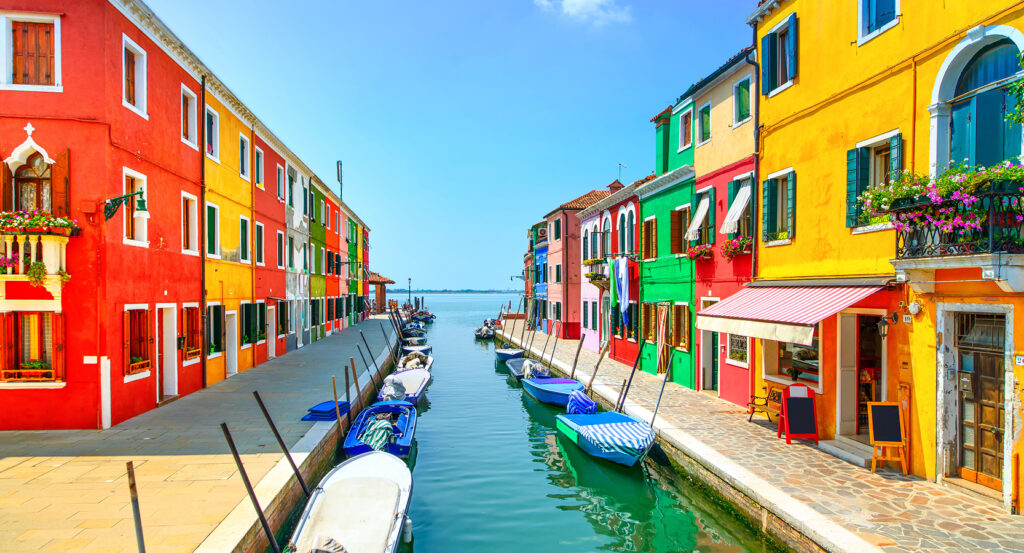
Unlike the grand palazzi of the Grand Canal, this one feels intimate, personal, the noble face of an island built on craftsmanship. Its façade, a blend of deep red brick and pale Istrian stone, rises directly from the water along the Fondamenta Vetrai, where boats still glide by carrying the island's lifeblood: glass. Pointed arches frame delicate quatrefoil windows, their tracery mirrored in the quiet canal below. In the morning, the light gilds its surface like molten glass; by evening, it burns a deep, dignified crimson. Palazzo da Mula captures Murano's dual nature, elegant yet humble, radiant yet enduring, a building that wears the same luminous patina as the art the island creates.
What defines Palazzo da Mula.
Built in the late 15th century, Palazzo da Mula was once the summer residence of a Venetian patrician family who sought refuge from the city's noise among Murano's calm canals.
While most noble families lived in marble grandeur along Venice's main waterways, Murano offered something subtler, an escape into artistry and air. The palace's Gothic design, with its ogee arches, Venetian balconies, and floral motifs, mirrors that of the famous Ca' d'Oro in miniature, but its soul is more personal. Inside, the ceilings once glowed with frescoes now lost to time, while the floors reflected the delicate shimmer of Murano mosaics. In the 19th century, when much of Murano's architectural heritage was altered or rebuilt, Palazzo da Mula survived largely untouched, a rare window into pre-Renaissance Venice. It was immortalized in paintings by John Singer Sargent and Claude Monet, who captured its façade glowing at sunset, a study in light, reflection, and quiet perfection. Few realize that the palace also served as an early civic center for Murano's artisans, hosting guild meetings and later housing the island's municipal offices. Its survival today stands as a symbol of Murano's resilience, beauty preserved not by fortune, but by devotion.
How Palazzo da Mula fits.
Visit in the late afternoon, when sunlight slides low across the lagoon and turns the palace into a living fresco.
From the Murano Faro vaporetto stop, walk along Fondamenta Vetrai, the palace stands prominently by the canal, its Gothic windows catching the light like jewels. Step inside if open to the public; the building now hosts art exhibitions and cultural events that celebrate Murano's creative legacy. Even when closed, its exterior alone is worth the journey. Stand across the water for the best view, where the palace's reflection doubles its beauty, arches above and below, fire meeting water. Take a few moments to trace the craftsmanship in the stone details: the floral rosettes carved by hand, the elegant rhythm of arches and shadows. Then wander the nearby glass galleries that line the canal; their glowing displays feel like an echo of the palace itself. As evening falls, the water mirrors the amber light of the furnaces, and Palazzo da Mula seems to float, suspended between history and imagination. It is not the grandest of Venice's palaces, but the most poetic, a reminder that Murano's finest art has always been light made permanent.
Where your story begins.
Foresyte Travel reveals places that feel extraordinary long before you arrive.
Enjoy editorial crafted for luxury travelers.
Foresyte may earn a commission when you book.