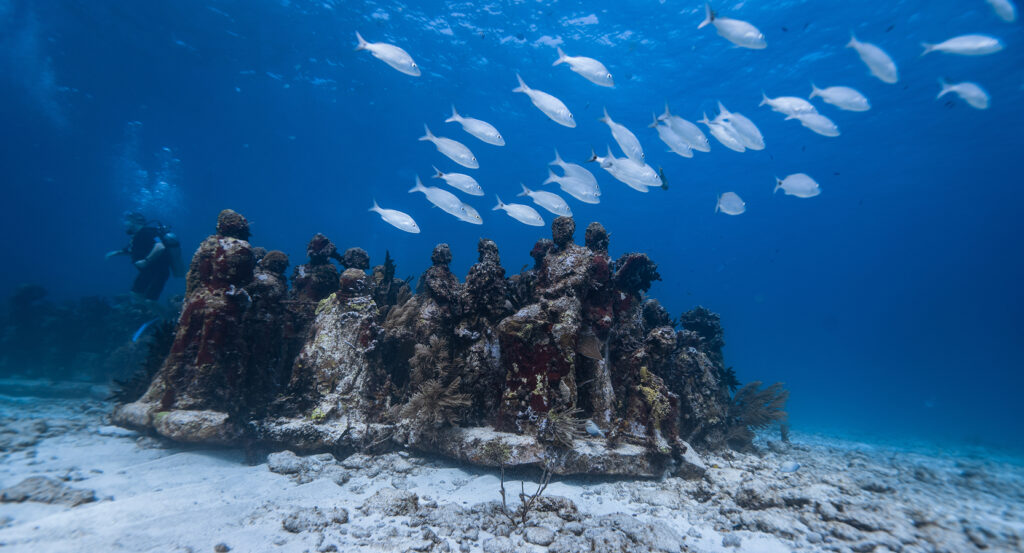
Why you should experience Man on Fire at MUSA in Mexico.
Man on Fire at MUSA is among the most hauntingly beautiful underwater artworks in the world, a single figure that captures both fragility and rebirth.
Submerged beneath the turquoise waters off Cancún's coast, the statue depicts a standing man whose body is pierced with small holes, designed to allow coral and marine life to grow through him over time. As sunlight filters through the Caribbean, his silhouette glows in shifting shades of orange, gold, and red, colors that, from certain angles, make it appear as though he's burning beneath the sea. Created by British artist Jason deCaires Taylor, the piece stands as a metaphor for humanity's destructive yet regenerative relationship with nature. Floating before him feels almost spiritual, an encounter with art that breathes, changes, and evolves alongside the ocean itself.
What you should know about Man on Fire at MUSA.
When Jason deCaires Taylor designed Man on Fire, he intended it to serve as both a visual statement and a living experiment in marine regeneration.
The sculpture's surface is crafted from pH-neutral marine-grade cement, a material engineered to foster coral attachment without leaching harmful chemicals into the sea. The small openings throughout the figure were deliberately placed to create microhabitats, allowing coral polyps to anchor and spread across its form. Over time, the figure has become home to sea fans, sponges, and schools of small fish, transforming what was once a symbol of environmental loss into one of renewal and coexistence. The sculpture's name, Man on Fire, carries layered meaning: it evokes both the destructive potential of humankind and the creative fire that drives change and restoration. The installation sits at a depth of 8 meters (26 feet), part of MUSA's Punta Nizuc Gallery, among several underwater spaces across the region featuring more than 500 sculptures designed to relieve pressure on natural coral reefs. Few visitors realize that Man on Fire was among the first pieces installed, setting the tone for the museum's philosophy: that art and ecology are not opposing forces, but partners in preservation.
How to fold Man on Fire at MUSA into your trip.
Experiencing Man on Fire at MUSA is a must for any traveler seeking a deeper, more meaningful connection to Cancún's underwater world.
The piece can be viewed by both snorkelers and divers as part of MUSA's guided tours departing from the Aquaworld Marina or Isla Mujeres. Morning tours offer the best visibility, when sunlight streams through the water and illuminates the figure in glowing hues, while late-afternoon dives lend it a moodier, more contemplative atmosphere. Certified divers can descend to observe the intricate coral growth up close, while snorkelers can float above, watching the sculpture's outline emerge from the seafloor like a mythic relic. Bring an underwater camera or GoPro, though no image can fully capture the stillness and weight of the experience. Combine this visit with The Silent Evolution installation to understand the full vision behind MUSA's creation, a discussion between art, environment, and time. After surfacing, take a quiet moment to reflect on what you've seen: a man engulfed by coral, transformed by the very element he once endangered. Man on Fire at MUSA isn't just an artwork, it's a tribute to resilience, redemption, and the living power of the sea.
Where your story begins.
Foresyte Travel reveals places that feel extraordinary long before you arrive.
Experience premium editorial crafted for luxury travelers.