
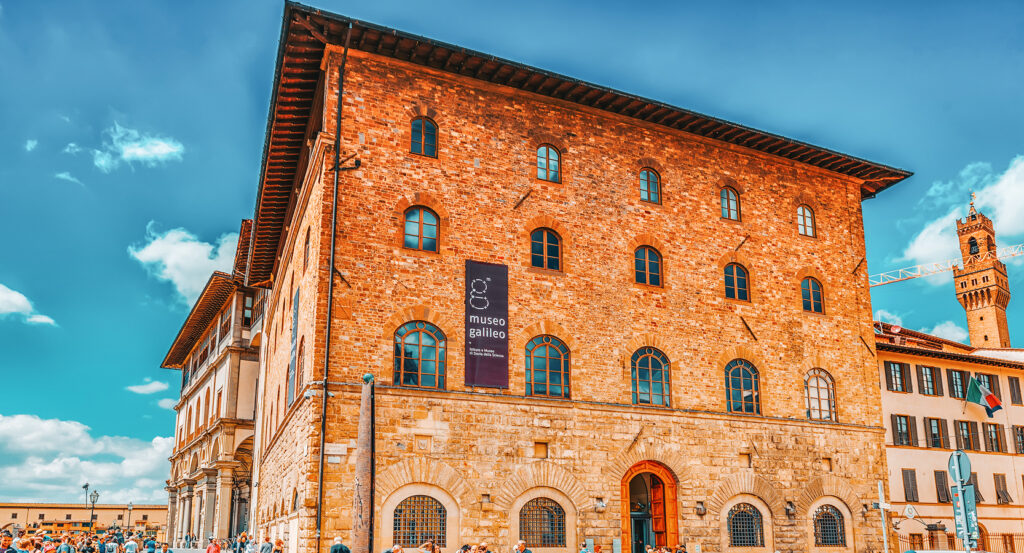
Why you should experience Instruments Collection at Museo Galileo in Florence, Italy.
The Astronomical Instruments Gallery at the Museo Galileo in Florence is where the Renaissance dream of understanding the cosmos comes vividly to life, a place where imagination, geometry, and faith in observation merge into pure wonder.
Stepping inside feels like entering the workshop of the universe. Golden armillary spheres spin in silent elegance, celestial globes map constellations as gods and beasts, and ancient astrolabes glimmer like jewelry for the mind. Each instrument was designed not just for measurement but for beauty, to make the heavens visible and knowable. The gallery unfolds like a visual symphony of brass and marble, its objects arranged to reveal how Florentine ingenuity helped humanity find its place among the stars. Sunlight from the Arno filters through tall windows, brushing against centuries-old craftsmanship that once guided sailors, scholars, and stargazers. Standing amid these instruments, you feel the quiet pulse of discovery, that hum of intellect and wonder that defines the spirit of Florence itself.
What you should know about Instruments Collection at Museo Galileo.
The Astronomical Instruments Gallery houses one of the world's most complete collections of celestial devices, a heritage shaped by both Medici grandeur and scientific daring.
Many of the pieces were commissioned by the Medici and Lorraine dynasties, who viewed astronomy as both an intellectual pursuit and a symbol of power. Among the most exquisite are the 16th- and 17th-century armillary spheres, intricate structures of rings representing the paths of the planets, that once adorned ducal studies and observatories. The collection also includes celestial and terrestrial globes by Vincenzo Coronelli, richly painted and vast in scale, as well as astrolabes crafted in brass and silver from across Europe and the Islamic world. These instruments tell a story of dialogue: between mathematics and myth, between East and West, between devotion and discovery. The gallery also displays early telescopic models that trace the evolution from naked-eye observation to Galileo's groundbreaking optics. Every surface gleams with the evidence of human ambition, a civilization seeking to translate divine order into measurable form.
How to fold Instruments Collection at Museo Galileo into your trip.
When visiting the Museo Galileo, approach the Astronomical Instruments Gallery as the centerpiece of your journey through Florence's scientific heritage.
Begin in the upper rooms, where the golden spheres and globes catch the morning light, revealing their delicate engravings of zodiac signs and planetary paths. Take time to walk slowly around each major piece, especially the massive armillary spheres, to appreciate the geometric perfection and hand-forged artistry. Use the museum's app or guidebook to follow the narrative of scientific progress: from the cosmological models of antiquity to the revolutionary heliocentrism that reshaped human thought. Visit in the late afternoon if you can, when the brass takes on a deep honeyed glow under Florence's fading sun. Before you leave, stand by the window overlooking the Arno and imagine the scholars of centuries past making their nightly observations from the same latitude. The Astronomical Instruments Gallery is more than a display of tools, it's a cathedral of curiosity, where the heavens themselves seem to lean down to meet the human mind.
Where your story begins.
Foresyte Travel reveals places that feel extraordinary long before you arrive.
Experience premium editorial crafted for luxury travelers.




















































































































