
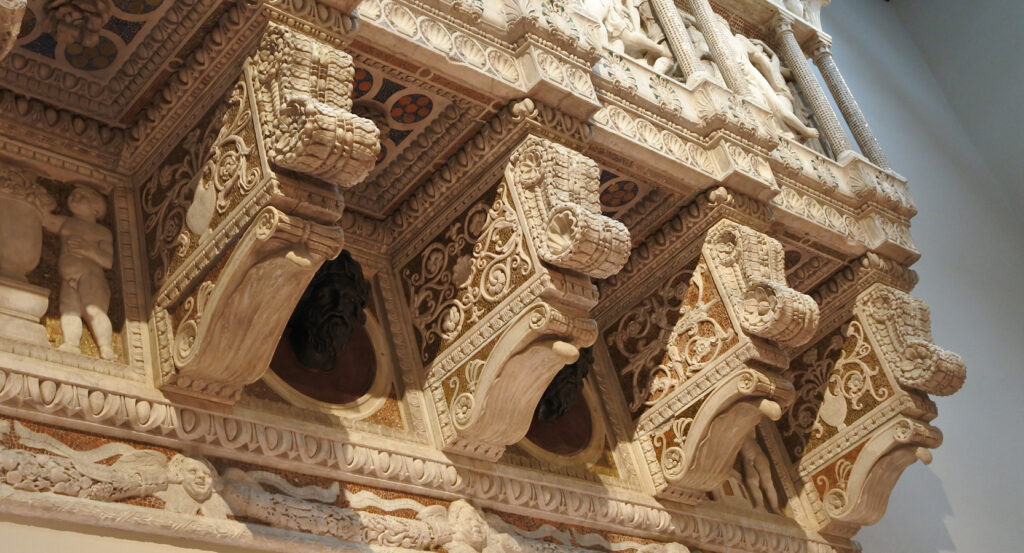
Why you should experience Cantoria by Donatello in Florence, Italy.
Cantoria by Donatello at Opera del Duomo Museum is one of Florence's most exuberant celebrations of sound, movement, and divine joy rendered in marble.
Created in the 1430s for the Cathedral of Santa Maria del Fiore, these masterpieces once faced each other above the choir, transforming liturgical song into sculptural rhythm. Donatello's loft bursts with vitality: angels twist, leap, and sing with unrestrained energy, their bodies alive with motion as if carried by celestial music. Across from it, Luca della Robbia's loft responds in serene counterpoint, his angels are poised, graceful, and radiant with harmony. Together, they form a discussion of spirit and style: Donatello's dramatic realism against Luca's classical order. To stand between them in the Opera del Duomo Museum today is to experience Renaissance Florence in stereo, intellect and passion perfectly balanced in stone.
What you should know about Cantoria by Donatello.
Cantoria by Donatello were not mere architectural elements, they were acts of artistic competition and devotion that defined the early Renaissance.
Commissioned by the cathedral's Opera del Duomo between 1431 and 1438, each sculptor was tasked with interpreting the same theme: “Praise God in His Sanctuary,” from Psalm 150. Yet their visions diverged completely. Donatello, ever the innovator, broke from convention by composing his reliefs in turbulent motion, overlapping limbs, flying draperies, and expressive faces that pulse with sacred ecstasy. His angels seem to dance to invisible music, their figures illuminated by deep carving and dramatic shadow. In contrast, Luca della Robbia, working in marble but informed by his mastery of glazed terracotta, crafted a measured procession of singers and musicians, their gestures refined, their joy orderly and divine. His figures embody the Florentine ideal of moderatio, beauty through restraint. Both artists revolutionized the idea of relief sculpture: Donatello by pushing it toward resonant freedom, Luca by perfecting spatial harmony. When the lofts were later removed in the 17th century and reunited centuries later in the museum, scholars finally recognized what they always were, a harmonious argument between two geniuses who taught Florence to see music.
How to fold Cantoria by Donatello into your trip.
When visiting the Opera del Duomo Museum, make Cantoria by Donatello your moment of delight and discovery, a pause between solemn masterpieces to feel the Renaissance at play.
They are displayed opposite each other, just as they once stood in the cathedral, allowing visitors to compare every gesture, rhythm, and emotion. Begin with Donatello's loft, stand close enough to see the flicker of his carving, the way garments ripple and wings seem to beat in motion. Step back, then turn toward Luca's loft: its composition calms the eye, each angel perfectly balanced within architectural frames. Spend time moving between them, as if listening to two musical variations on a sacred theme. Visit when the museum is quiet so the rhythm of your footsteps echoes faintly in the hall, the perfect soundtrack for this sculptural symphony. Before leaving, take one last look from the center of the room: the two lofts mirror the dual soul of Florence, reason and passion, intellect and faith, united in beauty. Cantoria by Donatello are not just sculptures; they are marble made to sing.
Where your story begins.
Foresyte Travel reveals places that feel extraordinary long before you arrive.
Experience premium editorial crafted for luxury travelers.




















































































































