Why Palm Beach Grill matters.
Palm Beach Grill is an established American restaurant where Royal Poinciana's refined social culture meets George Biel's hospitality enterprise, classic steakhouse cooking and a dining institution shaped by more than twenty-five years of Palm Beach history.
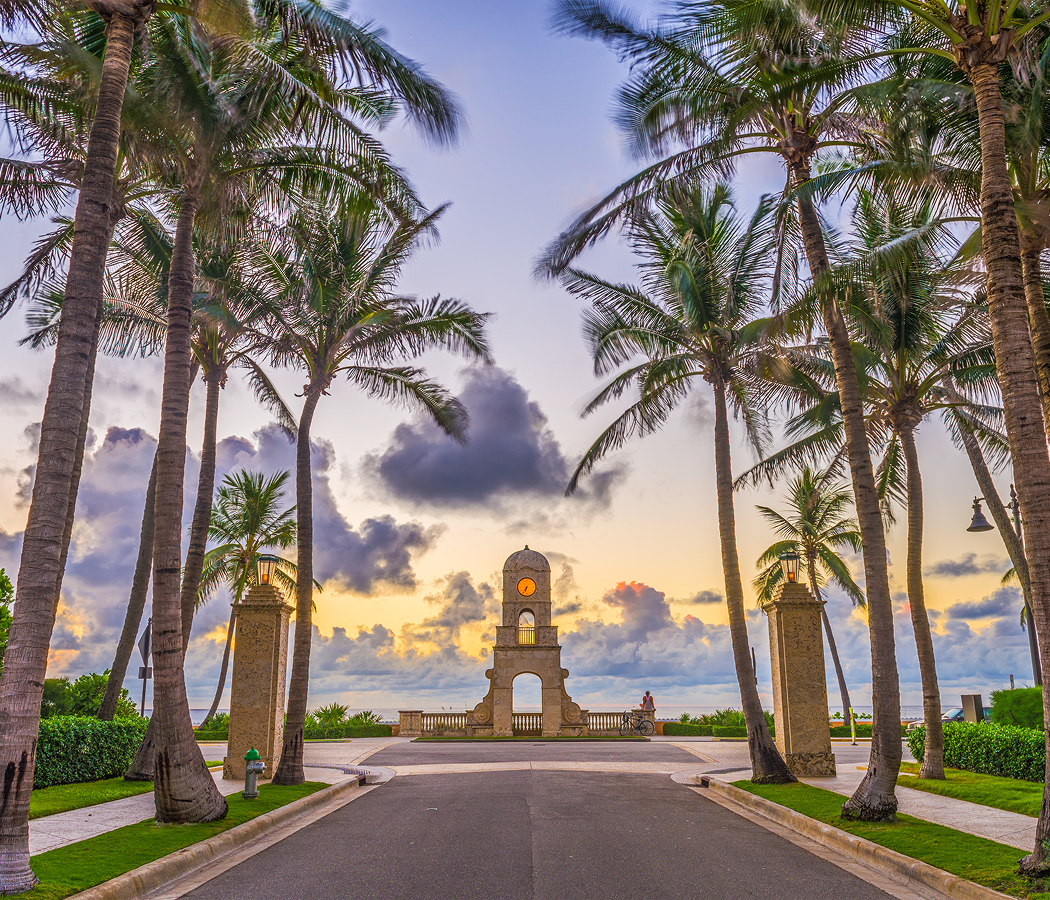
Occupying the northern side of Royal Poinciana Way within The Royal Poinciana Plaza, Palm Beach Grill stands near Cocoanut Row and Bradley Place, between the Flagler Memorial Bridge approach, the Royal Poinciana Playhouse and the landscaped courtyards of Palm Beach's northern commercial district. The restaurant inhabits John Volk's Regency-style shopping complex, whose covered walkways, white façades and formal courtyard arrangement preserve the architectural character of the island's midcentury commercial development. Inside, a polished dining room surrounds an open display kitchen, with dark wood, upholstered seating and carefully selected artwork establishing an intimate atmosphere within the broader retail setting. An adjoining bar extends the restaurant's social character, connecting classic cocktails and American cooking with the longstanding tradition of evening dining among Palm Beach residents. The result is a restaurant whose established culinary format, curated interiors and position within a preserved architectural complex connect American dining traditions with the social history of northern Palm Beach.
What defines Palm Beach Grill.
Palm Beach Grill is best known for bringing George Biel's influential approach to American restaurant dining into Palm Beach through a locally established institution whose development helped shape the island's modern restaurant culture. Biel and his wife Carol began their restaurant venture in Nashville in 1977, opening Houston's with a concept that combined steaks, burgers and American classics within a polished dining environment designed for a broad clientele. Their enterprise expanded across the United States during the following decades, developing a restaurant group distinguished by carefully controlled culinary standards, individualized dining rooms and a growing collection of regional concepts. Palm Beach became an important destination for that expansion in 1999, when restaurateur Joseph Ledbetter played a central role in establishing Palm Beach Grill within the historic Royal Poinciana Plaza. Ledbetter brought experience developing the Houston's restaurant organization, connecting the new Palm Beach establishment with a professional background in American hospitality management and restaurant growth. The restaurant adopted a distinct local name and dining character, establishing a menu organized around prime beef, fresh seafood and established American preparations. Its opening introduced the company's culinary approach into one of Florida's most established seasonal communities, positioning the restaurant within a commercial center whose history reached to the midcentury architectural work of John Volk. Palm Beach Grill developed a substantial following through the following decade, retaining classic preparations such as jumbo shrimp cocktail, cheeseburgers, prime steaks and Dover sole as defining elements of its cooking. By 2009, the restaurant had become an established part of the island's dining culture, preserving an American grill format through the continued expansion of more specialized restaurant concepts across South Florida. Its public presentation also incorporated a curated collection of artworks, making visual art a distinctive component of the dining environment alongside the open kitchen and traditional menu. A consequential chapter began in 2014 when WS Development acquired control of the Royal Poinciana Plaza leasehold through a $22.5 million transaction, initiating a major restoration and commercial repositioning of the surrounding complex. Led by Samantha David, the redevelopment retained Palm Beach Grill as an established tenant as new luxury retailers and restaurants entered the property. Architectural work by Smith and Moore Architects and landscape design by Nievera Williams renewed the historic setting, preserving Volk's original Regency character through a substantial transformation completed during 2017. Hillstone expanded its own presence that year with The Honor Bar, a separate restaurant and cocktail concept immediately adjoining Palm Beach Grill. The new establishment extended the group's dining presence into daytime service and more casual preparations, complementing the original restaurant's longstanding evening focus. The opening also coincided with the arrival of international fashion houses and independent culinary businesses that strengthened the plaza's commercial standing. Palm Beach Grill subsequently retained its established menu and American dining character through the surrounding property's redevelopment, preserving continuity across more than two decades of restaurant operation. Ledbetter's death in September 2026 brought renewed attention to his role in opening Palm Beach Grill and his subsequent involvement in developing BrickTop's, another restaurant group with a substantial Palm Beach presence. The restaurant's significance rests on its relationship with Biel's American hospitality enterprise, Ledbetter's founding contribution and a commercial transformation that preserved an established dining institution within one of the island's most historically significant retail properties.
How Palm Beach Grill fits.
Palm Beach Grill works as the evening destination for an exploration of northern Palm Beach connecting the island's earliest surviving residential architecture, Henry Flagler's religious patronage and the Gilded Age estate that transformed Florida's Atlantic coast.
Begin at Sea Gull Cottage, the Victorian residence constructed in 1886 for Denver railroad developer R. R. McCormick on the western shore of Palm Beach. The shingle-style house incorporated stained glass, a substantial mahogany staircase fashioned from shipwreck timber, marble entrance flooring and a third-story tower, establishing an elaborate residential retreat before the island's development as an American winter resort. Henry Flagler purchased the property in 1893 for $75,000, using the cottage as his winter residence before completing a larger estate nearby. The building subsequently moved to the oceanfront in 1913 and survived a proposed demolition through the Preservation Foundation of Palm Beach's intervention in 1984, returning to a restored lakefront setting. Continue to Royal Poinciana Chapel, whose foundation grew from the religious community organized by Congregational missionary Alexander B. Dilley during the 1880s. Flagler contributed land and financed a chapel serving guests of his developing resort, establishing an interdenominational church that opened in 1897 and reached completion the following year. Its white clapboard architecture drew upon New England meetinghouses, with a central cupola, cruciform interior and Palladian-style windows establishing an ecclesiastical presence beside the island's early hospitality developments. The congregation relocated the historic wooden building several times before dedicating its reconstructed sanctuary at the existing site on April 15, 1973, preserving a religious institution whose history accompanied the island's transformation into a seasonal resort community. Conclude at Henry Morrison Flagler Museum, occupying Whitehall, the Beaux-Arts residence Henry Flagler commissioned from architects John Carrère and Thomas Hastings as a wedding gift for Mary Lily Kenan. Completed in 1902, the mansion established a formal architectural setting for the industrialist whose Florida East Coast Railway and luxury hotels fundamentally changed the development of the state's Atlantic shoreline. The residence later became the Whitehall Hotel following a substantial 1925 expansion, introducing a commercial chapter that altered portions of the original building. Flagler's granddaughter Jean Flagler Matthews acquired the property in 1959 and established the museum, which opened in 1960 before the hotel addition was removed in 1963. Whitehall subsequently received National Historic Landmark designation in 2000, preserving one of the most consequential private residences associated with Florida's Gilded Age development. The progression moves from McCormick's pioneering residence through Flagler's religious foundation into Carrère and Hastings' Whitehall, tracing the architectural ambition, personal patronage and transportation wealth that transformed Palm Beach into an international winter destination.
Where your story begins.
Foresyte Travel reveals places that feel extraordinary long before you arrive.
Enjoy editorial crafted for luxury travelers.