
Why Triennale Milano matters.
Triennale Milano is a foundational design institution where Parco Sempione's architectural character meets a purpose-built 1933 Palazzo dell'Arte, a century of international exhibitions and Milan's enduring role in connecting design with industry.
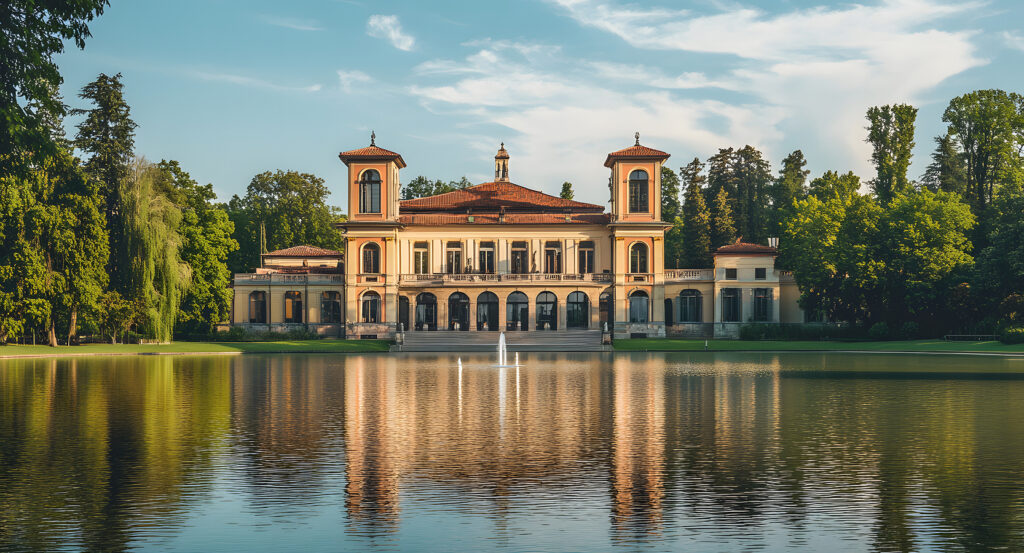
Set along Viale Emilio Alemagna near Viale Molière and just steps from Parco Sempione, the institution occupies the park's southwestern edge where Giovanni Muzio's long clinker-clad building, deep entrance portico, semicircular termination and garden stand between dense Magenta blocks and the open landscape extending toward Castello Sforzesco. The principal elevation presents a severe horizontal composition whose brick-toned surface and stone elements distinguish the palace from the greenery surrounding it. Muzio organized the interior around exhibition galleries wrapped around a central sequence of unusually large volumes, including the entrance vestibule, impluvium and Teatro dell'Arte. The rear garden extends the building into the park through outdoor installations and a broad relationship with the surrounding tree canopy. The result is a purpose-built cultural institution whose architecture joins gallery, theater and park within a physical composition created specifically for Milan's international exhibitions.
What defines Triennale Milano.
Triennale Milano is best known for developing one of the twentieth century's most consequential forums for Italian architecture and design from an exhibition first staged at the Villa Reale di Monza in 1923. The International Exhibition of Decorative Arts initially operated biennially with a stated ambition to connect industry, art and society as Italian manufacturing expanded after the First World War. Conversion to a three-year cycle coincided with the move to Milan in 1933, when the institution acquired independent legal status and Gio Ponti and Mario Sironi assumed central roles in the V Triennale. Antonio Bernocchi and his brothers Michele and Andrea had given the Comune five million lire in 1930 to construct a permanent exhibition building, allowing Giovanni Muzio to develop the Palazzo dell'Arte at the edge of Parco Sempione. Muzio conceived a flexible complex containing 12,000 square meters of exhibition and public space, and the palace opened with the V Triennale in 1933. Sironi collaborated closely with Muzio on the new institution and directed an artistic program that brought Massimo Campigli, Achille Funi, Giorgio de Chirico and Gino Severini into the inaugural Milan exhibition. De Chirico produced Cultura italiana as a mural for the palace, and Severini contributed the mosaic Le arti. Allied bombing later damaged the building, making the VIII Triennale of 1947 inseparable from postwar reconstruction as Piero Bottoni revived the QT8 experimental housing project with architects including Pietro Lingeri, Vittoriano Viganò, Marco Zanuso and Ernesto Nathan Rogers. The institution shifted from periodic exhibitions toward permanent activity during the closing decades of the century, becoming a foundation in 1996 as work initiated through design exhibitions curated by Manolo De Giorgi and Andrea Branzi supplied the nucleus of its permanent Italian design collection.
The Palazzo dell'Arte has repeatedly been treated as an active architectural project, allowing successive designers to alter its exhibition functions. Giuseppe Pagano expanded the building for the VI Triennale in 1936, only three years after its inauguration. Gae Aulenti and Umberto Riva led restoration work during the 1990s, followed by another intervention under Michele De Lucchi in 2002. A later recovery reopened one of Muzio's original ground-floor galleries and restored the long perspective from the entrance toward his helical staircase. The institution's permanent holdings grew alongside those architectural campaigns, with design exhibitions staged in 1995 and 1996 supplying an early basis for the collection subsequently assembled under Giampiero Bosoni. The present Museo del Design Italiano arranges more than 400 objects from the late 1920s through the opening years of the twenty-first century, drawing from holdings that also encompass the Giovanni Sacchi Collection and individual designer funds. Cuore extends that institutional memory into more than 30,000 photographs, 2,000 film and audio items, architectural models, drawings, posters and a library exceeding 22,000 books. Triennale Milano joins Muzio's exhibition architecture with permanent design holdings and a century-long institutional archive, turning a palace created for temporary international exhibitions into a continuing center for the study and presentation of Italian design.
How Triennale Milano fits.
Triennale Milano works as the anchor for a daytime exploration across Parco Sempione using three nearby sites that move from a steel experiment created for the same interwar exhibition culture through a Napoleonic amphitheater into the surviving pavilion of Milan's 1906 international exposition.
Begin at Torre Branca, designed by Gio Ponti for the V Triennale and erected in only two and a half months during 1933. Originally named Torre Littoria, the 108.6-meter structure used Dalmine tubes in special steel to create an exceptionally slender vertical counterpoint to the neighboring Palazzo dell'Arte. Closure followed in 1972 before Fratelli Branca financed restoration and gave the tower its present name, returning a surviving piece of the 1933 exhibition grounds to use. Its lightweight steel construction preserves the engineering ambitions that accompanied the V Triennale's experiments in modern architecture. Continue to Arena Civica Gianni Brera, where Luigi Canonica developed a Napoleonic amphitheater in 1805 as a setting for public celebrations and spectacles. Construction began in 1806, and the Arena was inaugurated on August 18, 1807 before work reached completion in 1827. Naumachias, rowing contests, chariot and equestrian races, balloon ascents and an 1830 display of an enormous whale constructed from wood, canvas and tin filled its first century; William Frederick Cody brought his Wild West show there in 1894 and 1906. The Comune acquired the Arena in 1870, sporting use expanded around the turn of the century and the complex received journalist Gianni Brera's name in 2002. Conclude at Acquario Civico, designed by Sebastiano Locati as the aquarium pavilion for Milan's 1906 international exposition and inaugurated on April 28 of that year. Its Liberty architecture survived after the larger exposition disappeared, and a station devoted to biology and applied hydrobiology joined the institution in 1908. Bombing severely damaged the building in August 1943 before reconstruction enabled reopening in 1963, followed by another comprehensive interior intervention between 2003 and 2006. The progression moves from Ponti's steel experiment for the 1933 exhibition through Canonica's Napoleonic arena into Locati's surviving pavilion from the 1906 exposition, placing Triennale Milano within three generations of architecture created for public performance, experimentation and large-scale cultural events in Parco Sempione.
Where your story begins.
Foresyte Travel reveals places that feel extraordinary long before you arrive.
Enjoy editorial crafted for luxury travelers.
Foresyte may earn a commission when you book.




















































































































