Why Queenstown Gardens matters.
Queenstown Gardens is a historic botanical reserve where Queenstown's alpine lakefront meets nineteenth-century civic ambition, mature ornamental landscapes and the recreational traditions that helped establish the settlement as one of New Zealand's most celebrated mountain destinations.
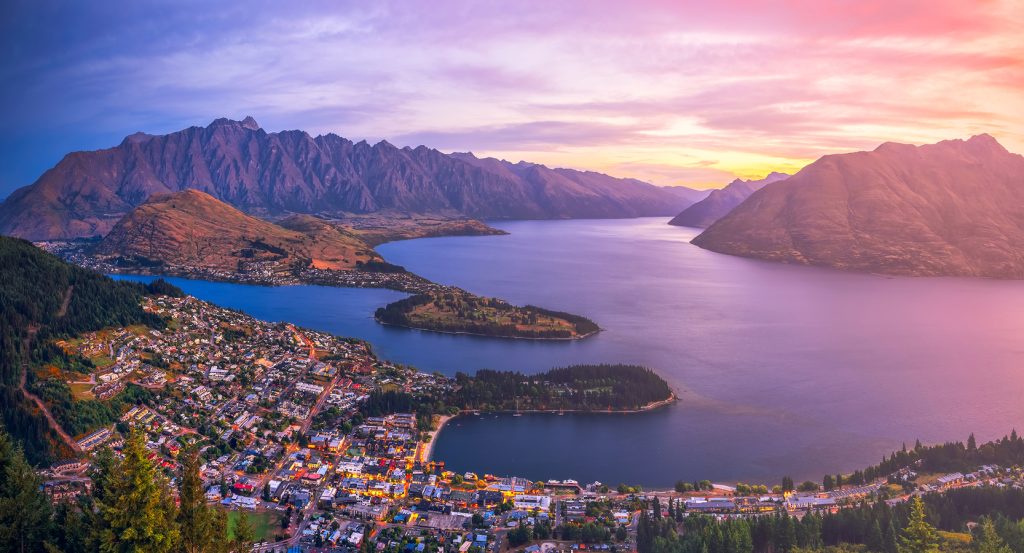
Occupying a wooded peninsula extending into Lake Wakatipu southeast of Queenstown's commercial center, the gardens connect the waterfront near Marine Parade and Park Street to a sheltered landscape framed by Queenstown Bay, Frankton Arm and the surrounding Southern Alps. A network of gently graded walking paths follows the shoreline and crosses the peninsula, opening views toward Cecil Peak, Walter Peak and the Remarkables mountain range. Towering Douglas firs, mature deciduous trees and ornamental conifers create a substantial woodland canopy above lawns, flowering borders and carefully maintained garden beds. The interior landscape incorporates a decorative pond, stone footbridge, formal rose plantings and open recreational grounds, combining botanical cultivation with the scenic conventions of nineteenth-century public park design. The result is a distinctive alpine garden whose sheltered woodland, cultivated landscape and expansive lake views preserve an important relationship between Queenstown's historic settlement and its mountainous natural surroundings.
What defines Queenstown Gardens.
Queenstown Gardens is best known for preserving one of New Zealand's earliest alpine resort landscapes, established during the transformation of a remote pastoral settlement into a permanent goldfields town. The peninsula formed part of a landscape used by Māori long before European settlement, with archaeological evidence of occupation and traditional travel routes associated with journeys toward the West Coast's pounamu resources. William Gilbert Rees established a pastoral station beside Queenstown Bay in February 1860, beginning a period of European settlement that accelerated following the discovery of gold in the Shotover River in November 1862. The ensuing gold rush transformed Queenstown into a commercial center supporting miners, merchants, transport operators and an expanding population. Local residents recognized the importance of securing public recreation land during this period of rapid development, and the Queenstown Improvement Society participated in discussions concerning the creation of a permanent reserve. Queenstown became an incorporated borough on August 1, 1866, providing the municipal authority needed to advance the proposal. The newly established Borough Council selected the peninsula for public purposes and sought government approval for its reservation. Approval followed in January 1867, securing the land for public recreation during the settlement's earliest period of municipal development. The original landscape consisted principally of tussock, speargrass, flax and matagouri, with a small natural tarn occupying higher ground near the peninsula's center. Mayor James William Robertson and nurseryman McConochie planted two English oaks near the principal entrance to commemorate the borough's incorporation, establishing the first major ornamental planting associated with the gardens. Survey work during 1867 introduced a principal avenue and circular walking route, providing the structural foundation for the developing reserve. Local residents subsequently participated in planting imported trees, contributing to an unusually varied collection of European, North American and Australian species. Municipal purchases recorded in 1886 included poplars, willows, sycamores, alders, larches, hollies, chestnuts, blue gums and black wattles, demonstrating the ambitious botanical scope of the developing public landscape. The Department of Tourism and Publicity assumed responsibility for the gardens in 1904, connecting their management to New Zealand's emerging national tourism infrastructure. Queenstown's development as a recreational destination subsequently encouraged the expansion of organized sporting facilities, including lawn bowls, tennis and croquet. An outdoor ice rink opened in 1966, introducing a winter recreation facility that subsequently developed into the enclosed Queenstown Ice Arena during the 1990s. The gardens also became associated with the early development of disc golf in New Zealand, with informal play beginning during the 1980s and a permanently marked course established during the following decade. Management transferred to Queenstown Lakes District Council in 1990, beginning another phase of municipal responsibility for the historic reserve. A substantial improvement program adopted in 2005 addressed aging trees, deteriorating pathways and the restoration of ornamental planting. The council adopted the Te Kararo Queenstown Gardens Conifer Succession Plan in August 2025, establishing a long-term program to replace aging Douglas firs with native and suitable exotic species over sixty to eighty years. The initiative represents an important continuation of the gardens' historical development, balancing the preservation of established landscape character with ecological restoration and the long-term management of a significant public reserve.
Queenstown Gardens' landscape character develops through the relationship between its nineteenth-century arboretum, formal ornamental planting and the distinctive environmental conditions of an exposed alpine peninsula. The original planting program introduced a wide range of exotic trees to a previously open landscape, gradually creating a substantial woodland whose mature canopy transformed the peninsula's appearance and environmental conditions. Douglas firs became particularly consequential along the southern and western shoreline, where their height and density established a protective windbreak against strong lake winds. This shelter supported the cultivation of more delicate ornamental plants within the gardens' interior, creating favorable conditions for lawns, flowering shrubs and seasonal displays. The resulting woodland contains an unusually varied collection of mature specimens, including black oak, red oak, grand fir, Algerian fir, western hemlock, monkey puzzle and giant sequoia. These trees demonstrate the botanical ambitions of nineteenth-century New Zealand horticulture, when imported species were cultivated for their ornamental qualities and suitability for developing colonial public landscapes. The contrast between evergreen conifers and deciduous trees produces a changing seasonal character, with autumn foliage contributing substantial color before the emergence of spring growth. Formal horticulture occupies another important position within the reserve, particularly through the rose garden developed during the twentieth century. A major redesign completed in 1968 established 850 rose bushes, creating a concentrated ornamental display whose flowering season contributes a distinctive botanical feature to the broader woodland landscape. Rhododendrons planted extensively during the 1960s introduced additional seasonal color, complementing the established collection of mature trees and flowering shrubs. The ornamental pond provides a different expression of landscape design, preserving the natural depression that originally contained a small alpine tarn. A timber bridge crossed the water as early as 1868, and subsequent improvements gradually transformed the surrounding ground into a cultivated garden feature. The existing stone bridge dates from 1960, establishing a durable architectural crossing that connects the pond's surrounding paths and planted banks. Decorative fountains contributed to the pond's development, with a replacement installed in 2009 using water drawn directly from Lake Wakatipu. The surrounding paths establish a continuous relationship between enclosed woodland and expansive alpine scenery, moving through sheltered interior plantings before reaching the peninsula's exposed shoreline. This combination of botanical cultivation, historical landscape engineering and distinctive alpine geography gives Queenstown Gardens its enduring character as a carefully developed public landscape shaped by successive generations of horticultural practice.
How Queenstown Gardens fits.
Queenstown Gardens works as the starting point for an outing connecting the town's commemorative waterfront, the surviving hospitality institutions of its gold-rush settlement and the historic steamship that transformed transportation across Lake Wakatipu.
Begin at Queenstown War Memorial, the commemorative archway marking the transition between the town's central waterfront and the historic public landscape surrounding the gardens. The memorial developed from the community's response to the First World War, when New Zealand's military participation brought substantial losses to settlements throughout the country. Its stone arch incorporates traditional commemorative architecture, establishing a permanent civic tribute to local servicemen whose deaths became part of Queenstown's twentieth-century history. The structure occupies a prominent position beside the lakefront promenade, connecting public remembrance to the ceremonial entrance of one of the town's most established recreational spaces. Its preservation maintains an important physical connection between the community's military history and the civic landscape developed during Queenstown's early municipal expansion. Continue to Eichardt's Private Hotel, the historic hospitality institution whose origins reach to the commercial development of Queenstown during the Central Otago gold rush. The establishment began as the Queen's Arms Hotel, converted from a pastoral woolshed by William Gilbert Rees following the influx of prospectors in 1862. Albert Eichardt became proprietor in 1866 and subsequently acquired the business, developing a more substantial hotel that served travelers, merchants and the region's expanding transport network. Following Albert's death in 1882, Julia Eichardt directed the establishment and commissioned architectural improvements, including the replacement of its remaining timber structures and the introduction of electric lighting in 1886. The surviving building preserves an important example of Victorian commercial architecture associated with Queenstown's transition from a mining settlement into an established destination for regional travel. Conclude at TSS Earnslaw, the historic steamship whose construction established a major transportation connection between Queenstown and the remote settlements surrounding Lake Wakatipu. Commissioned by New Zealand Railways, the vessel entered service on October 18, 1912, providing passenger, livestock, mail and freight transportation across a lake whose surrounding communities depended heavily on waterborne connections. Its 51.2-meter hull made it the largest steamship operating on the lake, and its coal-fired engines supported a substantial commercial transport operation during the first half of the twentieth century. The vessel faced withdrawal from service during the 1960s as improved road connections reduced demand for traditional lake shipping, prompting its acquisition by tourism operator Real Journeys in 1968. Its continued operation preserves a rare example of early twentieth-century steam engineering, connecting Queenstown's maritime transport history to the development of heritage tourism across the Southern Lakes region. The progression moves from Queenstown War Memorial's preservation of civic remembrance through Eichardt's Private Hotel's development of goldfields hospitality and culminates in TSS Earnslaw's surviving steamship engineering, connecting the town's public institutions, commercial origins and historical dependence on Lake Wakatipu.
Where your story begins.
Foresyte Travel reveals places that feel extraordinary long before you arrive.
Enjoy editorial crafted for luxury travelers.
Foresyte may earn a commission when you book.