
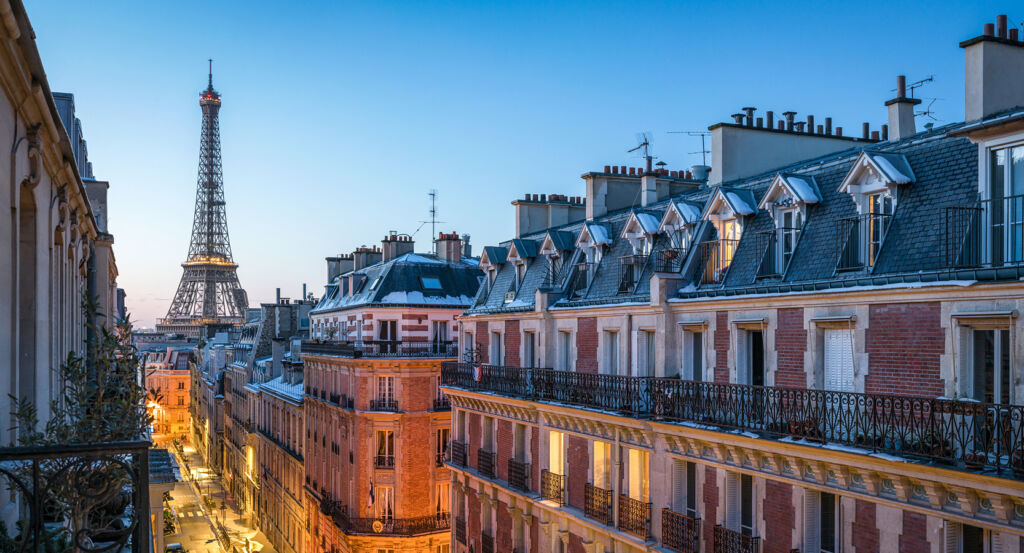
Why you should experience Renaissance Paris Nobel Eiffel Tower Hotel in Paris, France.
Renaissance Paris Nobel Eiffel Tower Hotel is a garden-centered retreat where Chaillot's residential elegance, nineteenth-century architecture, horticultural history, and contemporary French design create one of western Paris' most unusual hotel compounds.
Set along Avenue Raymond Poincaré near Rue de Longchamp and just steps from Place du Trocadéro, the hotel combines 122 rooms and suites, four historic buildings, Jean-Philippe Nuel interiors, reception salons, Maison Revka Garden, and a protected interior garden measuring 1,200 square meters within a secluded architectural ensemble. Anglo-Norman façades, a surviving turret, mature planting, sculpted landscaping, mahogany furnishings, marble bathrooms, and tree-inspired bedroom canopies create a visual style rooted in the property's unusually verdant history. Approximately 70 percent of accommodations face the garden, allowing greenery to remain a defining component of the interiors while the courtyard separates the property from the surrounding avenues. The result is a hotel where nineteenth-century architecture, horticulture, award-winning contemporary design, and Parisian hospitality remain inseparable.
What you should know about Renaissance Paris Nobel Eiffel Tower Hotel.
Renaissance Paris Nobel Eiffel Tower Hotel is best known for occupying an ensemble of historic buildings whose chronology includes a convent operating during the 1850s, a later stable with a turret residence and surviving hay-bale pulley, and a courtyard where Alfred Nobel maintained an orchid greenhouse, giving the present hotel an architectural and horticultural history extending far beyond its modern hospitality use. The property developed around Anglo-Norman buildings surrounding an 1,200-square-meter protected interior garden, with landscape designer Philippe Niez shaping the planted centerpiece around which its 100 rooms and 22 suites are organized. A four-month closure produced a comprehensive 2011 renovation by Jean-Philippe Nuel, replacing the previous Nina Campbell interiors with rounded mahogany furniture, gray and taupe palettes, baroque mirrors with gilded frames, tree-green upholstery, functional dressing areas, multifunction tables, marble bathrooms, and ethereal canopy treatments designed to dissolve the visual boundary between guestrooms and garden. That intervention earned Jean-Philippe Nuel the 2011 European Hotel Design Award for Bedrooms and Bathrooms, while 70 percent of the 122 accommodations were documented as overlooking the garden, demonstrating how the courtyard informed both the architectural organization and the award-winning interior concept.
Philippe Niez treated the 1,200-square-meter courtyard as the compositional center of the four-building ensemble, with its protected green-space status preserving a substantial planted environment inside a dense section of the 16th Arrondissement and reinforcing the botanical lineage established by Alfred Nobel's former orchid greenhouse. Jean-Philippe Nuel explicitly carried that vegetation indoors through a wood, sunlight, and plant-inspired design vocabulary, using tree-like green accents, mahogany, reflective surfaces, and canopy structures that evoke resting beneath foliage while incorporating laptop safes, storage, and multifunction furniture into the renovated guestrooms. Green Key added an operational dimension to that relationship with nature when the property achieved certification in 2013, following an eco-certification process begun in 2012 to improve responsible management practices across the hotel. Maison Revka Garden now activates the historic courtyard through French cooking shaped by Slavic flavors, including chicken chachlyk, cod with green asparagus, seafood service, and a summer setting of ivory trellises, roses, jasmine, fabrics, lanterns, and antique mirrors, extending the property's botanical character from Nobel's orchids and Niez's landscape into its contemporary culinary program.
How to fold Renaissance Paris Nobel Eiffel Tower Hotel into your trip.
Renaissance Paris Nobel Eiffel Tower Hotel works as an afternoon and evening exploring the architecture, decorative arts, and cultivated residential character of Chaillot.
Begin at Musée d'Art Moderne de Paris, where twentieth and twenty-first-century painting, sculpture, and grand installations inside the Palais de Tokyo complex establish the district's relationship with ambitious modern art before the afternoon moves into a more intimate architectural setting. Continue to Renaissance Paris Nobel Eiffel Tower Hotel, where the former convent, Anglo-Norman buildings, Alfred Nobel's horticultural history, Jean-Philippe Nuel interiors, and protected garden turn that discussion between history and design into the centerpiece of the experience. Continue to Musée Baccarat, where crystal craftsmanship, decorative objects, chandeliers, and Philippe Starck interiors shift the sequence toward the material refinement associated with western Paris and its historic luxury houses. Conclude at Palais de Chaillot, where grand terraces open toward the Eiffel Tower and Seine as daylight gives way to the illuminated city, providing the evening payoff through one of western Paris' defining panoramas. The progression moves from modern art through garden-centered hospitality and French decorative craftsmanship before culminating above the Seine, revealing the cultivated cultural character that defines Chaillot.
Where your story begins.
Foresyte Travel reveals places that feel extraordinary long before you arrive.
Experience premium editorial crafted for luxury travelers.














































































































