
Why Shangri-La Paris matters.
Shangri-La Paris is a palatial hotel where Chaillot's grand character meets Prince Roland Bonaparte's scientific residence, late nineteenth-century French architecture and Shangri-La's first European hotel inside a protected Parisian mansion.
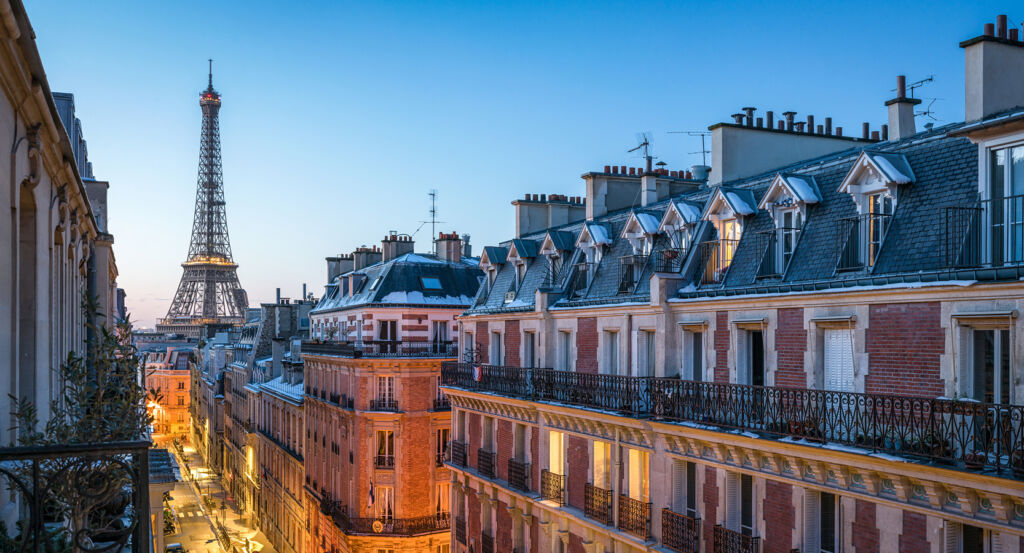
Set along Avenue d'Iéna near Rue Fresnel and just steps from Place des États-Unis, the hotel occupies Chaillot's eastern slope where grand avenues descend toward the Seine through a district shaped by private mansions, diplomatic buildings and institutions created around successive international expositions. The limestone palace rises behind an ornamental street enclosure, with projecting bays, carved stonework and a domed corner pavilion giving the residence an asymmetrical composition uncommon among the avenue's later institutional buildings. Marble floors, gilded ornament, restored parquet and grand staircases preserve the ceremonial scale of a private princely residence across the principal interiors. Empire references and Asian decorative elements occupy those historic volumes through a design program conceived during the building's conversion from institutional use. The result is a hotel whose protected architecture preserves the ambitions of a Bonaparte residence within an international hospitality property overlooking western Paris.
What defines Shangri-La Paris.
Shangri-La Paris is best known for occupying the palace Prince Roland Bonaparte commissioned as both his family residence and the headquarters for extraordinary scientific collections assembled during his career as a geographer and botanist. Bonaparte selected Ernest Janty in 1892 to design the mansion at 10 Avenue d'Iéna, creating a residence capable of accommodating domestic life alongside his geographical library and extensive herbarium. The completed 1896 palace combined eighteenth-century French references with Empire ornament and early Art Nouveau elements across ceremonial rooms organized around its grand staircase. Bonaparte died in 1924, and his daughter Marie Bonaparte began dispersing collections whose scale made their preservation inside the family residence increasingly impractical. The Suez Canal Company acquired the mansion during the following period and commissioned Michel Roux-Spitz to undertake extensive alterations beginning in 1929. The Société de Géographie occupied the palace between 1926 and 1942, maintaining a direct connection between the building and the discipline that had defined Roland Bonaparte's intellectual career. French state ownership followed, and the property became associated with the national foreign-trade apparatus for much of the later twentieth century. Shangri-La acquired the building from the state in 2005 for €92 million and began an extensive conversion directed by architect Richard Martinet. Monument Historique protection followed on February 10, 2009, encompassing the façades and roofs, street enclosure, principal staircase, galleries and a substantial group of surviving ceremonial interiors. Pierre-Yves Rochon directed the interior decoration as the restoration returned the former residence to hospitality and residential functions after decades of institutional occupation. Shangri-La Paris opened on December 17, 2010, establishing the Hong Kong-based group's first hotel in Europe inside a building whose transformation had extended across five years. France awarded the property Palace distinction in 2014, completing a transition from private scientific residence through corporate and state occupation to one of the country's formally designated palace hotels.
Roland Bonaparte made the Avenue d'Iéna palace an intellectual institution as well as a residence, concentrating a major private library, botanical specimens and geographical scholarship within rooms designed specifically around his scientific work. His herbarium became one of the great private botanical collections of its period, occupying dedicated space in the mansion alongside collections of Napoleonic material inherited through his family. Four wood-paneled rooms housed his library, whose foundations included books belonging to his father, Pierre-Napoléon Bonaparte, before acquisitions from collections including those of Louis Vivien de Saint-Martin and Charles Schefer expanded its scholarly depth. Bonaparte joined the Société de Géographie in 1884 and later led the organization during the final phase of his life, strengthening the relationship between his private collections and French geographical scholarship. The Académie des Sciences elected him in 1907 and elevated him to its presidency in 1919, the same year he presided over the Société botanique de France. His interests extended into emerging aviation, and he chaired the 1905 founding conference of the Fédération Aéronautique Internationale. The Société de Géographie subsequently transferred its headquarters into his former home, carrying the discipline he had supported directly into the palace after his death. Parts of Bonaparte's geographical library remained inside the building until 1942, when the material moved to the Société's Boulevard Saint-Germain headquarters and the Bibliothèque nationale. His botanical and scholarly holdings ultimately entered institutions including the Muséum national d'Histoire naturelle and Institut de France, dispersing the scientific collections for which the palace had originally been constructed. Shangri-La's restoration recovered the surviving ceremonial architecture of a residence whose original purpose joined Bonaparte dynastic history with the scientific institutions Roland Bonaparte helped lead.
How Shangri-La Paris fits.
Shangri-La Paris works as an anchor for an outing connecting a nineteenth-century collector's project that became France's great Asian art museum, a 1937 palace conceived for modern art and an architectural institution descended from Viollet-le-Duc's pioneering museum of grand casts.
Begin at Musée Guimet, created from industrialist Émile Guimet's ambition to establish a museum devoted to world religions. His 1876-1877 journey through Japan, China and India produced a major body of Asian material first displayed in the museum he established in Lyon in 1879. Guimet later transferred the project to Paris, donated his collections to the French state and inaugurated the Place d'Iéna museum in 1889. Archaeological expeditions by Louis Delaporte, Paul Pelliot and other scholars subsequently expanded its Asian holdings. A decisive 1945 exchange sent Guimet's Egyptian material to the Louvre and transferred the Louvre's Asian collections in return, concentrating the institution around Asian art. Continue to Palais de Tokyo, constructed for the 1937 Exposition internationale des arts et techniques de la vie moderne as a dual museum complex dedicated to modern art. Jean-Claude Dondel and André Aubert won the 1934 architectural competition with Paul Viard and Marcel Dastugue, developing two grand wings linked by a colonnaded terrace descending toward the Seine. The west wing received collections from the Musée du Luxembourg and Jeu de Paume in 1938 before becoming home to the Musée national d'art moderne. Anne Lacaton and Jean-Philippe Vassal later transformed that wing for contemporary creation, with a 2012 expansion producing a 22,000-square-meter arts center inside the stripped architectural volume. Conclude at Cité de l'architecture et du patrimoine, whose institutional ancestry reaches Eugène Viollet-le-Duc's Musée de Sculpture comparée, opened in the Palais du Trocadéro in 1882 to present full-scale casts of French architectural sculpture. The museum acquired France's first chair devoted to national architectural history in 1887. Léon Azéma, Jacques Carlu and Louis-Hippolyte Boileau incorporated its successor into the Palais de Chaillot for the 1937 exposition, adding galleries to the surviving wings of the earlier Trocadéro palace. Paul Deschamps expanded the museum through collections of mural and stained-glass reproductions. The Cité opened in 2007, joining those historic holdings with archives, a library and modern architectural collections. The progression moves from private collecting transformed into a national Asian art institution through an exposition palace dedicated to modern art and culminates in a museum whose full-scale architectural reproductions preserve centuries of French building culture.
Where your story begins.
Foresyte Travel reveals places that feel extraordinary long before you arrive.
Enjoy editorial crafted for luxury travelers.
Foresyte may earn a commission when you book.














































































































