
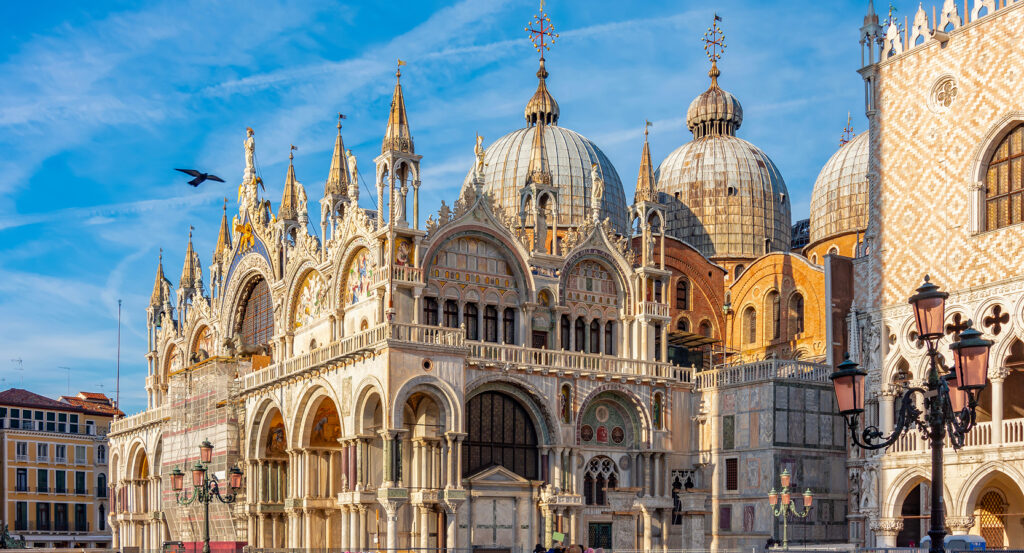
Why you should experience St. Mark's Campanile in Venice, Italy.
St. Mark's Campanile is Venice's eternal sentinel, a tower that has watched over the lagoon for a thousand years.
Rising 98 meters above St. Mark's Square, its red-brick shaft and golden angel gleam against the shifting sky, a vertical counterpoint to the horizontal sprawl of the city below. The bells toll like heartbeats across the water, their echoes rolling through alleys and canals. From the ground, the Campanile seems monumental; from its summit, the world becomes still. It's more than a viewpoint, it's a time machine, one that lets you see Venice as sailors once did, their first sight of home after months at sea. Here, between wind and silence, you understand why Venice built upward when all else floated outward.
What you should know about St. Mark's Campanile.
The Campanile's story is one of fall and rebirth.
The original tower was completed in 1514 after centuries of construction, built atop Roman foundations that once held a lighthouse for ships entering the lagoon. For nearly 400 years, it stood as the city's symbol, until July 14, 1902, when it collapsed suddenly into a heap of dust and rubble, miraculously killing no one except the caretaker's cat. The Venetians' response was immediate and unanimous: “Com'era, dov'era”, “as it was, where it was.” They rebuilt the tower stone for stone, completing it in 1912, exactly ten years later to the day. The golden archangel Michael was restored to the spire, still facing east to bless the Adriatic winds. Inside, five great bells once marked Venice's rhythm, each with a distinct purpose: Marangona for the start and end of the workday, Nona for noon, Trottiera for Senate sessions, Mezza Terza for criminal executions, and Renghiera to summon the Great Council. Today, their sound remains the heartbeat of the city, even as the modern elevator hums quietly up their ancient shaft. Few know that Galileo demonstrated his telescope here in 1609, showing Venetian nobles the moons of Jupiter, the moment Venice first looked beyond its own horizon. The Campanile isn't just an icon; it's a living chronicle of faith, science, and resilience written in brick and sky.
How to fold St. Mark's Campanile into your trip.
Approach the tower from the Piazza San Marco, and pause at its base before ascending, the view upward is almost dizzying, the brick tapering into the heavens.
Take the elevator to the top (a modern concession that preserves the tower's dignity), and when the doors open, let the view hit you all at once. Venice stretches in every direction: the domes of St. Mark's Basilica gleaming below, the lagoon glimmering like glass, the Alps visible on clear days beyond the horizon. Turn slowly, north to Murano, east to the Lido, south to the open Adriatic. Each angle tells a different story. Visit early morning for clarity or near sunset when the city glows like fire on water. Listen for the bells; they toll with a warmth that feels almost human, their sound weaving through the canals like memory. Before you descend, look up at the angel turning gently in the wind, a symbol of endurance, balance, and grace. When you step back into the square, the tower feels different, no longer a monument, but a companion. St. Mark's Campanile is Venice's voice in stone, steady, unshaken, and endlessly awake.
Where your story begins.
Foresyte Travel reveals places that feel extraordinary long before you arrive.
Experience premium editorial crafted for luxury travelers.




















































































































