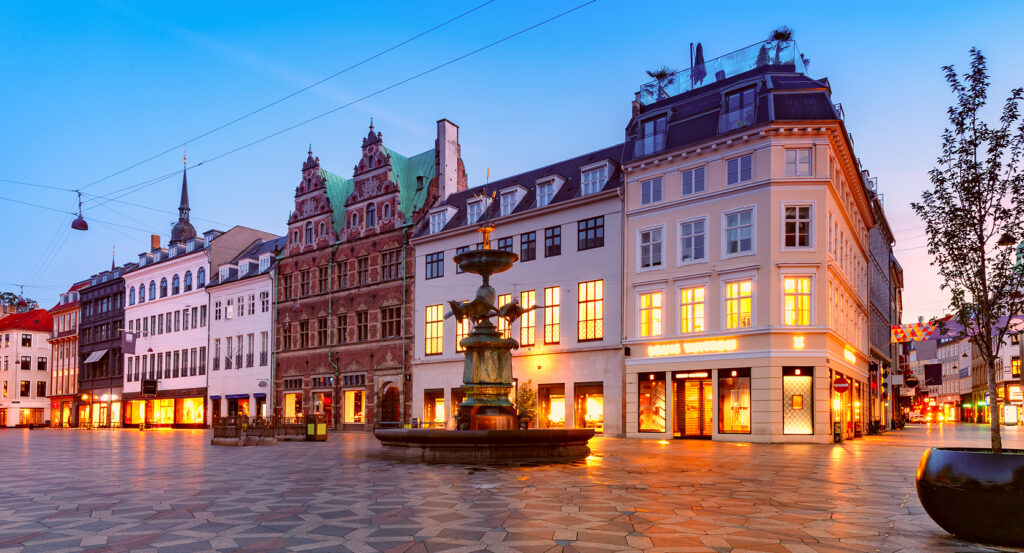
Why Gammeltorv matters.
Gammeltorv is Copenhagen's oldest public space, a living layering where the city's soul has gathered for nearly a thousand years.
Set just off the western stretch of Strøget, this historic plaza is less about performance and more about presence, a timeless rhythm of footsteps, fountains, and façades that have witnessed everything from royal proclamations to daily markets. The square's geometry still follows medieval contours, anchored by the elegant Caritas Fountain at its center, a Renaissance masterpiece whose water arcs dance gently in the wind. Around it, ochre and pastel façades rise in perfect proportion, their windows reflecting the same soft Nordic light that has washed this space for centuries. Here, the modern city hums quietly over ancient roots: the smell of roasted coffee from nearby cafés mingling with echoes of old trade cries and laughter that seem to linger in the cobblestones. Gammeltorv isn't merely a stop along Strøget, it's where Copenhagen began, and where, in some ineffable way, it still begins each day.
What defines Gammeltorv.
Gammeltorv, meaning “Old Square”, was once the political and commercial heart of Denmark's capital, and its history reads like a condensed biography of the city itself.
Founded in the 12th century, it served as the original marketplace for medieval Copenhagen, later becoming the site of the first City Hall before the great fire of 1795 consumed much of the area. The Caritas Fountain, built in 1608 by order of King Christian IV, is the oldest fountain in Copenhagen and remains one of the finest Renaissance monuments in Northern Europe. Its bronze figures, a mother with children, symbolizing charity, once poured wine instead of water during royal celebrations, a tradition that charmed locals and visitors alike. Few realize that Gammeltorv and the neighboring Nytorv were merged into a single elongated plaza after the fire, uniting civic and social life into one shared space. Beneath the surface, archaeological excavations have uncovered medieval wells and market stalls, confirming its role as the cradle of the city's urban identity. The surrounding buildings tell the story of rebirth, Neoclassical facades rebuilt after 1795, their symmetry and color reflecting Copenhagen's shift from medieval chaos to Enlightenment order.
How Gammeltorv fits.
Gammeltorv works as a moment of calm within the flow of Strøget, a chance to stand still and feel history breathe.
Approach from the direction of Rådhuspladsen, letting the bustle of shops and cafés slowly give way to open space and sunlight. Pause at the Caritas Fountain and watch the water arcs glisten against the façades, in summer, they shine gold; in winter, they freeze into delicate sculpture. Take a seat on one of the low benches that circle the fountain and listen to the sounds of the square, buskers playing jazz near the corner, locals chatting over espresso, bicycles rolling softly across the stones. For those who love architecture, look upward: the surrounding houses form one of the city's most harmonious ensembles, their muted tones glowing warmly at dusk. Continue northward to Nytorv, where the old courthouse and City Hall once stood, completing the twin-square story of Copenhagen's evolution. If you visit in the evening, the square takes on a quieter magic, lanterns flicker in café windows, and the water's reflection dances against centuries-old walls. Gammeltorv isn't just a place on a map, it's the city's memory made visible, a timeless intersection of commerce, community, and grace.
Where your story begins.
Foresyte Travel reveals places that feel extraordinary long before you arrive.
Enjoy editorial crafted for luxury travelers.
Foresyte may earn a commission when you book.