
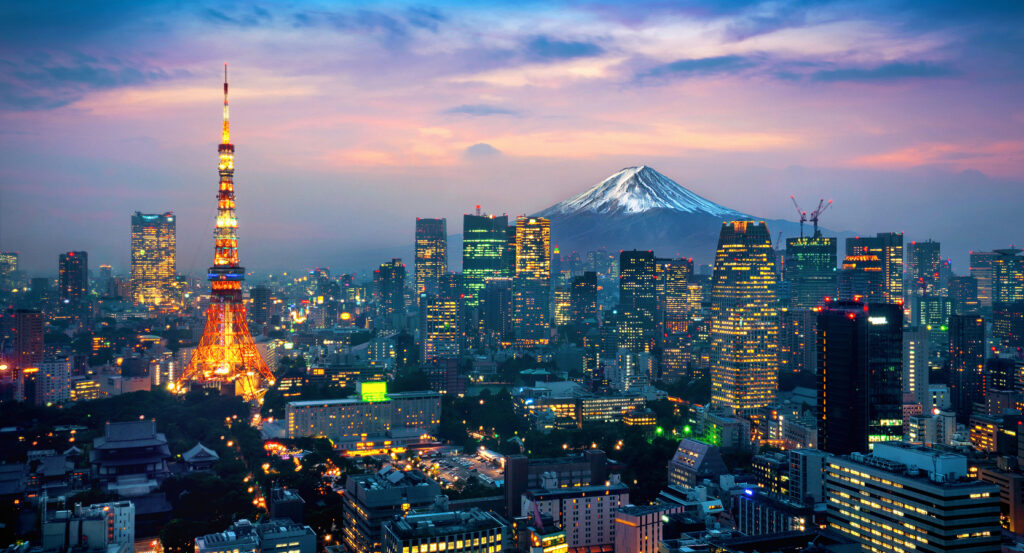
Why Tokyo Tower Top Deck matters.
Tokyo Tower Top Deck is a soaring observation chamber where Shibakoen's historic character meets postwar Tokyo engineering, a 250-meter panorama and KAZ Shirane's mirrored transformation of the tower's highest public interior.
Set within Tokyo Tower near Shiba Park and just steps from Zojoji, the observation chamber rises above a district where temple roofs, wooded parkland and the low slopes around Atago meet the dense towers of Minato. Tokyo Tower's tapered steel lattice narrows sharply around the deck, placing the compact circular interior high inside the structure before the antenna continues toward its 333-meter summit. Continuous windows expose the metropolis in every direction as geometric mirrors multiply fragments of buildings, sky and the tower's own steelwork across the room. The elevated position reveals the contrast between the greenery surrounding Zojoji and the immense urban field extending toward Central Tokyo, Tokyo Bay and distant mountain ranges. The result is a concentrated aerial room where the engineering scale of Tokyo Tower and the changing city beneath it become inseparable parts of the view.
What defines Tokyo Tower Top Deck.
Tokyo Tower Top Deck is best known for occupying the 250-meter observation level of the 333-meter broadcasting tower designed by structural engineer Tachu Naito during Japan's postwar television expansion. Regular television broadcasting began in Japan in 1953, and the multiplication of individual transmission towers created demand for a unified structure capable of serving the wider Kanto region. Newspaper executive Hisakichi Maeda established Nippon Television City Corporation in May 1957 and pursued a tower that would combine broadcasting infrastructure with a public observatory. Naito, already known for high-rise and tower engineering, developed the steel structure with Nikken Sekkei engineers as wind and earthquake resistance became fundamental requirements for a tower exceeding the Eiffel Tower in height. Construction lasted a year and a half before Tokyo Tower opened on December 23, 1958 at 333 meters, then the tallest freestanding tower in the world. Its height was calculated around the transmission range required for television service across the Kanto region, with the coincidence between 333 meters and Showa 33 becoming part of the tower's public history. Television stations began transmitting through the structure in 1959, placing its public observation functions directly inside infrastructure serving Japan's rapidly expanding broadcast culture. The Upper Special Observatory opened in 1967, adding the 250-meter viewing level that later became the Top Deck. A 2002 renewal updated both principal observatories, followed by another major intervention ahead of the tower's sixtieth anniversary. The former Special Observatory received the Top Deck name in 2018 as a new tour converted the tower's uppermost public room from a conventional viewing platform into a designed sequence connecting the original broadcasting structure with contemporary Tokyo.
KAZ Shirane's 2018 interior reconstruction developed the Top Deck around a permanent installation of polyhedral reflective surfaces whose geometry changes with the city visible beyond the windows. Renovation began in October 2016 and extended beyond the room itself through dedicated circulation and upgraded elevators between the 150-meter Main Deck and the upper observatory. Shirane covered the compact circular chamber with triangular and quadrilateral geometric mirrors, creating irregular reflections that fragment the skyline and shift as people move through the room. Mirror-finished SUS304 stainless-steel sheets provided the reflective skin, with close to 1,000 triangular pieces used across the installation. LED illumination enters the mirrored geometry after dark, producing another visual layer independent of the daylight skyline. Geometric programming by Shuta Takagi supported Shirane's design, with Dream Studio, Dentsu and NITTEN participating in direction, planning and execution; Takenaka Corporation handled architectural equipment construction. The renewed chamber opened on March 3, 2018 as the climax of the Top Deck Tour, whose route begins at Foot Town, passes through the 150-meter Main Deck and continues by dedicated elevator to 250 meters. The project received the 2018 Architecture MasterPrize Interior Design of the Year, giving the tower's smallest principal observation room an architectural distinction separate from Naito's original engineering achievement.
How Tokyo Tower Top Deck fits.
Tokyo Tower Top Deck works as the anchor for a daytime exploration through Shiba and Atago using three nearby sites that move from Tokugawa religious patronage through one of Japan's earliest public parks into a hilltop shrine established to protect Edo from fire.
Begin at Zojoji, founded in 1393 and relocated to its present site in 1598 after Tokugawa Ieyasu selected it as the family temple of the dynasty that would govern Japan for more than two and a half centuries. The complex eventually occupied 826,000 square meters, contained 48 subordinate temples and supported 3,000 priests and novices, establishing Shiba as a major center of Jodo Buddhism. Six Tokugawa shoguns were buried within its mausoleums, and Ieyasu's own funeral took place there in 1616. Air raids destroyed much of the complex during the Second World War, but the Sangedatsumon survives from 1622 as its principal original structure and one of Tokyo's oldest large wooden gates. Continue to Tokyo Metropolitan Shiba Park, established on October 19, 1873 during the Meiji government's creation of Japan's first public parks. The original park incorporated Zojoji ground before postwar separation of religious and public property produced the unusual discontinuous configuration surrounding the temple. Landscape architect Yasuhei Nagaoka later worked with the existing topography and established trees, and the grounds preserve Shibamaruyama Kofun, among Tokyo's largest surviving keyhole-shaped burial mounds. Sports facilities introduced in 1935 added another chapter to a park whose camphor, zelkova and ginkgo trees now frame some of the clearest ground-level views toward Tokyo Tower. Conclude at Atago Jinja, established by order of Tokugawa Ieyasu in 1603 atop 26-meter Atago Hill to protect the new shogunal city from fire and disaster. The shrine venerates Homusubi no Mikoto, the deity of fire, and its elevation once supplied commanding views across Edo long before modern towers surrounded the hill. Its famous stone staircase became associated with Magaki Heikuro after the samurai rode a horse up the steep ascent before the third shogun, Tokugawa Iemitsu, and returned with plum branches from the summit. The progression moves from Ieyasu's elevation of Zojoji into a Tokugawa religious center through the Meiji government's conversion of adjoining temple territory into an early public park into a hilltop shrine created to guard Edo, revealing three historical layers beneath the metropolitan panorama visible from the Top Deck.
Where your story begins.
Foresyte Travel reveals places that feel extraordinary long before you arrive.
Enjoy editorial crafted for luxury travelers.
Foresyte may earn a commission when you book.

















































































































