Why you should experience Buddhaisawan Chapel in Bangkok, Thailand.
Tucked within the tranquil compound of the National Museum Bangkok, the Buddhaisawan Chapel feels like a secret folded into the heart of the city, a sanctuary where history, devotion, and artistry converge in golden stillness.
The air inside is cool and fragrant with age; sunlight seeps through narrow windows, catching on gilded murals that shimmer like living silk. At its center sits the revered Phra Buddha Sihing, one of Thailand's most venerated images, its serene face radiating quiet authority from a pedestal of lotus petals. The Buddha's soft smile, cast in the elegant Chiang Saen style, seems to watch over centuries, its aura unbroken by time or circumstance. Around it, walls bloom with 18th-century murals depicting celestial realms, royal processions, and mythic battles, the brushstrokes so fine they feel whispered. Even the silence here has texture: the faint creak of wooden floors, the slow echo of footsteps, the hush of reverence shared by every visitor. To enter the Buddhaisawan Chapel is to step out of chronology and into devotion itself, a moment of equilibrium suspended in gold and still air.
What you didn't know about Buddhaisawan Chapel.
What most travelers never realize is that the Buddhaisawan Chapel is one of Thailand's oldest and most sacred royal temples, a cornerstone of both Bangkok's artistic and spiritual identity.
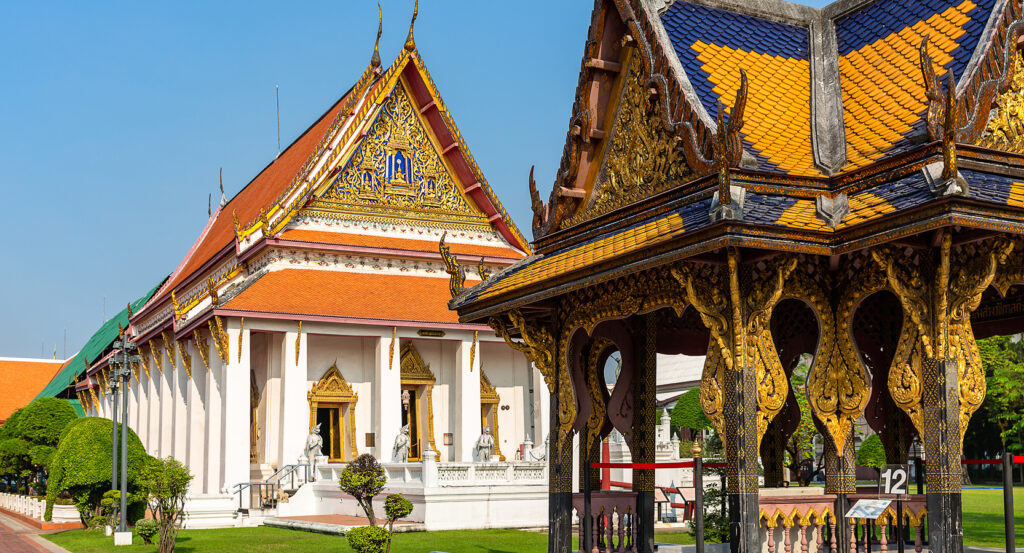
Built in 1795 during the reign of King Rama I, it was originally part of the Front Palace complex, residence of the vice-king and a ceremonial counterpart to the Grand Palace. The chapel housed royal monks and served as a spiritual nucleus for the palace's inner court, its design modeled closely after the sanctuaries of Ayutthaya, which had been destroyed in war just decades earlier. The Phra Buddha Sihing image, believed by some legends to have originated in India and journeyed through Chiang Mai and Ayutthaya before arriving in Bangkok, has long been associated with divine protection and moral governance. The chapel's architecture, steeply tiered roofs, gilded pediments, and elaborate door panels carved with mythical guardians, mirrors the aesthetic ideals of early Rattanakosin craftsmanship. But it's the murals that make it transcendent: visual scripture narrating the Jataka tales and the Buddha's final enlightenment with luminous precision. The Buddhaisawan Chapel thus stands not just as a relic, but as a living textbook of Thai artistic philosophy, where every brushstroke is both ornament and offering.
How to fold Buddhaisawan Chapel into your trip.
To fold the Buddhaisawan Chapel into your Bangkok journey, approach it as a pilgrimage of quiet observation.
Enter through the National Museum grounds, allowing time to wander past relics and sculptures that trace Thailand's spiritual lineage before stepping into the chapel itself. Remove your shoes, lower your voice, and let your eyes adjust to the dim glow within, gold leaf catching the light like the breath of the divine. Sit cross-legged for a few moments before the Phra Buddha Sihing, noticing how the calm it emanates seems to reorder your own thoughts. Then, move slowly along the walls, tracing the mural panels from left to right, the way a story unfolds in meditation. Look for the details: the posture of celestial beings, the tiny footprints of elephants crossing rivers, the subtle gradation of crimson and blue in the heavens above. When you leave, step back into the sunlight and glance once more at the temple's façade, its symmetry, its restraint, its grace. The Buddhaisawan Chapel doesn't demand devotion; it inspires it, quietly, completely, in the way that only beauty born of faith can.
Hear it from the Foresyte community.
Just enough life around you not to be overwhelming. Right pace.
Where your story begins.
Start your planning journey with Foresyte Travel.
Experience immersive stories crafted for luxury travelers.