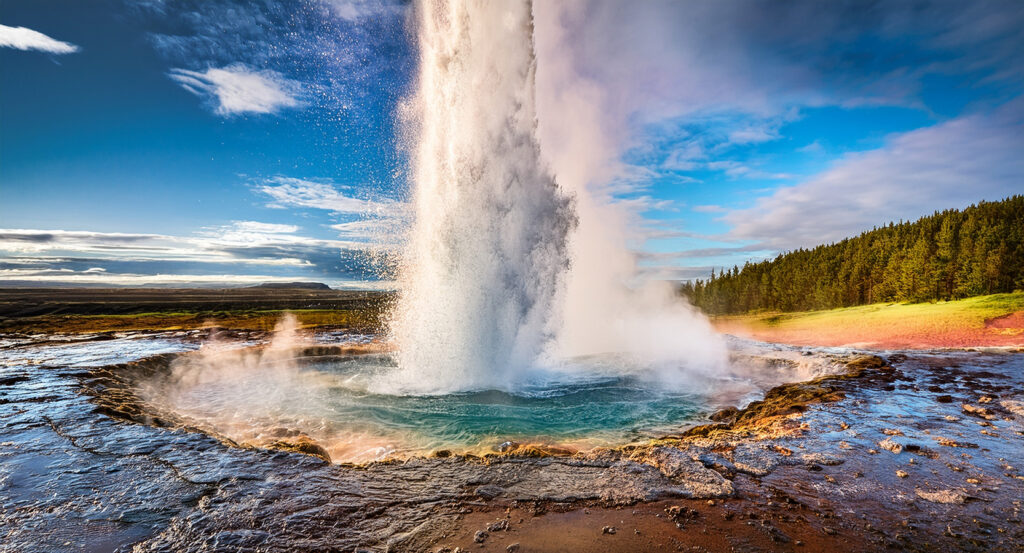
Why you should experience Kerið Crater in Iceland.
Some landscapes whisper, Kerið Crater in Iceland sings.
Set in the Grímsnes region of southern Iceland, this volcanic crater lake blazes with color in a country defined by extremes. Its caldera glows deep red, orange, and gold, a rare palette among Iceland's black basalt formations, while a pool of still, sapphire-blue water rests at its center like a gemstone set in fire. Measuring 270 meters across and over 55 meters deep, Kerið feels both intimate and immense, its steep slopes drawing you downward into a silence broken only by wind and the faint ripple of water. Formed roughly 3,000 years ago, this crater is younger than most volcanic relics in Iceland, and its vivid hues come from iron-rich soil still oxidizing beneath your feet. Walk the rim, and you'll see the layers of time stacked like pages, lava, ash, clay, moss, all radiating toward the blue heart below. To gaze into Kerið is to look into Iceland's soul: wild, unpredictable, and impossibly beautiful in its imperfection.
What you didn’t know about Kerið Crater.
Kerið's origin story challenges the assumptions of even seasoned geologists.
Unlike many volcanic craters formed by explosive eruptions, Kerið was likely a collapsed magma chamber, an emptied cauldron whose roof caved in once the lava drained away. The result is this near-perfect oval, carved not by violence but by gravity's quiet insistence. Its lake isn't fed by rivers or rain, but by groundwater that rises and falls with the surrounding water table, giving the crater a mirrored calm that changes color with the seasons. In summer, algae and minerals tint the water a bright turquoise; in winter, ice transforms it into a glassy mirror reflecting snow-laced cliffs above. Archaeological studies suggest the crater once marked a small volcanic chain that included the nearby Grímsnes cones, a reminder that the ground here, though tranquil, still sleeps above fire. Icelandic folklore, never far from science, adds its own explanation: that the crater was once the hearth of a giant who fell asleep, leaving behind a hollow where his heart once burned. Whether myth or geology, Kerið endures as both relic and revelation, a glimpse of Earth's unfinished artistry.
How to fold Kerið Crater into your trip.
Kerið lies just off the Golden Circle route, making it one of Iceland's most accessible geological wonders.
Plan your visit either early in the morning or near sunset, when the slanting light ignites the crater walls and turns the lake into a glowing mirror. A circular walking path traces the rim, offering panoramic views of the Grímsnes lava fields and distant mountains. Descend the wooden staircase to the crater floor, the shift in perspective is astonishing. From below, the walls rise like a cathedral of color, their striations revealing centuries of cooling and erosion. In summer, you can walk the water's edge and listen to the wind ripple across the lake; in winter, the snow softens everything into quiet perfection. Wear sturdy shoes, the path can be slick, and linger if you can, especially after light rain, when the colors appear most vivid. If you're driving the full Golden Circle, pair Kerið with nearby stops at Geysir and Gullfoss, but treat this one differently. Where those sites roar and surge, Kerið invites stillness. It's less about spectacle, more about surrender, a reminder that not all power is loud. Sometimes, the Earth's most extraordinary moments are the quietest.
Hear it from the Foresyte community.
Just enough life around you not to be overwhelming. Right pace.
Where your story begins.
Start your planning journey with Foresyte Travel.
Experience immersive stories crafted for luxury travelers.