Why you should experience Geysir in Iceland.
There are places where the Earth breathes, and in Iceland's Geysir, you can feel its pulse beneath your feet.
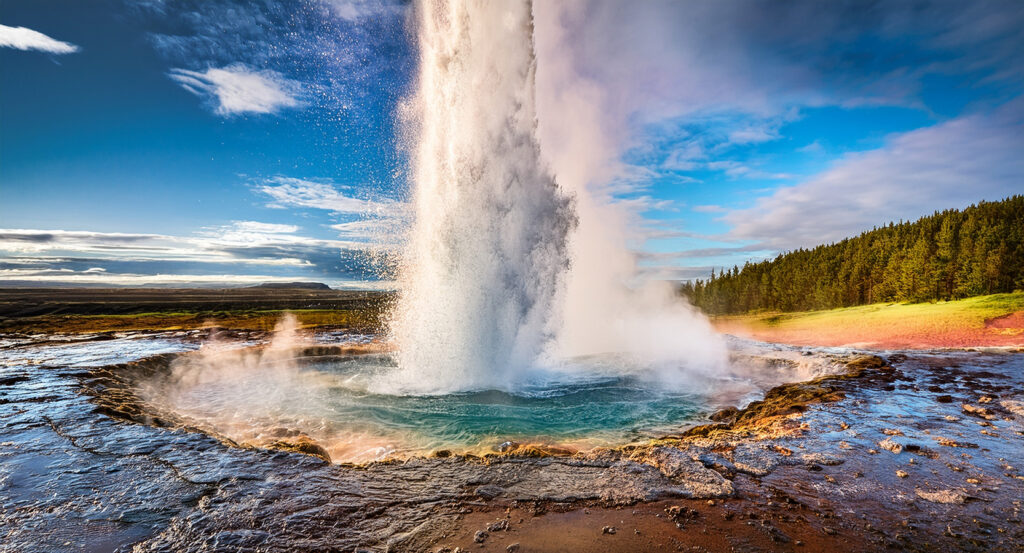
Steam rises from fissures like ghostly ribbons, the scent of sulfur mingling with cold mountain air, and the ground trembles with the rhythm of the planet itself. This is the original “Geysir”, the very phenomenon that gave its name to every geyser on Earth. Located in the Haukadalur Valley, it's a realm where fire and water meet in an ancient truce. Here, Strokkur, Geysir's fiery successor, erupts every five to ten minutes, launching a boiling column of water up to 30 meters into the sky. Crowds gather in awe, the sound like a deep exhale from the core of the world. Around it, mud pots bubble, fumaroles hiss, and the ground glows in mineral hues of ochre, turquoise, and silver. It's a landscape that feels alive, not metaphorically, but literally, as if the Earth itself is whispering its secrets through heat and steam.
What you didn’t know about Geysir.
The valley's geothermal activity has shaped both Iceland's identity and its language.
The Great Geysir, first recorded in the 13th century, is the reason we even have the word “geyser”, derived from the Old Norse geysa, meaning “to gush.” At its peak in the 18th century, Geysir erupted columns over 70 meters high, making it one of the most powerful natural fountains in the world. Today, Geysir itself lies mostly dormant, its vent sealed by silica and shifting geothermal pressure, but its spirit lives on in Strokkur, the “Churn.” Strokkur's eruptions are fueled by groundwater heated by magma just below the surface, turning into steam and pressure until it bursts through the earth in a flash of power. Beneath the valley, water channels snake through volcanic rock, circulating heat that's been building for millennia. Each vent and hot spring is chemically unique, some rich in sulfur, others laced with iron or copper that stain the soil in painterly swirls. Icelanders have long respected this valley as a sacred zone, both feared and revered, where the Earth's anger and beauty are inseparable. Local folklore speaks of trolls who once bathed in these pools, and of Geysir itself as a living being, a sleeping giant that wakes when the ground quakes.
How to fold Geysir into your trip.
Visiting Geysir is an exercise in both timing and presence.
Arrive early or late in the day, when the light turns the steam golden and the crowds thin. The main path loops safely around Strokkur, offering a front-row view of its eruptions, wait patiently, as the intervals vary, and you'll soon see the surface dome and quiver before it explodes skyward. The key is to feel it, not just watch it: the heat on your skin, the scent of minerals in the air, the split second of silence before the blast. Continue along the trail to lesser-known pools like Litli-Strokkur and Blesi, whose azure waters are deceptively serene, concealing near-boiling depths. Respect the boundaries, the ground here can scald in an instant. After exploring, stop at the nearby Geysir Center for insights into the valley's thermal systems and a warm Icelandic meal before continuing to Gullfoss, just 10 minutes away. The Geysir is more than a natural wonder, it's a dialogue with the planet's living core, a reminder that the ground beneath us is never still, only mercifully calm between breaths.
Hear it from the Foresyte community.
Just enough life around you not to be overwhelming. Right pace.
Where your story begins.
Start your planning journey with Foresyte Travel.
Experience immersive stories crafted for luxury travelers.