Why you should experience Amansara in Siem Reap, Cambodia.
Amansara is where time loosens its grip, where the world narrows to soft light on white walls, the slow rustle of frangipani leaves, and the quiet hum of history echoing through a former royal retreat turned sanctuary of pure, distilled calm.
Set just moments from the gates of Angkor but tucked into its own private cocoon of minimalist elegance, Amansara occupies the former guesthouse of King Sihanouk, a mid-century masterpiece transformed into an Aman estate of serene courtyards, reflective pools, and hushed, monastic beauty. The property is a study in restraint: clean architectural lines, soft neutrals, curved walls, flawless symmetry, mirrored water, and lush greenery arranged with almost spiritual intention. Nothing shouts. Everything whispers. Each suite feels like a private world, spacious, pared-back, almost meditative in its simplicity, with high ceilings, warm woods, stone floors, sunken baths, floor-to-ceiling glass, and private outdoor spaces cocooned by tropical foliage. Some suites come with private plunge pools that glow in candlelight at night, turning your villa into a silent pavilion of water and air. Bathrooms are sanctuaries, deep soaking tubs, rainfall showers, airy spaces where warm light filters through minimal lines and handcrafted materials. The main swimming pool is long, elegant, and framed by immaculate lawns and palms, a cinematic stretch of still water that feels like a physical exhale the moment you step into its orbit. The restaurant sits in a circular, airy pavilion that pays homage to the property's royal origins, a space where breakfasts unfold as quiet rituals of tropical fruit, warm pastries, Khmer dishes layered with lemongrass and herbs, and coffee that tastes richer in the slow morning light. Dinner becomes a soft, candlelit experience of refined Cambodian flavors, French influence, and the kind of understated finesse that Aman quietly perfects. Service at Amansara is almost telepathic, deeply personal yet never intrusive, warm but gracefully invisible, shaped by an intuitive awareness of what guests need before they articulate it. Experiences here are curated with the same intentionality: sunrise temple tours by remorque or vintage Land Rover, private breakfasts in jungle clearings, monk blessings, village walks, meditation, and exclusive access to lesser-visited parts of the Angkor complex. Amansara is not simply luxury, it is atmosphere, memory, ritual, and stillness woven together into a living experience of calm. It is intimate, design-pure, spiritually attuned, and ideal for travelers who want to experience Angkor not just as a destination, but as a presence.
What you did not know about Amansara.
Amansara rests on land that has held royal energy, sacred purpose, and architectural significance for generations, layers of history that shape the deep, almost otherworldly quiet that permeates the estate.
The property was originally built in the 1960s as a royal guesthouse for visiting dignitaries under King Norodom Sihanouk. Its design was a bold architectural statement for Cambodia, a masterpiece of New Khmer modernism blending clean geometry with tropical sensibility. The curved lines, reflecting pools, long corridors, and open-air transitions were meant to symbolize elegance and openness during a time of cultural pride and optimism. When Aman restored the compound, they preserved not only the architectural bones but the monarchy's philosophy of hospitality, a blend of warmth, reverence, and privacy that still defines the experience. Amansara's placement just outside the French Quarter was intentional: close enough for royal ceremony, yet private enough to host dignitaries from around the world. Many original features remain, the circular dining pavilion, the sweeping lawns, the structural symmetry engineered to catch wind and create natural cooling long before modern AC. The estate sits along a historic spiritual path used by monks traveling between Angkor temples and town pagodas. This is why, even today, early morning chanting can occasionally drift softly across the property, a barely perceptible thread of sound connecting guests to centuries of ritual movement. The mature trees surrounding the compound, tamarind, frangipani, heliconia, and old palms, are relics of the original royal garden. Their placement follows traditional Khmer cosmology, with certain species aligned to cardinal directions, protective beliefs, and symbolic meanings tied to longevity, wisdom, and spiritual purity. The quietness that guests describe is partly due to the estate's acoustics. The curved walls and water features were designed to soften sound, creating pockets of near-total silence where even a breeze feels amplified. Many of the handcrafted objects inside the suites, ceramics, silks, lacquer pieces, come from Cambodian artisans preserving pre-war techniques that survived against all odds. These craftspeople work in shadows of history, weaving resilience directly into the objects that decorate Amansara's minimalist world. Even the vintage vehicles used for temple tours, the black Mercedes and cream-colored Land Rovers, once belonged to Cambodia's royal household, restored and maintained as moving artifacts of the era. Amansara is not merely built on history, it is history, breathing quietly beneath every understated gesture of its design.
How to fold Amansara into your trip.
Amansara becomes the meditative, minimalist, spiritually tuned center of your Angkor journey, a place where mornings bloom in temple light, afternoons drift into warm stillness, and evenings settle into a soft, reflective calm beneath the palms.
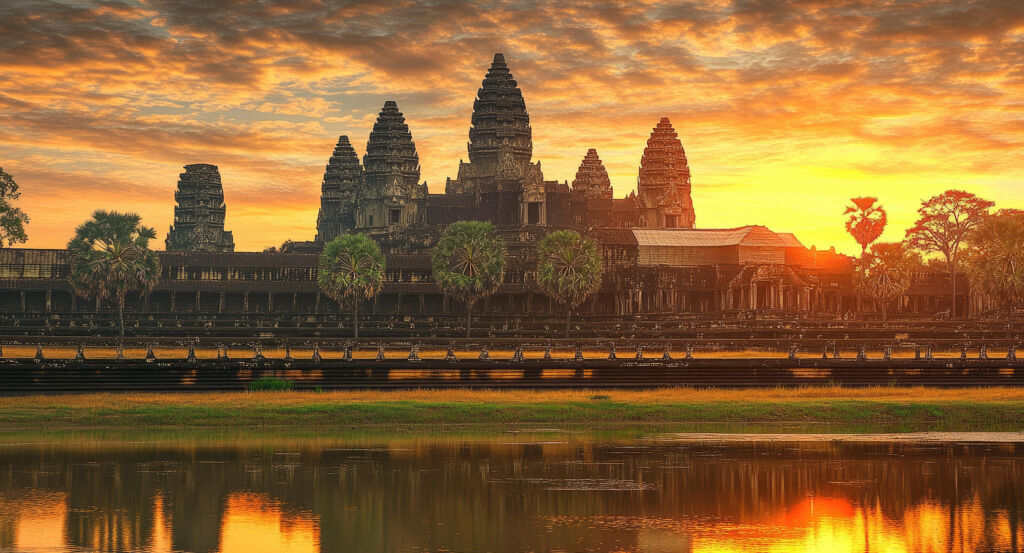
Start the morning before sunrise with a private remorque or vintage Land Rover, guided by an expert in Khmer history. Let the dawn break over Angkor Wat or Ta Prohm while the world is still blue-grey and the temples whisper their ancient breath. Return to Amansara for a slow breakfast, tropical fruit, Khmer porridge, homemade yogurt, fresh bread, served in the circular pavilion awash in morning light. Spend late morning by the pool, floating in cool water as birds move through the garden's canopy and warm breezes wrap the estate in gentle hush. If you crave deeper immersion, join a private tour of lesser-visited temples, Beng Mealea's overgrown labyrinths, Koh Ker's pyramid, or the serene ruins far from crowds, guided by someone who knows both history and silence. In the afternoon, retreat to your suite for a nap, a long bath in a sunken tub, or quiet time on your private terrace. Later, experience a monk blessing or a meditation session arranged through the hotel, moments that connect you not just to place, but to the deeper spiritual pulse running through Angkor. As golden hour arrives, wander the gardens or sit by the pool as the estate glows in soft, honeyed light. Evening can unfold in town, but the purest experience is often dinner at Amansara, fresh herbs, fragrant broths, French-Khmer dishes, candlelight, and the soft hum of night settling around you. End your night beneath the palms, reading on your terrace or floating in the quiet of your private pool. Fall asleep to subtle garden sounds and the deep stillness that defines the property. Amansara becomes not just a hotel, but the contemplative, refined, history-infused soul of your entire journey through Angkor.
Where your story begins.
Foresyte Travel reveals places that feel extraordinary long before you arrive.
Experience premium editorial crafted for luxury travelers.