
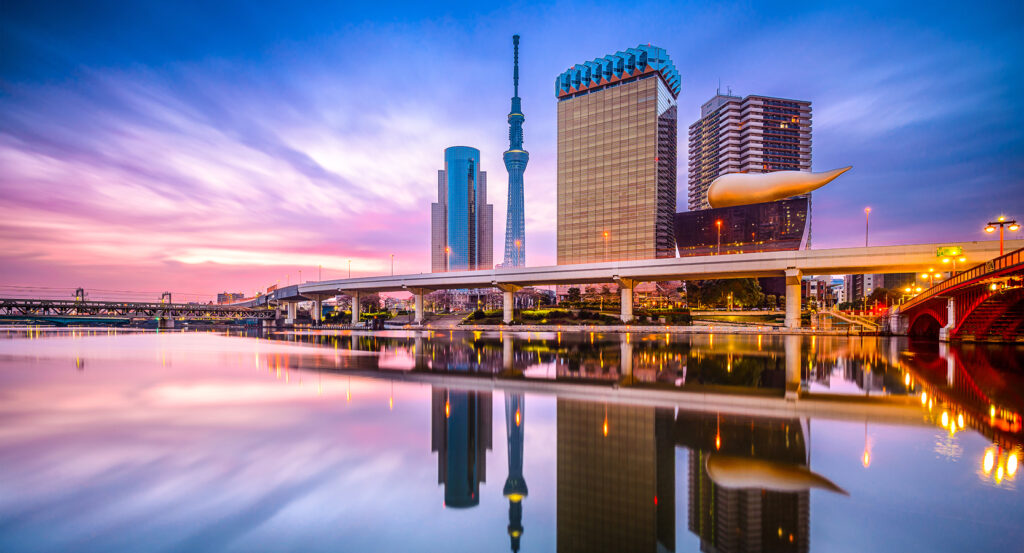
Why Sumida River Walk matters.
Sumida River Walk is a distinctive pedestrian crossing where Mukojima's historic riverside character meets a 1931 railway bridge, close-range train movement and the modern walking axis linking Asakusa with Tokyo Skytree.
Set across the Sumida River near Azumabashi and just steps from Sumida Park, the 160-meter walkway runs directly beside the Tobu Skytree Line tracks as they cross between Taito and Sumida, placing pedestrians unusually close to an operating railway above one of Tokyo's defining waterways. Its narrow 2.5-meter deck sits on the downstream side of the older steel truss, so the crossing unfolds between the open river on one side and the riveted geometry, rails and passing trains on the other. Sections of glass flooring interrupt the walking surface with downward views toward boats moving beneath the bridge, adding a vertical relationship with the river that conventional crossings along this stretch do not provide. Looking east brings Tokyo Skytree progressively into alignment with the railway corridor, and the bridge's Skytree White finish strengthens that visual connection before the route reaches Sumida Park and the low-rise development beneath the elevated tracks beyond it. The result is a short crossing with exceptional spatial intensity, compressing river traffic, railway engineering, moving trains, open sky and Tokyo Skytree into a pedestrian route that makes the transition between Asakusa and Mukojima an experience in its own right.
What defines Sumida River Walk.
Sumida River Walk is best known for adding a pedestrian route directly to Tobu Railway's historic Sumida River Bridge, transforming railway infrastructure completed in 1931 into the central link of a new walking connection between Asakusa and Tokyo Skytree Town. The older bridge opened on May 25, 1931 as Tobu extended its railway into Asakusa, carrying two tracks across a 166-meter steel structure between Asakusa and the former Narihirabashi station. Its engineering took the form of a through-type cantilever Warren truss divided into spans of 51.054, 64.008 and 51.054 meters. Yokogawa Bridge Works manufactured the steelwork in 1929, and bridge engineer Yutaka Tanaka guided the design of a structure distinguished by its uncommon intermediate-height truss configuration. Nearly nine decades later, Tobu Railway made that existing bridge the foundation of a wider project intended to establish a direct pedestrian axis between two major centers on opposite sides of the river. The company announced the Sumida River Walk name in November 2019, explaining it as an invitation to circulate through the waterfront connecting Asakusa and Tokyo Skytree Town. Construction attached the new path to the southern side of the railway structure, creating a route from Hanakawado in Taito to Mukojima in Sumida. The bridge was recolored around the Skytree White used by Tokyo Skytree, visually connecting infrastructure from two radically different periods of Tobu Railway's history. Opening had been planned for spring 2020 before the schedule changed amid the first months of the COVID-19 pandemic. Sumida River Walk finally opened at 7 a.m. on June 18, 2020, on the same day that the western section of Tokyo Mizumachi began operating beneath the railway on the Sumida side. The intervention turned a railway crossing built for Tobu's arrival in Asakusa into a public pedestrian connection serving the twenty-first-century relationship between Asakusa, the river and Tokyo Skytree Town.
Kajima Corporation developed the new pedestrian structure around the engineering constraint of attaching substantial public infrastructure to a railway bridge already approaching ninety years of service. Steel members project outward from the existing truss to support the walkway, transferring its loads into a structure never originally intended to carry a public promenade. Weight reduction governed the new construction, leading the engineering team to use aluminum components for the deck and railings. Project credits joined Tobu Railway, United Design, Kajima Corporation, Higashi-Nihon Consultants and JR Souken Engineering on the pedestrian crossing, combining railway ownership, architectural coordination and bridge engineering within the same intervention. The work formed one component of a larger waterside project extending eastward along the Kitajukken River, where Tokyo Mizumachi occupied spaces beneath the Tobu elevated railway and new waterfront terraces accompanied improvements to the river edge. Sumida Park underwent related renewal beside that route, creating a continuous sequence between the bridge landing, park and elevated railway. Tobu framed the combined work as an effort to integrate waterfront, railway viaduct, road and park spaces through public-private coordination. The attached bridge functions as the hinge in a larger piece of urban infrastructure, converting the railway from a line that carried people between Asakusa and Oshiage into the physical armature for walking through the riverfront itself.
How Sumida River Walk fits.
Sumida River Walk works as the anchor for a walking route through three nearby sites that carry Mukojima from an ancient shrine tradition through Edo poetry and merchant patronage into the cultural landscape formed along the eastern bank of the Sumida River.
Begin at Ushijima-jinja Shrine, whose foundation is associated with Jikaku Daishi during the Jogan era of 859 to 877 and whose long history established it as the principal guardian shrine of Honjo. The shrine once stood farther north before reconstruction of Sumida Park prompted its relocation in 1932, and its precinct preserves the unusual three-part torii, ox guardian figures and Nadeushi, the recumbent ox touched in a long-standing practice associated with healing corresponding parts of the body. Katsushika Hokusai also produced Susanoo no Mikoto Conquering Gods of Pestilence for the shrine, connecting its religious history with the artist born and raised elsewhere in Sumida. Continue to Mimeguri-jinja Shrine, whose name is linked to a medieval account in which a white fox circled a newly uncovered sacred image three times. The precinct acquired another celebrated association in 1693 when poet Takarai Kikaku composed a rain-prayer haiku during an Edo drought; its later relationship with the Mitsui family produced a distinctive collection of objects including a Mitsukoshi lion and a three-pillar torii. Conclude at Mokuboji Temple, founded by the Tendai priest Chuen in 976 and long associated with the Umewaka legend, whose story entered noh, joruri and nagauta. Abolished during the early Meiji separation of Buddhism and Shinto, the former Umewakadera became Umewaka Shrine before priest Koen secured its restoration as a Buddhist temple in 1888; the surviving Umewaka mound and annual April memorial preserve a religious and performing-arts tradition stretching across a millennium of Mukojima history. The progression moves from Ushijima-jinja Shrine's ancient guardian tradition through Mimeguri-jinja Shrine's fusion of poetry, legend and Mitsui patronage into Mokuboji Temple's millennium-old Umewaka tradition, extending a crossing of Sumida River Walk into the deeper cultural history of Mukojima.
Where your story begins.
Foresyte Travel reveals places that feel extraordinary long before you arrive.
Enjoy editorial crafted for luxury travelers.
Foresyte may earn a commission when you book.

















































































































