Why you should experience Bajra Sandhi Monument in Denpasar, Indonesia.
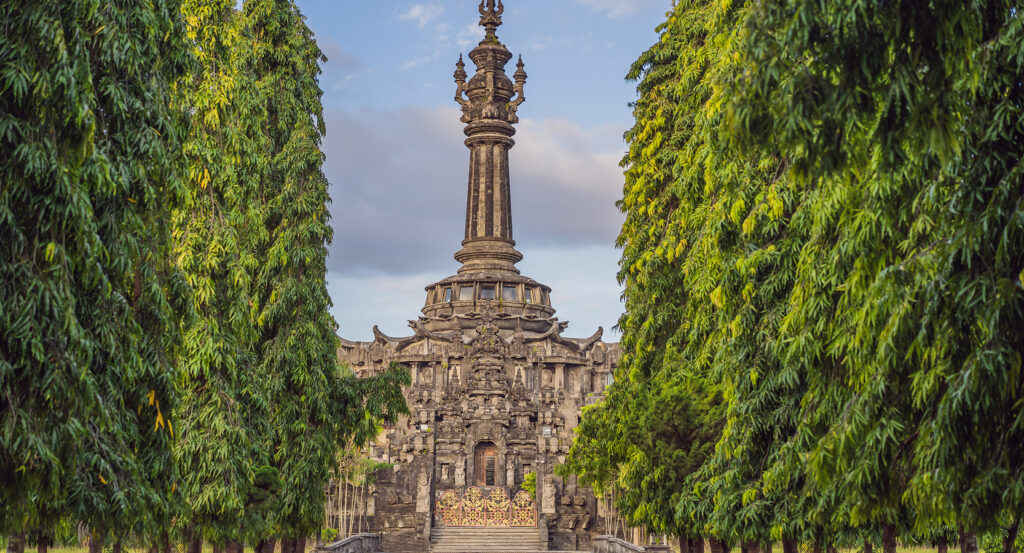
The Main Monument at Bajra Sandhi in Denpasar is the heart of Bali's story, a structure that feels both sacred and monumental, where history, devotion, and art converge into one unbroken prayer.
Standing in the center of Renon Square, its towering spire commands reverence, echoing the form of a Hindu priest's bell (“bajra”), a symbol of balance between the spiritual and the earthly. Its intricate carvings and tiered roofs glimmer under the tropical sun, each detail breathing with the island's soul. The monument's stonework, crafted from dark volcanic rock, exudes a quiet strength, its surface etched with mythological motifs that seem to whisper ancient truths. The surrounding pools reflect its silhouette like a mirror of the heavens, while pathways lined with frangipani trees invite reflection and stillness. Here, the hum of Denpasar fades into the sound of birds and the rustle of palm leaves, transforming a civic landmark into a sacred pause. It's a place that doesn't demand awe, it earns it, slowly, through silence and gravity.
What you should know about Bajra Sandhi Monument.
The monument's architecture is a tapestry of symbolism, each number, shape, and direction infused with meaning drawn from Balinese cosmology.
It stands on three levels, representing the realms of the underworld, earth, and heaven, the cosmic structure known as Tri Loka. The central tower rises 45 meters high, its measurements deliberately chosen to align with Indonesia's independence date: 17 steps, 8 pillars, and 45 meters corresponding to 17-8-1945. The main hall inside, known as the Utamaning Utama Mandala, is surrounded by twenty-nine diorama chambers depicting the island's history, from the dawn of Balinese civilization and the Majapahit migration to colonial resistance and modern independence. The craftsmanship is remarkable: murals glow with natural pigments, and the scent of burning sandalwood lingers faintly in the air. The ceiling's lotus motif symbolizes purity emerging from struggle, a fitting metaphor for Bali itself. Few visitors realize the monument also conceals an earthquake-resistant foundation, a nod to the island's harmony between art and engineering. This fusion of faith, philosophy, and functionality makes the Main Monument not just a symbol, but a living embodiment of resilience.
How to fold Bajra Sandhi Monument into your trip.
Visiting the Main Monument at Bajra Sandhi is best experienced as both pilgrimage and discovery.
Arrive early, when the morning light strikes the stone with soft gold, and circle the monument's gardens before entering the central hall. Take time to trace the dioramas in order, each one unspools Bali's journey through conquest, spirituality, and rebirth. As you ascend the spiral staircase toward the observation deck, light filters through patterned windows, scattering like blessings across the floor. The view from above is panoramic, Renon Square spreads below, the city hums quietly beyond, and Mount Agung looms faintly on the horizon. Spend a few minutes here in stillness; it's where Bali feels most alive yet timeless. Afterward, wander the outer grounds where locals practice yoga or meditate under banyan trees. Pair the visit with a walk around Renon Park or a stop at a nearby café serving Balinese coffee, the perfect way to linger in reflection. The Main Monument at Bajra Sandhi in Denpasar is not merely a landmark, it's Bali's heart cast in stone, pulsing with the rhythm of faith, endurance, and eternal identity.
Where your story begins.
Start your planning journey with Foresyte Travel.
Experience immersive stories crafted for luxury travelers.