
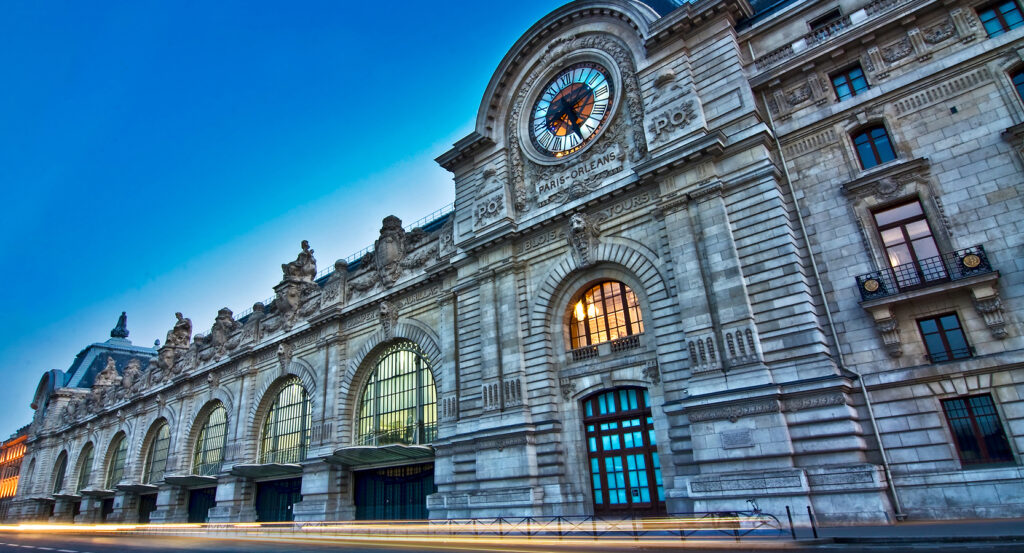
Why you should experience Beaux-Arts Clock Tower in Paris, France.
Beaux-Arts Clock Tower is an architectural centerpiece where Saint-Germain-des-Prés' artistic heritage, Beaux-Arts engineering, railway history, and panoramic city views define one of Musée d'Orsay's most recognizable spaces.
Set within Musée d'Orsay overlooking the Seine and just steps from Impressionist Gallery at Musée d'Orsay, the grand clock combines elegant gilded numerals, intricate ironwork, grand glass, and the soaring architecture of the former Gare d'Orsay into one of Paris' most photographed museum interiors. Framed by the station's vast barrel-vaulted nave, the restored timepiece preserves the building's original railway function while creating an extraordinary viewing point across the Jardin des Tuileries, the Louvre, and the Right Bank. The result is an experience defined by architectural preservation, engineering excellence, and timeless Parisian grandeur.
What you should know about Beaux-Arts Clock Tower.
Beaux-Arts Clock Tower is best known for preserving one of the grand station clocks installed for the Gare d'Orsay when the railway terminal opened on July 14, 1900 for the Exposition Universelle, serving as both a precision timekeeping instrument for rail passengers and a defining architectural feature of Victor Laloux's Beaux-Arts masterpiece. Constructed by the Compagnie du Chemin de fer de Paris à Orléans, the station employed advanced steel framing concealed beneath an ornate limestone façade that harmonized with the surrounding classical architecture while housing one of the world's most technologically advanced railway terminals at the dawn of the twentieth century. After long-distance rail service declined because increasingly larger trains exceeded the station's platform lengths, the building narrowly escaped demolition before French President Valéry Giscard d'Estaing approved its transformation into Musée d'Orsay in 1977. Italian architect Gae Aulenti led the celebrated conversion completed in 1986, preserving the grand clocks as integral elements of the museum's historic character while adapting the former station into one of the world's foremost museums devoted to art created between 1848 and 1914. Today the restored clock remains among the museum's defining architectural features, framing sweeping views toward the Louvre, Jardin des Tuileries, and the Seine while illustrating the successful preservation of one of France's greatest Beaux-Arts public buildings.
Monumental iron framing, finely detailed clock faces, expansive glazed openings, and the immense vaulted ceiling continually reveal the exceptional engineering and craftsmanship that distinguished early twentieth-century railway architecture. Carefully balanced restoration, adaptive reuse, and museum design preserve the station's original spatial drama while allowing visitors to appreciate both the mechanics of historic transportation infrastructure and the artistic collections housed beneath its soaring roof. Beaux-Arts Clock Tower continues demonstrating how visionary preservation transformed an endangered railway station into one of the world's great cultural institutions.
How to fold Beaux-Arts Clock Tower into your trip.
Beaux-Arts Clock Tower works as part of a curated exploration through Musée d'Orsay's celebrated art and architecture.
Begin at Impressionist Gallery at Musée d'Orsay, where masterpieces by Monet, Renoir, Van Gogh, and Degas establish the artistic legacy of the museum before continuing to Beaux-Arts Clock Tower. Continue through The Sculptures at Musée d'Orsay, where one of the world's finest collections of nineteenth-century sculpture fills the museum's grand central nave. Conclude at Marcel Proust Bed Chamber, whose preserved interior provides a fitting finale celebrating the artistic and intellectual culture of fin-de-siècle France. The progression moves naturally from revolutionary painting to architectural preservation before concluding through one of the museum's most intimate historical spaces, revealing why Beaux-Arts Clock Tower remains the defining architectural symbol of Musée d'Orsay.
Where your story begins.
Foresyte Travel reveals places that feel extraordinary long before you arrive.
Experience premium editorial crafted for luxury travelers.














































































































