Why Chinatown matters.
Chinatown is a mercantile enclave where Singapore's multicultural character meets the Chinese immigrant institutions, trading streets, sacred sites and conserved shophouses that grew from the colonial port established in the nineteenth century.
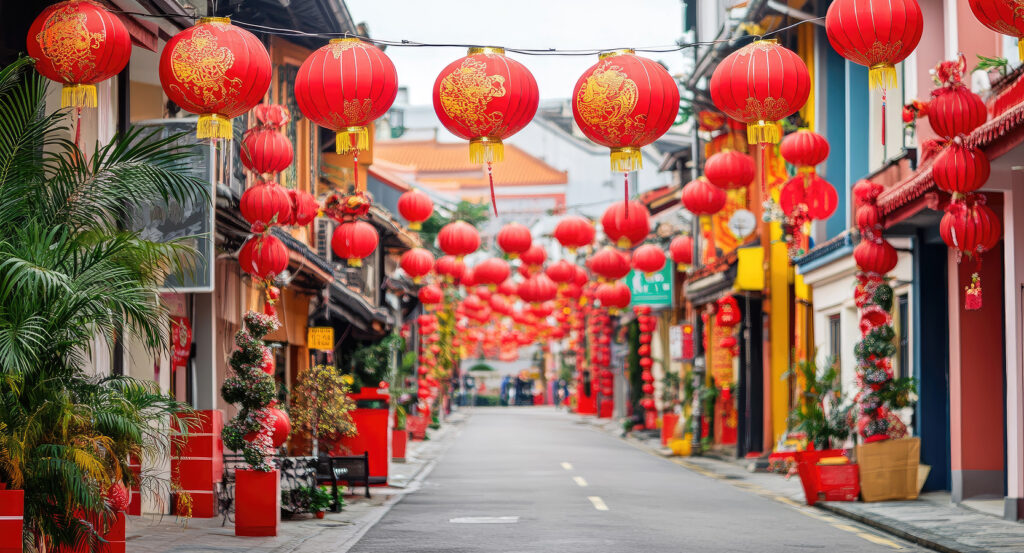
Positioned between Outram, Tanjong Pagar, and the Singapore River, the neighborhood occupies the historic street grid extending from New Bridge Road and Eu Tong Sen Street east toward South Bridge Road, with Upper Cross Street forming a principal northern approach and Keong Saik Road reaching into its southwestern quarter. Kreta Ayer forms the district's traditional cultural heart around Smith Street, Temple Street and Trengganu Street, where narrow blocks preserve the scale of the old commercial quarter. Telok Ayer runs along the eastern side, its religious buildings marking ground that once stood much closer to the shoreline before successive reclamation altered Singapore's waterfront. Bukit Pasoh rises southwest through a quieter shophouse district whose streets climb away from the denser market blocks below. The result is a compact historic quarter in which former shoreline, commercial grid and rising inland terrain remain legible within Central Singapore.
What defines Chinatown.
Chinatown is best known for developing from the Chinese settlement zone formalized in Singapore's 1822 town plan into a dense commercial and institutional center for successive immigrant communities. Lieutenant Philip Jackson translated Stamford Raffles' planning instructions into the Jackson Plan, allocating land southwest of the Singapore River to Chinese settlers at a time when Chinese migration was already becoming fundamental to the port's growth. Different dialect communities developed concentrations within the larger quarter: Hokkiens became closely associated with Telok Ayer and its commercial institutions, Teochews occupied areas nearer the river, and Cantonese communities became strongly associated with Kreta Ayer. The latter name derives from the Malay words for water cart, recalling the bullock carts once used to distribute water through the district. Thian Hock Keng emerged between 1839 and 1842 under Hokkien leadership as a temple dedicated principally to Mazu, the protector of seafarers, on ground then close to the sea where migrants could give thanks after surviving the voyage from China. The adjacent Chongwen Ge was founded in 1849 and became part of an educational complex connected with the Hokkien community, demonstrating how worship, schooling and migrant association developed beside one another. Clan and surname organizations multiplied through the nineteenth and early twentieth centuries, supplying social networks to newcomers separated from family structures in China. Streets simultaneously acquired specialized trades and markets, with Sago Street and Sago Lane associated with sago processing before the latter became notorious for death houses serving impoverished residents approaching the end of life. The Jinrikisha Station opened in 1903 at the junction of Neil and Tanjong Pagar roads, when hand-pulled rickshaws were integral to movement between the docks, commercial streets and residential quarters. Large-scale rehousing after independence emptied many overcrowded shophouses, and urban renewal threatened portions of the old quarter before conservation policy redirected its trajectory. The Urban Redevelopment Authority subsequently conserved extensive shophouse areas across Kreta Ayer, Telok Ayer, Bukit Pasoh and Tanjong Pagar, preserving a street fabric whose architecture still registers the commercial ascent, overcrowding and institutional complexity of immigrant Singapore.
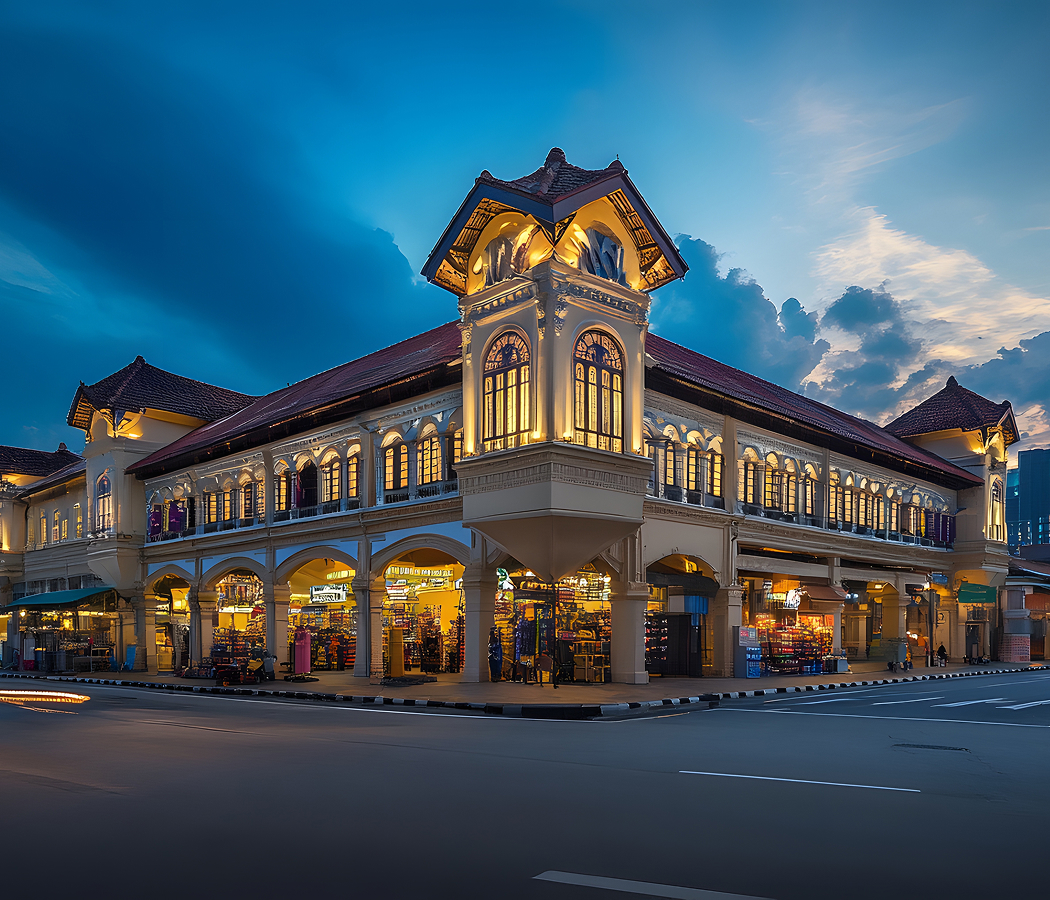
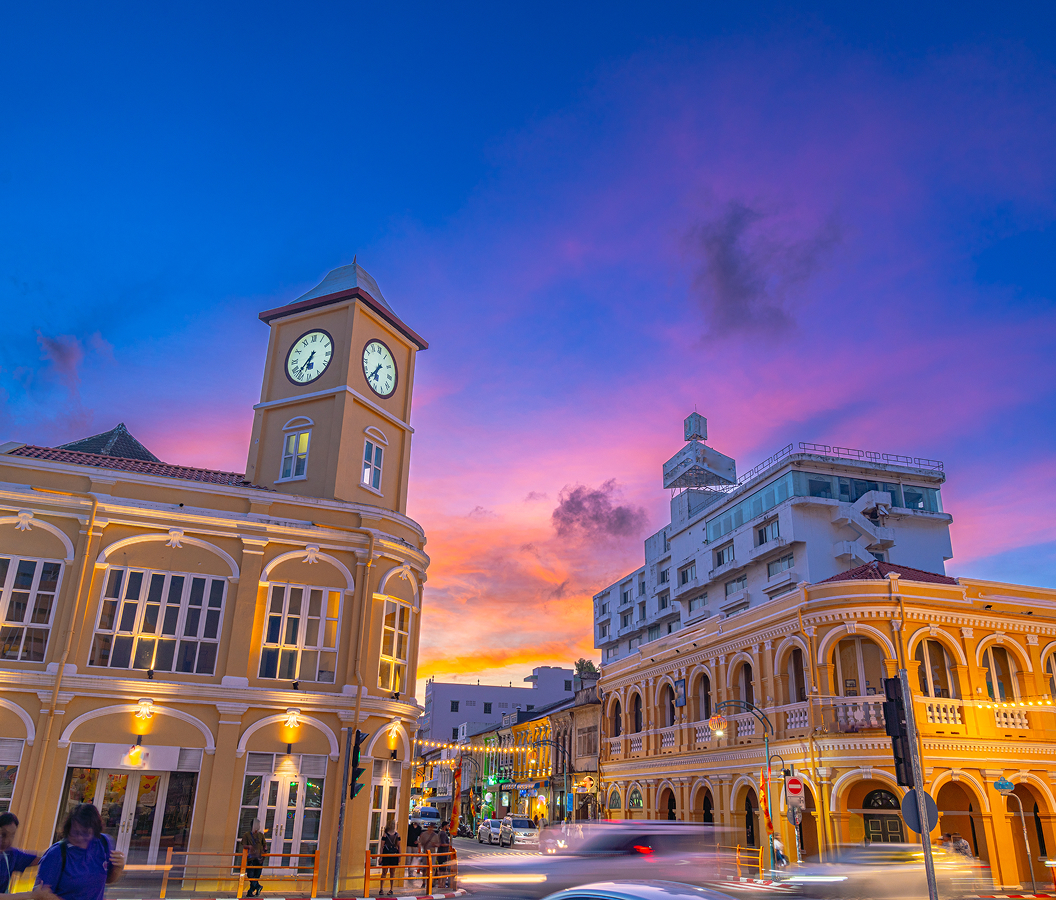
Nineteenth-century Chinatown never developed as an exclusively Chinese religious landscape, and its surviving sacred buildings expose the deeper multicultural structure of the colonial port. Sri Mariamman Temple began in 1827 under Naraina Pillai, an early Indian merchant who had arrived in Singapore with Raffles in 1819, and the temple subsequently developed into the oldest Hindu temple in the country. Its South Bridge Road compound became closely associated with Tamil Hindu life even as Chinese businesses and residences surrounded it. Masjid Jamae was constructed nearby between 1830 and 1835 by the Chulia Muslim community originating from southern India, giving the same street another major institution created by migrants drawn to Singapore's expanding trade. Those buildings stood within walking distance of Chinese temples and associations, making religious plurality a physical characteristic of the neighborhood from its formative decades. Later shophouses added another layer through architectural combinations of Chinese construction traditions, European classical ornament, Malay climatic adaptation and decorative tile work. Early examples remained narrow and restrained; later nineteenth-century and early twentieth-century facades accumulated pilasters, plasterwork, glazed tiles and elaborate window surrounds as merchants invested greater wealth in their premises. The five-foot way tied these buildings together at street level through covered pedestrian passages mandated under early colonial building regulations, creating continuous sheltered frontage beneath residences and businesses. Conservation retained entire rows rather than isolated monuments, allowing these differences in period, wealth and decorative ambition to remain visible across adjoining blocks. Chinatown's significance extends beyond the history of one migrant population: its streets preserve the close physical coexistence through which Chinese, Indian, Malay and European influences shaped the architecture and institutions of the colonial trading city.
How Chinatown fits.
Chinatown works as a historical anchor for an outing connecting three institutions that expose different dimensions of migration, worship and urban transformation within Singapore's old southern quarter.
Begin at Buddha Tooth Relic Temple and Museum, a Tang-inspired complex completed in the twenty-first century under Venerable Shi Fazhao. Its name refers to a relic regarded by the temple as the Buddha's tooth, housed within the Sacred Light Hall in a stupa incorporating hundreds of kilograms of gold donated by devotees. The building's architecture draws deliberately on northern Chinese Buddhist forms, placing a contemporary religious monument within streets dominated by much older shophouses and migrant institutions. Its museum collections and ceremonial spaces extend the district's Buddhist history through a structure conceived long after the original immigrant quarter had been transformed by conservation. Continue to Singapore City Gallery, where the physical history of Chinatown expands into the planning history of the entire city-state. Operated by the Urban Redevelopment Authority, the gallery occupies the Maxwell Road complex beside the conserved district and uses large-scale models to show Singapore's built form and successive phases of development. Its central city model makes the contrast between the compact nineteenth-century street network and the high-rise commercial core surrounding it immediately visible. The institution also illuminates the planning authority responsible for conservation areas that protected extensive portions of Chinatown's shophouse fabric, linking the neighborhood's survival to Singapore's broader management of scarce urban land. Conclude at NUS Baba House, a restored Peranakan residence constructed 1895 and associated with the family of Wee Bin, a nineteenth-century Chinese shipping merchant. The National University of Singapore acquired the house through a donation from Agnes Tan in memory of her father, Tun Tan Cheng Lock, and restoration preserved its carved timber screens, decorative tiles, furnishings and domestic organization. Unlike a reconstructed streetscape, the house retains the intimate scale of an affluent Straits Chinese household, revealing how trade wealth, Chinese ancestry and locally developed Peranakan culture converged inside domestic architecture. The progression moves from a contemporary Chinese Buddhist monument through an institution explaining Singapore's sweeping physical reconstruction and culminates inside a nineteenth-century Peranakan home where migration, commerce and domestic culture survive at residential scale.
Where your story begins.
Foresyte Travel reveals places that feel extraordinary long before you arrive.
Enjoy editorial crafted for luxury travelers.
Foresyte may earn a commission when you book.