Why Fort Zachary Taylor Historic State Park matters.
Fort Zachary Taylor Historic State Park is a coastal military and recreational preserve where Truman Annex's nineteenth-century naval heritage meets Civil War fortifications, tropical marine habitats, and the southern maritime defenses of Key West.
Occupying the southwestern tip of Key West beyond the historic streets of Truman Annex, the park extends across a waterfront landscape bordered by the Gulf of Mexico and the Straits of Florida, with Key West Harbor to the north and open Atlantic waters stretching toward the south. Its defining setting combines massive brick fortifications, shaded coastal woodland, and a coral-rock beach whose shoreline curves around the island's western approaches. The principal entrance leads through landscaped grounds toward the fort's imposing masonry walls, where arched passageways, elevated gun platforms, and broad interior courtyards reveal the physical scale of nineteenth-century coastal defense. Beyond the fort, walking and cycling routes pass beneath Australian pines and tropical vegetation before reaching the beach, where shallow turquoise water and exposed limestone create a striking contrast with the historic military architecture. The result is a distinctive waterfront park whose surviving fortifications and protected shoreline connect Key West's strategic military history with the natural character of the Florida Keys.
What defines Fort Zachary Taylor Historic State Park.
Fort Zachary Taylor Historic State Park is best known for preserving one of the most important surviving American coastal fortifications of the nineteenth century, a massive masonry stronghold whose construction and military service reveal Key West's strategic importance during the Civil War. The United States acquired Florida from Spain in 1821, gaining control of a peninsula whose southern islands commanded the maritime approaches between the Atlantic Ocean and the Gulf of Mexico. The federal government recognized Key West's defensive value during the 1820s, establishing a naval presence and developing plans for permanent fortifications that would protect the island's harbor and surrounding shipping channels. Construction of Fort Taylor began in June 1845 under the supervision of Captain George Dutton of the United States Army Corps of Engineers. The project occupied a shallow offshore site near the island's southwestern shoreline, requiring substantial engineering work to establish stable foundations beneath the enormous weight of the proposed masonry structure. Workers drove wooden pilings into the seabed and constructed a massive foundation of granite and limestone, creating the platform for an imposing three-tiered fortification. The design followed the principles of the Third System of American coastal defense, a national program developed after the War of 1812 to protect important harbors through permanent masonry forts. Its original configuration incorporated three seaward-facing bastions connected by substantial curtain walls, creating an irregular trapezoidal enclosure designed to support artillery fire across the surrounding channels. Construction materials arrived by ship from distant American ports, including granite from New England and brick produced in northern manufacturing centers. The project employed hundreds of laborers, including enslaved workers hired from local owners during the early construction period. Yellow fever epidemics, hurricanes, and the logistical difficulties of building on an isolated tropical island repeatedly interrupted progress, extending construction across more than two decades. The fort received its name in 1850 following the death of President Zachary Taylor, a military commander whose career included service during the Second Seminole War and the Mexican-American War. Its strategic importance became decisive in January 1861, when Florida seceded from the Union and federal forces faced the possibility of losing their southern coastal installations. Captain John Milton Brannan, commanding the United States troops stationed in Key West, moved his garrison into Fort Taylor on January 13, 1861, securing the unfinished fortification for the Union. The action prevented Confederate forces from taking control of one of the most valuable deepwater harbors along the southern coast.
Key West remained under federal authority throughout the Civil War, providing the Union Navy with a critical base for enforcing the blockade of Confederate shipping. The fort's heavy artillery protected the harbor, and its position near the Florida Straits supported naval operations against vessels attempting to transport goods through the Caribbean. Construction continued during the conflict, and the fort reached substantial completion in 1866, shortly after the war ended. Its original armament eventually included 140 guns, creating one of the most heavily fortified coastal installations in the United States. The development of rifled artillery during the Civil War exposed the vulnerability of traditional masonry forts, prompting significant changes in American coastal defense technology. Fort Taylor underwent a major modernization during the 1880s and 1890s, when engineers removed substantial portions of its upper structure and incorporated reinforced concrete batteries capable of supporting more powerful weapons. These alterations belonged to the Endicott Period, a nationwide effort to modernize coastal defenses through disappearing guns, improved ammunition storage, and more effective fire-control systems. Additional batteries appeared around the fort during the Spanish-American War of 1898, strengthening Key West's role as a staging area for American naval operations in Cuba. The fort continued serving military purposes through the First and Second World Wars, although changing naval technology gradually reduced the importance of its original masonry defenses. The United States Army eventually abandoned the installation, and the surrounding military property underwent substantial changes during the twentieth century. Dredging projects and land reclamation altered the shoreline, connecting the formerly isolated fort to the main island and creating additional coastal land around its historic walls. Preservation efforts accelerated during the 1960s as local advocates recognized the fort's architectural and historical significance. The property received designation as a National Historic Landmark in 1973, acknowledging its exceptional importance to American military history. The State of Florida acquired the site and opened Fort Zachary Taylor Historic State Park in 1976, establishing public protection for the fort and its surrounding coastal landscape. The park's creation preserved a major Civil War installation whose surviving architecture demonstrates the evolution of American coastal defense from heavy masonry fortifications to modern artillery systems.
How Fort Zachary Taylor Historic State Park fits.
Fort Zachary Taylor Historic State Park works as the military centerpiece for an exploration connecting Key West's maritime commerce, nineteenth-century federal administration, and the presidential history of the island's naval installations.
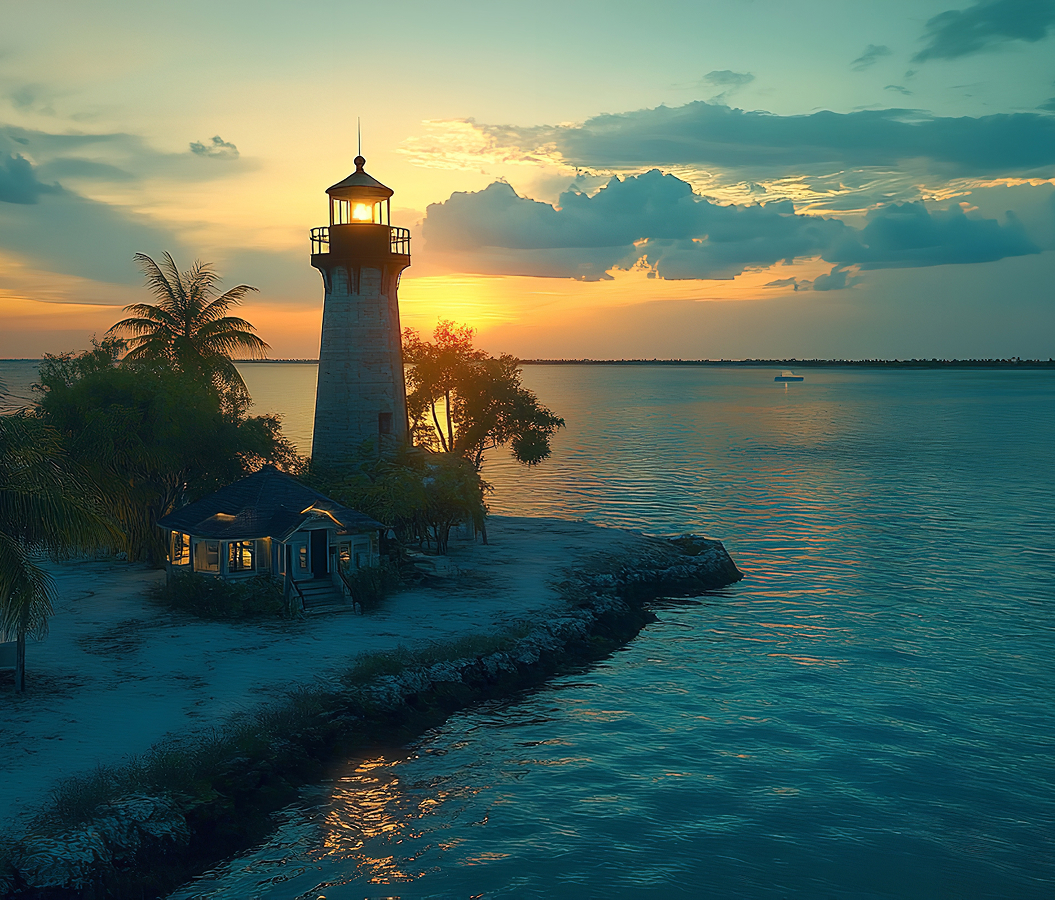
Begin at Key West Lighthouse and Keeper's Quarters Museum, the historic navigational station whose development accompanied the expansion of American maritime activity in the Florida Keys. The original lighthouse entered service in 1825, guiding vessels through the dangerous reefs and channels surrounding the island. The Great Havana Hurricane of 1846 destroyed the structure, prompting construction of a replacement farther inland that entered service in 1848. Barbara Mabrity became keeper following her husband's death in 1832 and continued her responsibilities through the rebuilding period, becoming one of the earliest prominent female lighthouse keepers in American maritime history. The tower received a third-order Fresnel view in 1858 and underwent a substantial height increase in 1894 to maintain visibility above the surrounding buildings and trees. The station ceased operating as an active lighthouse in 1969, and its preserved keeper's residence became part of a museum devoted to Key West's maritime heritage. Continue to Key West Museum of Art & History at the Custom House, the substantial federal building constructed during the expansion of the island's nineteenth-century commercial economy. The United States Treasury authorized a larger customs facility in 1885, responding to the demands of maritime trade, federal administration, and judicial proceedings. Architect William Kerr designed the Romanesque Revival building, whose construction began in 1889 and reached completion in 1891. Its red-brick exterior, substantial arches, and prominent corner tower established a commanding presence near the harbor. The building accommodated federal customs offices, the United States District Court, and the post office, concentrating several important government functions within a single waterfront institution. Its addition to the National Register of Historic Places in 1973 supported the preservation of an architectural monument associated with the island's commercial development. Conclude at Harry S. Truman Little White House, the former naval officers' quarters that became a working presidential retreat during the administration of Harry S. Truman. Constructed in 1890, the building accommodated senior naval personnel during the development of Key West's military installations. Truman first visited in November 1946 following a period of illness and returned for eleven working vacations through March 1952. His stays totaled 175 days, during which he conducted official business, met with advisers, and addressed consequential domestic and international questions. The property subsequently hosted other American presidents and diplomatic gatherings, including discussions between the leaders of Armenia and Azerbaijan in 2001. Its preserved interiors connect the island's military infrastructure with the responsibilities and personal routines of the American presidency. The progression moves from Key West Lighthouse and Keeper's Quarters Museum's maritime navigation history through the Custom House's federal commercial administration and culminates at Harry S. Truman Little White House, connecting the island's nineteenth-century development with its enduring significance to American military and political history.
Where your story begins.
Foresyte Travel reveals places that feel extraordinary long before you arrive.
Enjoy editorial crafted for luxury travelers.
Foresyte may earn a commission when you book.