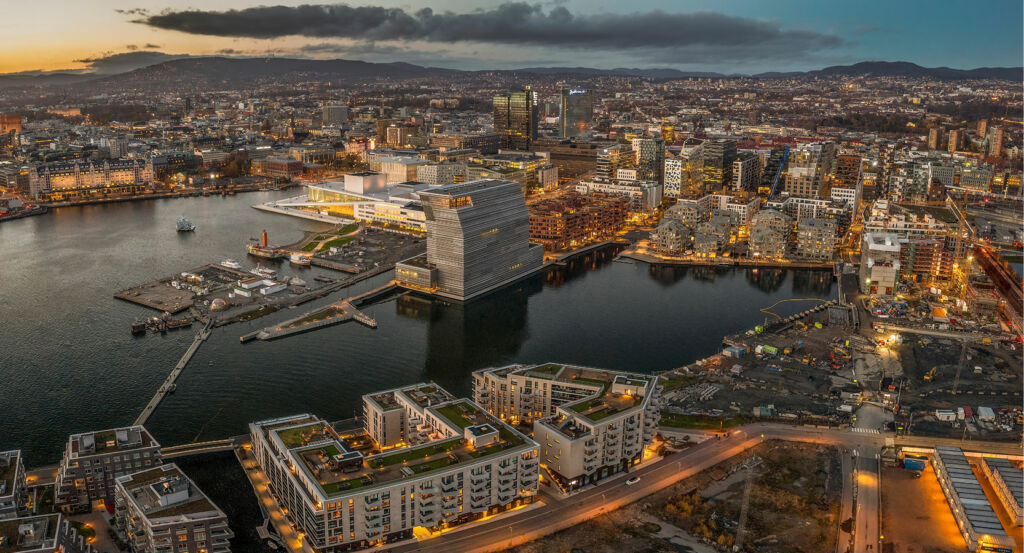
Why you should experience Grand Hotel Oslo in Oslo, Norway.
Grand Hotel Oslo is the city's most emblematic grand hotel, an institution where history, national identity, and refined European hospitality converge to create a stay that feels ceremonial, culturally charged, and unmistakably central to Norway's story.
Standing proudly on Karl Johans gate, Oslo's main boulevard, the Grand Hotel occupies a position that is both geographic and symbolic. From the moment you approach the façade, there is a sense that this is not merely a hotel but a landmark, one that has watched the city evolve, hosted its most consequential moments, and quietly shaped how Oslo presents itself to the world. Inside, the atmosphere balances classical grandeur with Nordic restraint. Ornate detailing, polished stone, elegant chandeliers, and carefully preserved architectural elements coexist with modern finishes and a softened color palette that keeps the experience composed. The public spaces feel stately without being stiff, animated without becoming theatrical. There is movement and presence throughout the lobby, guests arriving, locals passing through, conversations unfolding, yet the hotel maintains a dignified calm that anchors the energy. Guest rooms reflect this same philosophy of controlled grandeur. Spaces are generously sized by European city standards, with high ceilings, thoughtful layouts, and furnishings that favor longevity and comfort over trend-driven statements. Beds are substantial and deeply inviting, dressed in crisp linens that emphasize rest as a priority. Materials feel deliberate: solid woods, tactile fabrics, muted tones that reference Scandinavian landscapes. Many rooms offer views over Karl Johans gate, the Royal Palace, or Oslo's rooftops, placing the city visually at your doorstep while preserving a sense of privacy and quiet once the door closes. Bathrooms are refined and functional, with quality fixtures, strong lighting, and layouts designed to support unhurried routines. Throughout the hotel, there is an emphasis on balance, between heritage and modernity, formality and warmth, presence and retreat. Service at Grand Hotel Oslo is polished and professional, shaped by decades of experience hosting diplomats, artists, heads of state, and global travelers. Interactions are efficient yet courteous, attentive. Staff members operate with a confidence that reflects the hotel's stature, offering assistance that feels assured. Staying here feels like stepping into the gravitational center of Oslo, a place where the city's past, present, and cultural authority quietly intersect.
What you should know about Grand Hotel Oslo.
Grand Hotel Oslo is inseparable from Norway's national narrative, having served as a stage for some of the country's most defining cultural, political, and intellectual moments for over a century.
Opened in 1874, the hotel quickly established itself as Oslo's premier gathering place at a time when Norway was shaping its modern identity. Its most famous association is with the Nobel Peace Prize. Each year, the Grand Hotel hosts Nobel laureates, diplomats, and global leaders, with celebrations and events unfolding within its walls. This connection has imbued the hotel with a rare international gravitas, one rooted not in performance, but in substance. Beyond the Nobel legacy, the hotel has long been a preferred residence for artists, writers, musicians, and thinkers, both Norwegian and international. Figures such as Henrik Ibsen were known to frequent the hotel, using its spaces as extensions of their creative and intellectual lives. Over time, the Grand became less a temporary lodging and more a cultural salon, a place where ideas were exchanged, movements debated, and history quietly nudged forward. Architecturally, the building has undergone multiple restorations and expansions, each carefully executed to preserve its core character while adapting to contemporary standards. Rather than erasing its past, renovations have layered new functionality atop historical bones, allowing original details to coexist with modern systems. This approach mirrors Norwegian values of stewardship and continuity. The hotel's operational philosophy reflects the same mindset. Systems are designed for reliability and scale, capable of hosting high-profile events while maintaining consistency for everyday guests. Staff training emphasizes institutional knowledge, ensuring that service is informed by history. One lesser-known aspect of the Grand Hotel is how deeply it is woven into local life. Its restaurants, bars, and common spaces are not isolated tourist enclaves; they are frequented by Oslo residents who view the hotel as part of the city's social fabric. This integration prevents the hotel from feeling sealed off or overly ceremonial. Instead, it functions as a living institution, one that adapts while remaining anchored. The Grand's endurance is not accidental. It has resisted the pressure to reinvent itself for relevance, choosing instead to refine what it already represents. In doing so, it offers a form of luxury that is increasingly rare: one grounded in cultural legitimacy, historical continuity, and earned authority.
How to fold Grand Hotel Oslo into your trip.
Grand Hotel Oslo works as a central, ceremonial base, ideal for travelers who want to experience the city through its cultural core while maintaining a sense of occasion throughout their stay.
Begin your days with Oslo unfolding directly outside the hotel's doors. Karl Johans gate provides immediate access to the city's rhythm, whether that means a short walk to the Royal Palace, a visit to nearby museums, or a casual coffee stop as the street comes to life. Because of the hotel's location, exploration feels intuitive rather than planned; the city reveals itself step by step without the need for transportation or rigid itineraries. Midday returns to the Grand feel grounding. Whether you pause in your room, pass through the lobby, or sit quietly in one of the hotel's public spaces, there is a sense of continuity that keeps the experience cohesive. Afternoons can be shaped by curiosity rather than urgency, gallery visits, waterfront walks, or neighborhood exploration all remain easily accessible from this central point. The hotel's proximity to cultural institutions makes it particularly well-suited for travelers interested in Oslo's artistic and intellectual life. Attend a performance, explore exhibitions, or simply observe the city's civic pulse before returning to the hotel to reset. Evenings at the Grand carry a natural sense of ceremony. Dining options within and around the hotel allow plans to remain flexible, while the surrounding streets offer both refinement and informality depending on mood. Returning to the hotel after dinner feels like closing a circle, ending the day within a space that feels both significant and familiar. Over several nights, a rhythm emerges that mirrors the hotel's character: engagement balanced by reflection, movement anchored by presence. Grand Hotel Oslo does not attempt to script your experience or overwhelm it with narrative. Instead, it provides a stable, authoritative setting that allows the city to be experienced with depth and clarity.
Where your story begins.
Foresyte Travel reveals places that feel extraordinary long before you arrive.
Experience premium editorial crafted for luxury travelers.