
Why Nymphes de la Seine matters.
Nymphes de la Seine is a vivacious sculptural centerpiece where the Champs-Élysées quarter's ceremonial grandeur meets Belle Époque metalwork, river mythology and the Franco-Russian symbolism embedded across Pont Alexandre III.
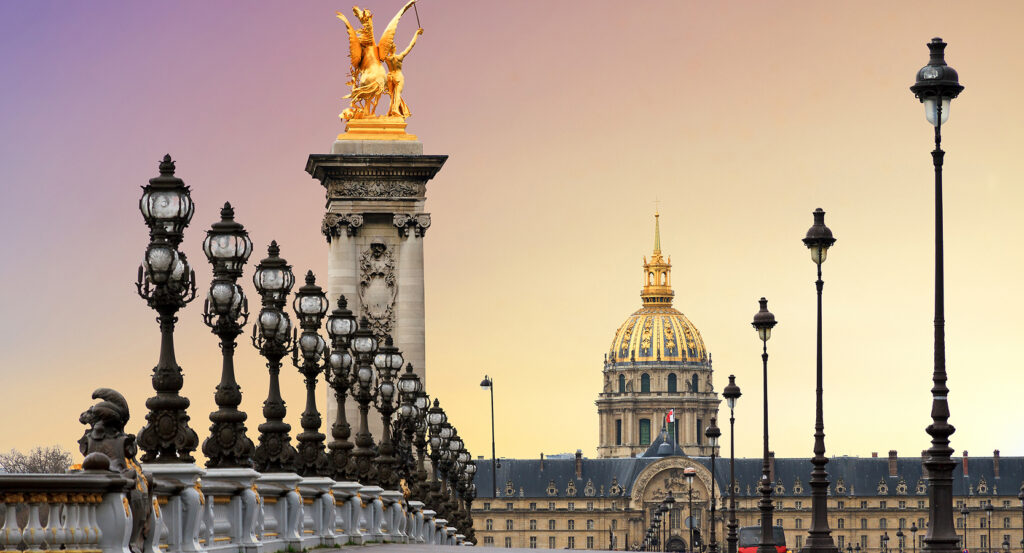
Set along Pont Alexandre III near Cours la Reine and just steps from Avenue Winston Churchill, the sculptural group occupies the downstream center of the bridge where the Seine, gilded pylons, elaborate bronze lighting and the grand axis between Hôtel des Invalides and the Grand Palais create one of western Central Paris's most concentrated architectural ensembles. Georges Récipon's figures spread across the center of the low metal arch, placing their hammered copper forms directly above the river they personify. The bridge's four tall pylons frame the composition at a distance as rows of ornate lamps and sculpted aquatic figures carry decorative detail toward both banks. Open water beneath the relief gives the nymphs a physical relationship with the Seine distinct from the stone architecture rising behind the quays. The result is a riverfront sculpture whose placement transforms an engineering joint into the symbolic center of the bridge's vast decorative program.
What defines Nymphes de la Seine.
Nymphes de la Seine is best known for forming Georges Récipon's downstream counterpart to Nymphes de la Néva, pairing the rivers of Paris and Saint Petersburg at the center of Pont Alexandre III's single metal arch. France authorized the bridge through legislation of June 13, 1896 as part of the works for the Exposition Universelle of 1900, and a decree of October 5 gave the crossing the name of Tsar Alexander III. Nicholas II, Empress Alexandra Feodorovna and French president Félix Faure laid its first stone on October 7, 1896, turning the project into a ceremonial statement of the Franco-Russian alliance. Engineers Jean Résal and Amédée Alby developed a single-span crossing whose extreme flatness preserved the view between the Champs-Élysées and Hôtel des Invalides and left the river channel unobstructed. Their structure used fifteen three-hinged cast-steel arches, with a principal span exceeding 107 meters and immense abutments absorbing the horizontal thrust generated by the shallow profile. Architects Joseph Cassien-Bernard and Gaston Cousin received responsibility for the architectural decoration after the engineering form and dimensions had been established. Récipon then transformed the mechanically difficult central crown into an allegorical pair, placing the Seine group with the arms of Paris on one face and the Néva group with Russian arms on the opposite face. The finished bridge opened with the Exposition Universelle on April 14, 1900, fixing the two river personifications at the structural and symbolic center of a crossing conceived simultaneously as infrastructure, international ceremony and urban performance.
Récipon developed Nymphes de la Seine in hammered copper, a technique that permitted large sculptural forms to cover the moving crown of the metal structure without imposing the mass of solid sculpture. Contemporary technical writing singled out decoration of the bridge key as a difficult problem: the three-hinged arch produced small vertical movements under expansion, requiring its central ornament to accommodate the behavior of the underlying structure. Récipon answered with a marine allegory spread horizontally across that point, joining human figures, aquatic forms and the arms of Paris into a composition integrated with the arch. The corresponding Nymphes de la Néva established a bilateral scheme in which each face of the bridge represented one of the two rivers associated with the allied capitals. Récipon's commission belonged to an exceptional concentration of sculptural work for the 1900 exposition, since he simultaneously produced the immense copper quadrigas crowning the nearby Grand Palais. His career had begun at the Salon in 1879, followed by membership in the Société des Artistes Français and the first second Grand Prix de Rome for sculpture in 1889. The bridge itself received protection as a Monument historique on April 29, 1975, bringing Récipon's central groups within the protected ensemble. A major restoration beginning in 1998 addressed corrosion across the ornamental metalwork after technical study by the Ville de Paris and the Laboratoire de Recherche des Monuments Historiques, preserving the hammered-copper sculpture at the point where Récipon had converted structural necessity into grand river imagery.
How Nymphes de la Seine fits.
Nymphes de la Seine works as the anchor for a daytime exploration across the grand territory adjoining the Seine using three nearby sites that move from an exposition palace converted into a municipal museum through Louis XIV's vast institution for military veterans into an eighteenth-century mansion personally secured as a museum by Auguste Rodin.
Begin at Petit Palais, designed by Charles Girault for the Exposition Universelle of 1900 as part of the new architectural composition established between the Champs-Élysées and the Seine. Girault organized the building around varied galleries and an internal garden, with a grand entrance grille leading into a rotunda illuminated by Champigneulle stained glass and a peristyle enriched with gilded metal ornament. The building passed to the Ville de Paris after the exposition and reopened as the municipal Palais des Beaux-Arts in 1902. That same year brought the Dutuit bequest, whose paintings, sculptures, decorative arts, prints and antiquities substantially enlarged the municipal holdings; subsequent gifts from Edward and Julia Tuck, Carpeaux, Courbet, Ambroise Vollard and Roger Cabal extended a collection spanning antiquity into the twentieth century. Continue across the Seine to Hôtel des Invalides, commissioned and financed by Louis XIV in 1670 to house and care for wounded, sick, disabled and elderly soldiers. Libéral Bruant directed construction from 1671 to 1675 around a vast quadrilateral plan centered on the Cour Royale, and the first veterans entered the institution in 1674. Jules Hardouin-Mansart replaced Bruant in 1676 for the religious complex, completing the soldiers' church in 1679 before developing the royal church crowned by the Dôme, inaugurated by Louis XIV in 1706. The complex later accumulated the Musée des Plans-Reliefs in 1777, Napoleon I's remains in 1840 and the Musée de l'Armée in 1905, extending the original veterans' institution into a major repository of French military history. Conclude at Musée Rodin, housed in the Hôtel Biron, the rocaille residence Jean Aubert developed for financier Abraham Peyrenc de Moras beginning in 1727. Louis-Antoine de Gontaut-Biron acquired the estate in 1753 and doubled its ornamental garden before the property passed through diplomatic, religious and educational uses during the following century. Jean Cocteau, Henri Matisse, Isadora Duncan and Clara Westhoff were among the artists occupying the property after 1905; Westhoff's husband, Rainer Maria Rilke, helped lead Rodin to the site, and the sculptor rented four ground-floor rooms in 1908 before occupying the entire mansion from 1911. Rodin's three donations to the French state were accepted by law in 1916 on the condition that the Hôtel Biron become his museum, which opened in 1919. The progression moves from Girault's exposition palace and its conversion into a municipal collection through Bruant and Hardouin-Mansart's royal institution for veterans into Aubert's eighteenth-century residence and Rodin's successful campaign to secure it for his artistic legacy, extending the riverfront setting through three distinct forms of Parisian cultural patronage.
Where your story begins.
Foresyte Travel reveals places that feel extraordinary long before you arrive.
Experience premium editorial crafted for luxury travelers.
Foresyte Travel may earn a commission when you book through the link on this page.














































































































