
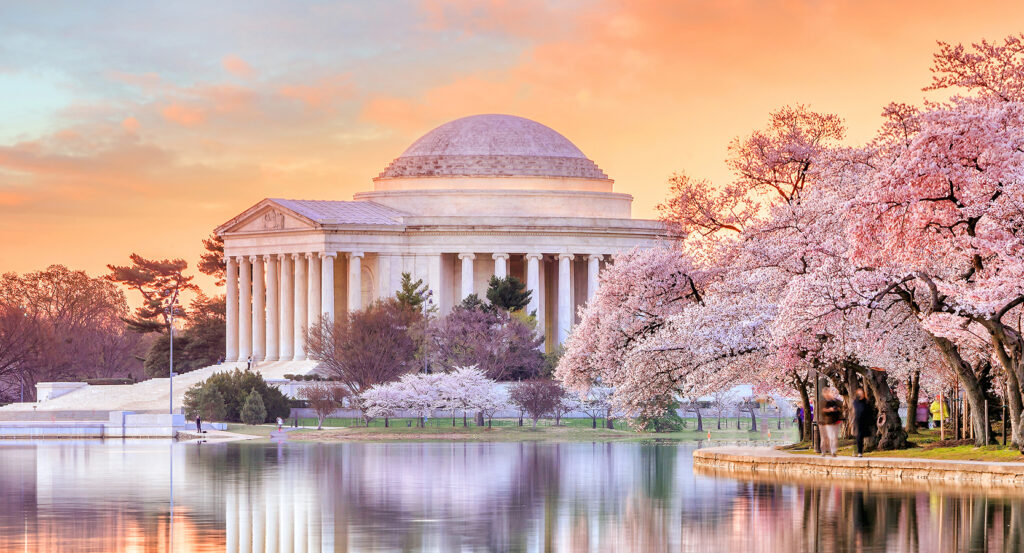
Why you should experience Thomas Jefferson Memorial in Washington, D.C.
Thomas Jefferson Memorial in Washington, D.C. stands as one of America's most graceful tributes to intellect, democracy, and the enduring power of ideas.
Rising along the Tidal Basin, framed by cherry blossoms that shimmer like silk in spring, this neoclassical masterpiece feels both grand and serene, a sanctuary of marble and meaning. Designed by architect John Russell Pope and completed in 1943, the memorial reflects Jefferson's admiration for the Pantheon in Rome, its circular colonnade and open dome evoking enlightenment ideals of balance, symmetry, and reason. Inside, a bronze statue of Jefferson gazes outward toward the city he helped envision, his figure cast in quiet contemplation beneath the oculus of open sky. The air inside carries a hushed reverence; footsteps echo softly against marble as visitors read the carved inscriptions of Jefferson's words, meditations on liberty, equality, and the pursuit of knowledge. Sunlight filters through the columns, changing with the hour, bathing the chamber in tones of gold, rose, and silver. It's a living canvas that mirrors the man it honors: philosopher, author of the Declaration of Independence, and architect of American thought. To stand within the memorial is to stand inside an idea, one that still challenges and inspires the nation he helped shape.
What you should know about Thomas Jefferson Memorial.
While its beauty is immediately apparent, Thomas Jefferson Memorial carries a layered story of controversy, symbolism, and vision.
Construction began in 1939, more than a century after Jefferson's death, and quickly ignited debate. Some critics opposed adding another grand structure to the National Mall, while others questioned the design's classical style as outdated. Yet President Franklin D. Roosevelt, a lifelong admirer of Jefferson, pushed forward, believing the founding father deserved a shrine as dignified as the man's intellect. The site itself was chosen with poetic precision: directly across the Tidal Basin from the White House, symbolizing Jefferson's presence as both inspiration and conscience for future leaders. The 19-foot bronze statue, sculpted by Rudulph Evans, originally depicted Jefferson in plaster due to wartime metal shortages; it wasn't until 1947 that the permanent bronze figure replaced it. Surrounding the statue are five passages from Jefferson's writings, carefully selected to reflect his complex vision of freedom, governance, and faith in human reason. Yet what few realize is that the memorial also captures contradictions: Jefferson, the champion of liberty, was also a slave owner, and his legacy continues to invite deep reflection about the American experiment itself. The memorial's subtle design encourages such contemplation, its open rotunda symbolizing transparency, its dome representing enlightenment, and its reflection in the Tidal Basin suggesting both clarity and distortion in how history remembers its heroes.
How to fold Thomas Jefferson Memorial into your trip.
Visiting Thomas Jefferson Memorial works as both a journey through space and time, a quiet discussion between past ideals and present aspirations.
Begin your visit in the early morning or at twilight, when the light softens across the Tidal Basin and crowds thin to a reverent hush. Walk the path that curves along the water, the dome gradually revealing itself through trees before the memorial opens in full view, serene, symmetrical, and perfectly mirrored in the basin below. Step inside the rotunda and take time to read each inscription carved into the marble walls, phrases from Jefferson's Notes on the State of Virginia and the Declaration of Independence that still feel startlingly alive. Notice how the sound shifts under the dome, the acoustics amplifying whispers into echoes, a fitting metaphor for the reach of Jefferson's words. For photographers, the experience is transcendent at dawn, when the first light illuminates the bronze statue in amber glow, and again at night, when the memorial gleams softly against the darkened water. Pair your visit with a stroll around the Tidal Basin to the nearby Franklin Delano Roosevelt Memorial, tracing the arc of American leadership across eras. During the Cherry Blossom Festival in spring, the surrounding trees explode into pink and white clouds, turning the site into one of the most breathtaking vistas in Washington. Whether you come for history, architecture, or quiet reflection, Thomas Jefferson Memorial rewards presence with perspective, a reminder that democracy, like light, must be tended daily. Here, marble meets meaning, and the spirit of Jefferson still speaks through silence.
Where your story begins.
Foresyte Travel reveals places that feel extraordinary long before you arrive.
Experience premium editorial crafted for luxury travelers.







































































































