Why Kuala Lumpur Railway Station matters.
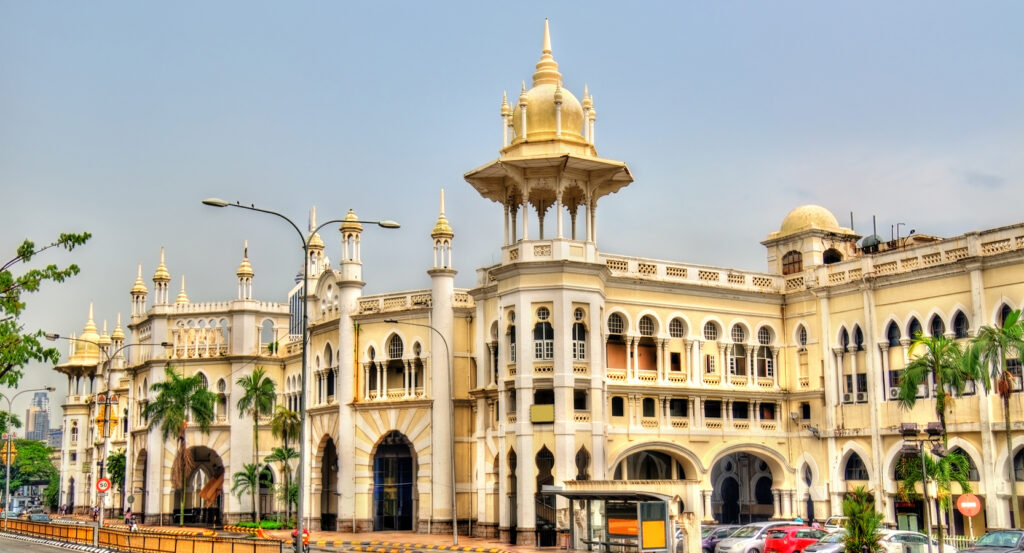
Kuala Lumpur Railway Station is a masterpiece of colonial-era design where Moorish arches, domed towers, and British precision meet in one of Asia's most evocative architectural fusions.
Completed in 1910 and designed by British architect Arthur Benison Hubback, the station was conceived as a symbol of Malaya's growing importance within the British Empire and its role as a crossroads of East and West. Built in the Indo-Saracenic style, a blend of Indian, Islamic, and European influences, it stands as one of the most elegant railway buildings in the world. White stucco façades gleam under the tropical sun, crowned with onion domes, horseshoe arches, and minarets that seem to dance against the skyline. The symmetry of the design is unique, every balcony, window, and spire aligned with mathematical grace. Inside, wrought-iron columns and vaulted roofs create an almost cathedral-like atmosphere, where light filters through latticed panels, casting patterned shadows across the tiled platforms. For much of the 20th century, this was Malaysia's main rail hub, linking travelers from Singapore to Bangkok and beyond. Today, while its operational role has shifted to the newer KL Sentral, the old station remains a living monument, not frozen in time, but alive with echoes of history, craftsmanship, and the soft rhythm of passing trains. To stand on its platform is to feel both the romance of a bygone age and the pulse of a city that continues to reinvent itself.
What defines Kuala Lumpur Railway Station.
Beneath its graceful façade lies a story of cultural convergence, colonial ambition, and enduring beauty that mirrors Malaysia's own evolution.
Arthur Benison Hubback, who also designed several other landmarks across Kuala Lumpur, including the Sultan Abdul Samad Building and Masjid Jamek, drew inspiration from the great Mughal monuments of India, reinterpreting their curves and domes for a tropical climate. The result was architecture that looked ancient yet modern, European yet distinctly Malayan. The station's construction used concrete and steel, cutting-edge materials at the time, but its ornate detailing came from local artisans who infused the building with Southeast Asian craftsmanship. Originally serving the Federated Malay States Railways, it was a key stop for luxury trains like the Eastern & Oriental Express, carrying dignitaries, merchants, and adventurers across the peninsula. During World War II, it survived bombings and occupation, its domes blackened by soot yet still standing as a symbol of endurance. Few realize that the station's roofline, a dramatic procession of domes and cupolas, was designed not only for visual splendor but also to ventilate the platforms naturally in the tropical heat. Over the years, several restorations have balanced preservation with adaptation, ensuring the building's beauty remains intact even as rail operations shifted to modern facilities nearby. Today, it serves as both a functioning commuter stop and a heritage site, its arched hallways occasionally hosting film shoots, photography exhibitions, and nostalgic travelers tracing the routes of an earlier era. At night, when the façade glows softly against the Kuala Lumpur skyline, the station feels almost ethereal, less a building, more a dream of a city that learned to marry its past and present with effortless grace.
How Kuala Lumpur Railway Station fits.
To truly experience Kuala Lumpur Railway Station, approach it not as a commuter, but as a traveler in time.
Start from the front entrance along Jalan Sultan Hishamuddin, where the sweeping façade rises like a vision from another world, domes, balconies, and finials layered in rhythm and shadow. Step beneath the archway and into the main hall, where high ceilings and iron beams create a cavernous sense of space. Walk the length of the platforms, feeling the air shift from humid warmth to cool shade as trains glide in and out, their echoes merging with the distant hum of the city. Pause to admire the details, the floral plasterwork, the carved columns, the repetition of arches that frame every view like a painting. Visit during late afternoon, when sunlight filters through the arches in golden slants, illuminating the Moorish motifs that adorn every surface. For a complete experience, pair your visit with the nearby Muzium Negara (National Museum) or Masjid Negara (National Mosque), both within walking distance, to trace the architectural discussion between Malaysia's colonial past and its independent identity. If you're an architecture lover, bring a camera, every corner of the station tells a story in light and symmetry. After the visit, cross over to the newer KL Sentral to see how Malaysia's modern transit system evolved from these roots, a reminder of how progress can coexist with preservation. And if time allows, return at night: under floodlights, the white domes shimmer like pearls, the arches casting deep, cinematic shadows across the plaza. Kuala Lumpur Railway Station isn't just a relic, it's a living monument to Malaysia's fusion of cultures, faiths, and eras. To stand beneath its domes is to feel the country's spirit, adaptive, resilient, and endlessly elegant. In a city defined by contrasts, this building remains the bridge, between past and present, East and West, motion and memory.
Where your story begins.
Foresyte Travel reveals places that feel extraordinary long before you arrive.
Enjoy editorial crafted for luxury travelers.
Foresyte may earn a commission when you book.