
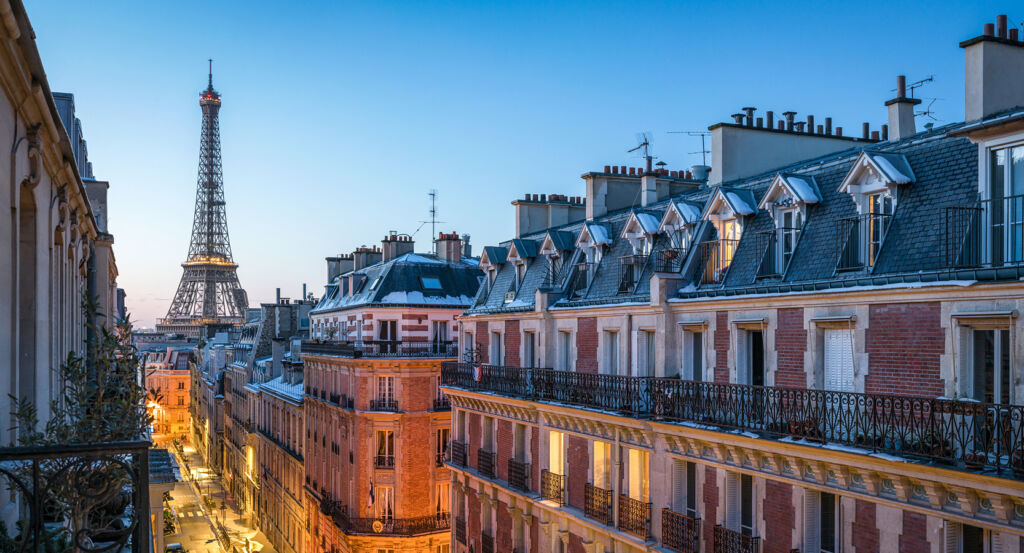
Why you should experience L'Edmond Hotel Parc Monceau in Paris, France.
L'Edmond Hotel Parc Monceau is a literary boutique hotel where Plaine-Monceau's cultured residential character, nineteenth-century artistic society, Edmond Rostand's theatrical legacy and contemporary apartment-style hospitality converge inside the playwright's former private mansion.
Set along Avenue de Villiers near Rue de Lévis and just steps from Parc Monceau, the four-star hotel occupies number 22, an address associated directly with Rostand and the artistic and financial circles received within his home. The nineteenth-century residence was comprehensively renovated in 2011 while retaining the generous ceiling heights of its first two floors, creating a contemporary interior around pale wood, stone, mosaics and restrained natural tones. The current property contains 25 suites equipped with kitchenettes, with accommodation extending through 34-square-meter terrace suites and 35-to-38-square-meter courtyard suites to sixth-floor rooftop suites opening onto 50-square-meter furnished terraces. The resulting house preserves the intimate proportions of Rostand's residence while giving the accommodation an unusually independent character through separate living areas, kitchen facilities and private outdoor space.
What you should know about L'Edmond Hotel Parc Monceau.
L'Edmond Hotel Parc Monceau is best known for occupying the former private mansion of playwright and poet Edmond Rostand at 22 Avenue de Villiers, where the author associated with Cyrano de Bergerac maintained a residence that received prominent figures from Parisian artistic and financial society. Paris's 17th Arrondissement records Rostand arriving in the capital from Marseille in 1884 at age 16 to complete his studies, while the Avenue de Villiers residence subsequently became part of the cultural world surrounding his rise as a dramatist and poet. The nineteenth-century mansion was comprehensively renovated in 2011 by private investors, preserving the original high ceilings across its first two floors while introducing a contemporary minimalist interior, and the property opened that year as a four-star hotel carrying Rostand's first name. The contemporary accommodation program now comprises 25 suites with discreet kitchenettes, separate living spaces in principal categories, stone-and-mosaic bathrooms and configurations measuring 34 to 38 square meters, while two sixth-floor rooftop suites add 50-square-meter furnished terraces with panoramic perspectives encompassing the Eiffel Tower, Arc de Triomphe and Sacré-Coeur. The literary residence consequently combines Rostand's documented connection with Avenue de Villiers, a surviving nineteenth-century mansion, the 2011 reconstruction and an apartment-style hospitality model within one of western Paris's historically creative residential districts.
Rosemonde Gérard deepens the literary history surrounding L'Edmond Hotel Parc Monceau through her marriage to Edmond Rostand in 1890, linking the Avenue de Villiers household with two writers rather than Rostand's theatrical career alone and placing the residence within the literary culture that accompanied his ascent in Paris. Paris dix-sept develops that connection through Rostand's relationship with the surrounding Arrondissement, recording the young Marseille-born writer's arrival in Paris in 1884 and the artistic and financial society later entertained at his Avenue de Villiers home. Jean-Sébastien Pouch added a later gastronomic chapter to the same address when he became chef of the hotel's former 1868 restaurant in 2012 after working with Michel del Burgo and Éric Fréchon at Le Bristol and subsequently leading the kitchen at Lapérouse, establishing a fine-dining program directly inside Rostand's former residence. Together, Edmond Rostand, Rosemonde Gérard, Paris dix-sept and Jean-Sébastien Pouch reveal an Avenue de Villiers address whose character has repeatedly centered on literature, artistic society and French hospitality, allowing the current 25-suite hotel to inherit a cultural history extending considerably beyond its 2011 reconstruction.
How to fold L'Edmond Hotel Parc Monceau into your trip.
L'Edmond Hotel Parc Monceau works as the anchor for an afternoon tracing Asian collecting, artists' houses and nineteenth-century private interiors through the cultural institutions surrounding Parc Monceau.
Begin at Musée Cernuschi, where republican banker Henri Cernuschi returned from an 1871-to-1873 journey through Japan and China with 5,000 works, commissioned William Bouwens van der Boijen to construct a neoclassical mansion on Avenue Vélasquez and later bequeathed both house and collection to the City of Paris before the museum opened on October 26, 1898. Continue to Musée national Jean-Jacques Henner, occupying the mansion painter Guillaume Dubufe purchased as his home and studio in 1878 before Marie Henner acquired it from his heirs in 1921, commissioned architect Marcel Legendre to convert the residence and opened the museum in 1924, with more than 2,200 works now preserved in the collection. Conclude at Musée Nissim de Camondo, where collector Moïse de Camondo commissioned René Sergent to build a residence between 1911 and 1914 inspired by the Petit Trianon for his collection of eighteenth-century French decorative arts, later dedicating the house to his son Nissim, killed in combat in 1917. The progression moves from Cernuschi's Asian collection through Dubufe and Henner's artistic residence into Camondo's eighteenth-century interiors, creating a concentrated study of the collectors, writers and private houses that shaped the cultural world surrounding L'Edmond Hotel Parc Monceau.
Where your story begins.
Foresyte Travel reveals places that feel extraordinary long before you arrive.
Experience premium editorial crafted for luxury travelers.














































































































