Why you should experience Thingvellir National Park in Iceland.
Thingvellir National Park is where Earth's architecture makes room for heaven's light.
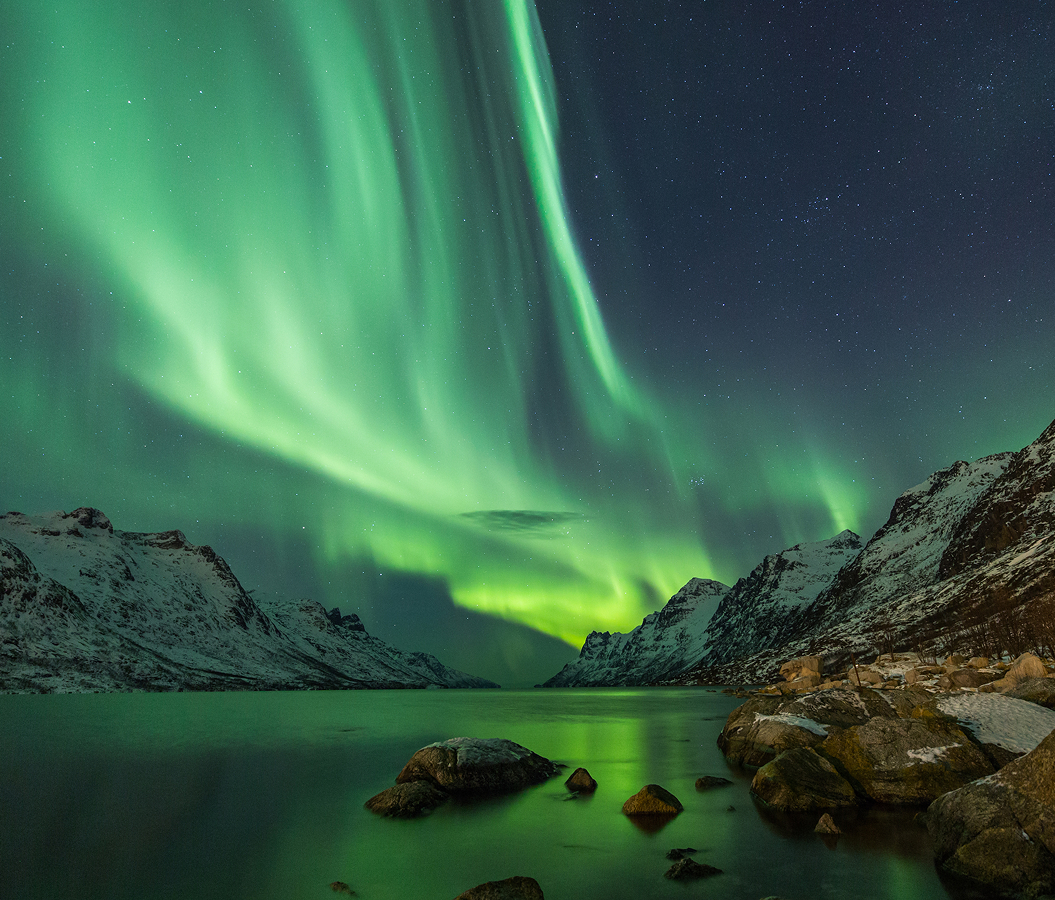
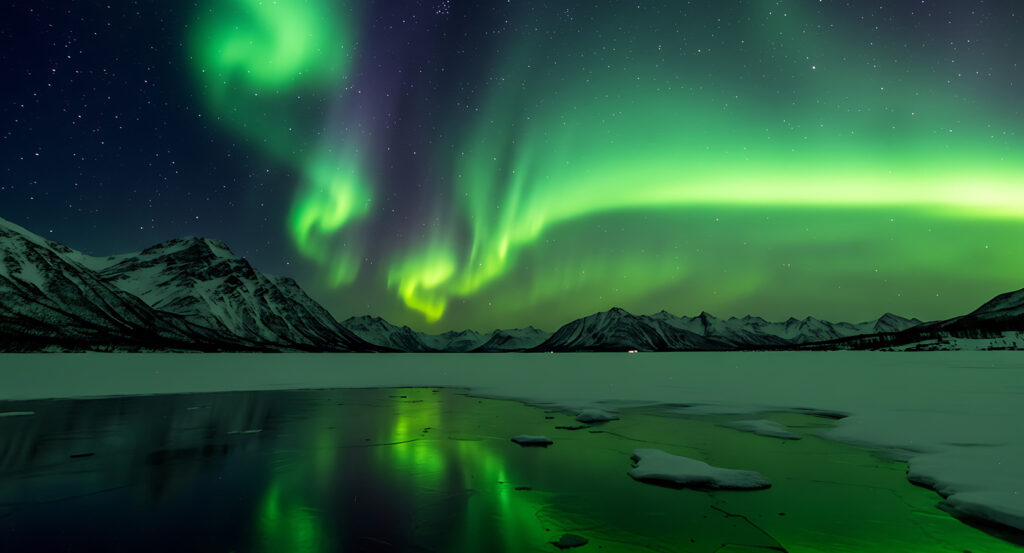
Here, the Northern Lights don't just appear, they seem to breathe across a landscape already in motion, unfurling over a rift valley where the North American and Eurasian plates drift apart grain by grain. Basalt cliffs rise like organ pipes, Lake Þingvallavatn lies still as polished glass, and the aurora draws veils of green and violet from horizon to horizon until the valley feels roofed by silk. Stand on the overlook above Almannagjá and watch the first faint glow gather over the lake; it thickens, ripples, and suddenly the sky becomes kinetic, mirrored perfectly in water so clear the boundary between above and below dissolves. The silence here is different, not empty, but charged, as if the ground is quietly humming while the cosmos writes with light. Unlike coastal viewpoints, Thingvellir National Park's broad basin and low light pollution give the aurora space to expand, so the show often feels closer, more architectural, almost choreographed to the valley's lines. You sense history under your feet, the parliament that met here a thousand years ago, the laws spoken into lava and wind, and you realize people have been lifting their eyes at this exact crossroads for a millennium. Few places bind geology, memory, and sky like this. When the lights crest and spill, it feels less like watching a phenomenon and more like standing inside one.
What you should know about Thingvellir National Park.
The aurora's poetry is written in physics, and Thingvellir National Park helps you read it.
When gusts of solar wind reach Earth, charged particles stream along magnetic field lines and collide with atoms high in the atmosphere; oxygen paints the familiar green, nitrogen adds pinks and purples at the fringes. That story plays out all across the auroral oval, but Thingvellir National Park amplifies it with design only nature could draft. The valley's dark basalt absorbs stray light, sharpening contrast; snow patches scatter color into the fissures; and Thingvellir National Park doubles the performance so completely the eye begins to believe the sky has depth. Even small breezes stirring across the water create a living echo, one ribbon in the heavens, one on the lake, moving out of phase like a duet. The place is layered with meaning beyond performance. This was the seat of the Althing, where chieftains gathered in 930 to speak law under open sky; to watch the aurora here feels like eavesdropping on a conversation that never ended. Local guides say the valley's geometry teaches patience: the faintest arc can harden into a crown in minutes, then fade to ember before flaring again. And while forecasts and indices help, Þingvellir rewards the quietly attentive, the traveler who lets eyes dark-adapt, who notices the sky's first green breath rather than waiting only for its thunderclap. The result is intimacy rather than chase, a sense that the lights choose this valley because it already knows how to listen.
How to fold Thingvellir National Park into your trip.
Approach Thingvellir National Park like a ritual, simple, prepared, unhurried.
Leave Reykjavík after dark and follow Route 36 as city glow recedes into a hush of lava fields; arrive with layers you can add and remove, boots for frozen paths, a thermos for the still hours. Park near Almannagjá or by the lake pullouts where the horizon is clean, then settle into the dark and give your eyes fifteen quiet minutes to open. Keep your phone dimmed, your headlamp off once you're set, and your camera stowed for the first minutes of the show; the human eye holds nuance no sensor can chase. When the arc appears, track it with your whole body, face north to see the sweep, then pivot toward the water to catch the reflection's second act. If clouds drift in, wait; Thingvellir National Park's weather is mercurial and often parts. Consider pairing your vigil with a late soak at Laugarvatn Fontana on the drive back, steam rising into auroral glow is a uniquely Icelandic benediction. Aim for moonless nights from September through April, with the valley's deepest quiet between 10 p.m. and 2 a.m. Most of all, give yourself time. The lights can tease for an hour before blooming, and when they do, the valley seems to inhale with you, cliffs dark as ink, lake bright as mercury, sky alive with motion. You'll leave not just with photos, but with a recalibrated sense of scale, small beneath the cosmos, held by the land, luminous for having witnessed it.
Where your story begins.
Foresyte Travel reveals places that feel extraordinary long before you arrive.
Experience premium editorial crafted for luxury travelers.