Why you should experience Patung Catur Muka in Indonesia.
Patung Catur Muka in Denpasar is more than a landmark, it's the spiritual and cultural compass of Bali's capital, where the island's ancient symbolism meets its modern heartbeat.
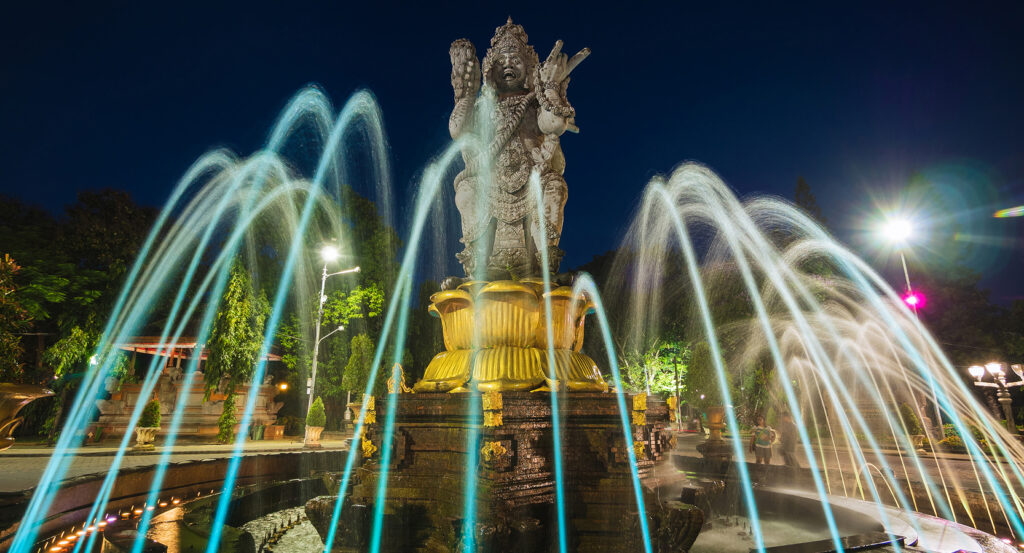
Standing proudly in the city's Central Puputan Square, this four-faced statue represents the Hindu god Brahma, the creator, whose presence watches over the island from all directions. Catur Muka” literally translates to “four faces,” each gazing north, south, east, and west, a reminder of balance, vigilance, and harmony in every aspect of life. Sculpted in 1973 by I Gusti Nyoman Lempad, among Bali's most celebrated artists, the statue is carved from volcanic stone and rises elegantly from a lotus-shaped fountain base. As you approach, the sound of trickling water and the hum of city traffic merge into an oddly calming rhythm, a contrast of chaos and serenity that feels quintessentially Balinese. The statue's serene expressions, eyes half closed, lips hinting at a smile, seem to radiate calm authority. Around it, locals gather under the banyan trees, street vendors sell satay skewers and coconut water, and children play freely, a living tribute to how deeply spirituality weaves through daily life here. While temples often embody devotion through grandeur, Patung Catur Muka captures it through presence, unshakable, graceful, eternal.
What you should know about Patung Catur Muka.
Patung Catur Muka's design and meaning extend far beyond its aesthetic, it is a philosophical statement in stone, embodying the Balinese ideal of universal harmony.
Brahma's four faces symbolize the omnipresence of divine wisdom and the virtues of sincerity, compassion, fairness, and mindfulness, values that guide Balinese society. The statue stands at the intersection of Denpasar's major roads, symbolizing both physical and spiritual crossroads, where every direction leads back to balance. Its placement in Puputan Square is deliberate: the park itself commemorates the 1906 puputan, or mass ritual suicide, in which the Balinese royal family chose death over surrender to Dutch colonial forces. Thus, the Catur Muka statue honors not only creation but also resilience, the eternal cycle of life, sacrifice, and rebirth that defines the island's history. The surrounding fountain is said to represent the flow of wisdom and purification, its waters glistening beneath the tropical sun. During Galungan and Kuningan, two of Bali's most sacred festivals, the area comes alive with offerings, music, and flower-laden processions circling the statue, transforming the city's civic center into a spirited temple square. Few visitors realize that the statue's intricate detailing, from the swirling lotus base to the flame-like crown, reflects the fusion of classical Balinese artistry with Hindu cosmology, a design language that bridges faith and character in every carved line.
How to fold Patung Catur Muka into your trip.
A visit to Patung Catur Muka offers a grounding moment amid Denpasar's energetic pulse, a glimpse into how the island's heart beats in harmony with its soul.
Begin your journey at Puputan Square, the green space surrounding the monument. It's best visited in the early morning or late afternoon when locals come to walk, practice yoga, or share quiet conversations beneath the banyan trees. As you stand before the statue, take time to walk around its base, noting how each face seems subtly different, one calm, one smiling, one contemplative, one wise, a sculptural meditation on perspective and peace. From here, wander across the square to the nearby Bali Museum, which houses traditional carvings, textiles, and relics that deepen your understanding of the culture that birthed such artistry. Just beyond lies the Jagatnatha Temple, Denpasar's largest Hindu temple, where daily offerings and chants echo softly through the air, a perfect companion stop to experience the living faith that the statue symbolizes. If you linger into evening, the soft glow of sunset turns the stone golden, and the rhythmic splash of the fountain mingles with the hum of scooters and street musicians, a soundscape that perfectly captures Bali's balance between the sacred and the everyday. Before leaving, pause for a final moment of stillness in front of the statue. Let the four faces remind you that clarity, like creation itself, comes from seeing the world from every direction.
Where your story begins.
Foresyte Travel reveals places that feel extraordinary long before you arrive.
Experience premium editorial crafted for luxury travelers.