Why Lapangan Puputan Badung matters.
Puputan Square in Denpasar isn't just the city's central park, it's a living memorial, a stage where Bali's courage, culture, and community meet beneath the open sky.
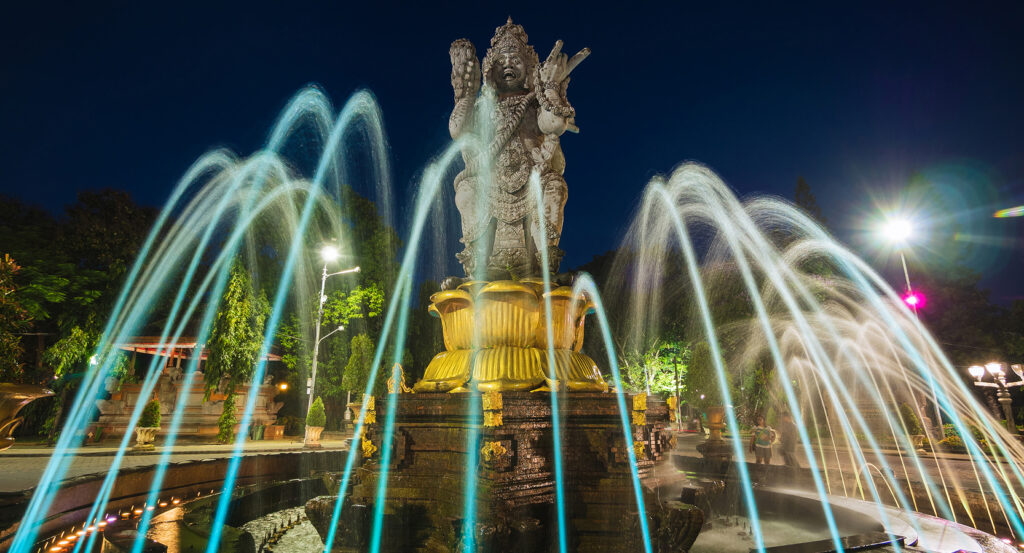
Spread across the heart of the capital, this vast green expanse breathes history and renewal in equal measure. Towering banyan trees shade walking paths where locals gather for prayer, conversation, and afternoon strolls. At its center rises the Catur Muka Statue, its four serene faces gazing over the city as a spiritual compass. Yet beneath the tranquility, the ground holds stories of unimaginable bravery, the word puputan itself means “fight to the death,” recalling the 1906 mass ritual suicide of Balinese royals and citizens who chose honor over surrender during the Dutch invasion. Today, the square stands not in mourning, but in triumph, a place where memory has transformed into resilience, and where Denpasar's pulse beats strongest. Morning joggers, temple dancers, and schoolchildren move through the same space where history once bled into legend.
What defines Lapangan Puputan Badung.
Puputan Square is both a civic center and an open-air shrine to Bali's unbreakable spirit.
The square was established to commemorate the Puputan Badung, a defining moment in 1906 when the Balinese royal family and their followers faced Dutch colonial forces with ritual defiance. Clad in white ceremonial dress, armed only with kris daggers and spiritual conviction, they walked into battle chanting prayers, transforming resistance into sacred sacrifice. The monument at the park's southern end depicts this act of unity, a family of three, kris raised high, eyes fixed forward, symbolizing the courage that became the foundation of modern Bali. The park was later redesigned as a civic heart, where national celebrations, art festivals, and political rallies coexist with daily rituals of leisure. Even the layout carries intention, the walkways align with cardinal directions, linking it symbolically to the nearby Catur Muka Statue and Denpasar's cosmic geometry. Few realize that the banyan trees encircling the park are descendants of the originals that once shaded royal courtyards, deliberately replanted here to preserve the continuity of lineage.
How Lapangan Puputan Badung fits.
To experience Puputan Square fully, don't just visit, linger.
Arrive early in the morning when the air is cool and filled with birdsong, and watch the city awaken around you. Locals gather here for tai chi and morning prayers, their movements framed by the monument's silhouette against the rising sun. Walk the circular paths beneath the banyan canopy and pause at the memorial statue, notice the calm expressions on the figures' faces, their defiance captured in stillness. At midday, the square becomes a mosaic of life: students eating lunch on the grass, families feeding pigeons, vendors selling coconut water and satay from pushcarts. Return in the evening when the fountains glimmer under soft amber light and the city slows into its rhythm of dusk. The air fills with laughter, incense, and the sound of children playing, a powerful contrast to the solemn history beneath your feet. Combine your visit with nearby landmarks like the Bajra Sandhi Monument or the Bali Museum to deepen your understanding of Denpasar's story, from sacrifice to self-definition. In every sense, Puputan Square isn't a park, it's the beating heart of Bali's memory, where history exhales peace and the present inhales pride.
Where your story begins.
Foresyte Travel reveals places that feel extraordinary long before you arrive.
Enjoy editorial crafted for luxury travelers.
Foresyte may earn a commission when you book.