Why you should experience Ráðhúsið in Iceland.
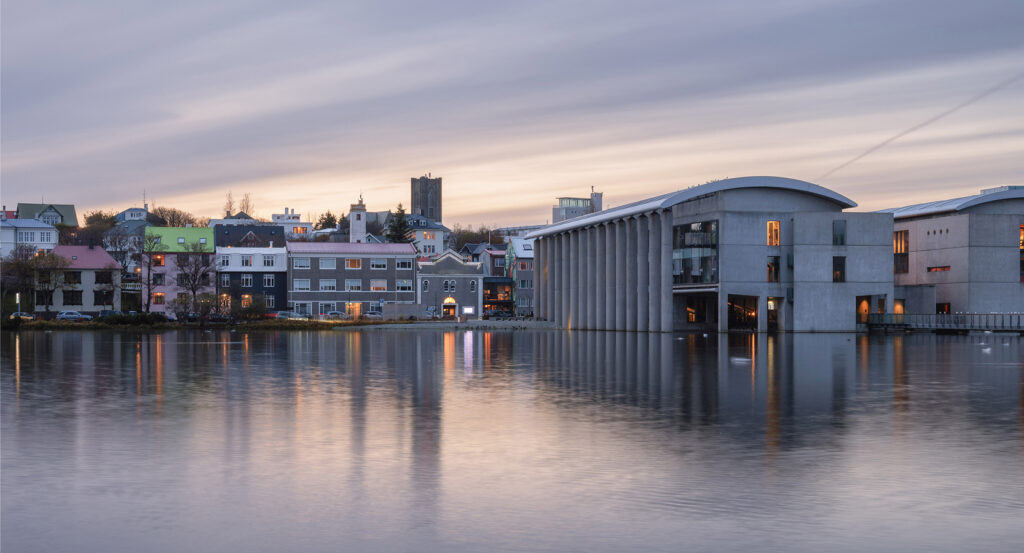
The City Hall Plaza is Reykjavík's civic threshold, a serene, open gathering place that bridges the still waters of Tjörnin Pond with the reflective glass and concrete of the City Hall itself.
Here, nature and architecture exist in dialogue. As you step onto the plaza, the surface beneath your feet shifts from stone to wood, tracing gentle curves that echo the ripples of the pond. The air feels different, lighter, quieter, touched by the faint murmur of ducks on the water and the wind whispering through the reeds. The plaza's design invites pause: low walls for sitting, shallow pools that mirror the sky, and a walkway that seems to float above the lake's edge. By day, the plaza is filled with life, children feeding birds, cyclists rolling past, and artists sketching the mirrored reflections of the City Hall's façade. By night, its soft lighting transforms the space into a dreamlike scene, where Reykjavík's skyline glows across the water and the dome of Perlan flickers faintly in the distance. Standing here, you feel the calm rhythm of the city, balanced between civic energy and natural stillness, glass and lake, motion and quiet.
What you should know about Ráðhúsið.
The City Hall Plaza is more than a public square, it's an engineered landscape built to blend Reykjavík's hydrology, history, and human movement into one living design.
When City Hall was constructed in 1992, its architects, Studio Granda, envisioned the plaza not as a forecourt but as a continuation of Tjörnin itself. The structure's foundation extends partially into the lake, supported by concealed pylons that allow water to flow freely beneath. The plaza's stone slabs are made from locally quarried basalt, the same material that forms Iceland's cliffs and volcanic columns, while the lighter concrete elements were tinted to mirror the muted tones of Reykjavík's light. A hidden geothermal system warms the paving stones in winter, melting snow naturally and keeping the surface walkable even during heavy frost. Beneath the plaza lies an advanced drainage and circulation network that helps maintain the pond's delicate ecosystem, channeling overflow and filtering runoff through natural reeds at the waterline. The curved design lines are intentional, echoing both the forms of Icelandic topography and the democratic openness of the building they lead into. Few visitors know that the plaza also doubles as an acoustic amplifier, its shallow reflecting surfaces and stone geometry create a subtle echo that enhances street musicians' performances year-round.
How to fold Ráðhúsið into your trip.
The City Hall Plaza is the perfect starting point for exploring Reykjavík's historic and cultural heart.
Arrive mid-morning when sunlight hits the glass façade of the City Hall and scatters across the lake. Stroll along the curved boardwalk toward the plaza's edge, where the reflections of mountains, steeples, and clouds shift with the breeze. Take a moment to watch the birds glide across Tjörnin or to snap a photo of the perfect symmetry between water and architecture. From here, you can step directly into the 3D City Map Exhibition inside the hall, or wander toward Austurvöllur Square and the Parliament Building just a few blocks away. In winter, bring hot chocolate and linger as the snow falls softly across the basalt stones, the plaza's quiet warmth and soft lighting create one of Reykjavík's most peaceful urban scenes. In summer, sit on the low ledge near the water and let the city unfold around you, a harmony of human design and Icelandic light. The City Hall Plaza is Reykjavík distilled: open, reflective, and timelessly balanced between earth and sky.
Where your story begins.
Foresyte Travel reveals places that feel extraordinary long before you arrive.
Experience premium editorial crafted for luxury travelers.