
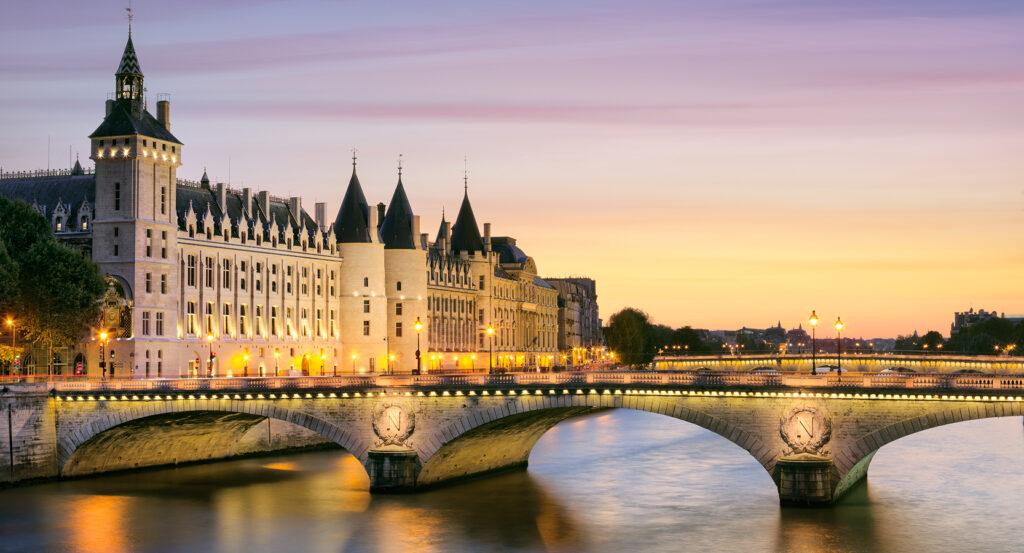
Why Salle des Gardes matters.
Salle des Gardes is a formidable Gothic chamber where Île de la Cité's royal character meets the surviving architecture of the Capetian palace, medieval justice and the prison complex later absorbed into the Conciergerie.
Set within the Conciergerie along Boulevard du Palais near Quai de l'Horloge and just steps from Sainte-Chapelle, the chamber occupies the northern edge of the former Palais de la Cité where thick masonry, ribbed vaults and the César and Argent towers preserve a rare interior fragment of medieval royal Paris. Two vaulted naves extend beneath low Gothic arches carried by three massive central piers, giving the room a compressed scale distinct from the immense adjoining Salle des Gens d'Armes. Sculpted capitals introduce animal combats and human figures into the otherwise austere stone structure. The surrounding palace fabric places the chamber beneath later judicial spaces and beside towers subsequently incorporated into the prison, compressing royal, judicial and carceral architecture into the same medieval core. The result is a powerful surviving interior where the spatial hierarchy of the Capetian palace remains visible beneath centuries of institutional change.
What defines Salle des Gardes.
Salle des Gardes is best known for surviving from the vast rebuilding of the Palais de la Cité undertaken under Philippe IV, when the Capetian monarchy transformed its Parisian residence into an architectural statement of royal government. Construction extended from the closing years of the thirteenth century into the opening decades of the fourteenth, producing the Salle des Gardes alongside the larger Salle des Gens d'Armes and the César and Argent towers. The chamber occupied the lower level beneath the Grand'Chambre, where the king held his lit de justice and the Parlement de Paris developed as the kingdom's highest court. A spiral stair connected the two levels, making the lower hall an antechamber within the circulation leading toward royal justice above. Three central piers divide the room into two naves beneath ribbed vaults, with capitals carved alternately with animal struggles and scenes involving human figures. Philippe IV's palace placed this chamber within a larger ceremonial complex that included the Grand'Salle, whose upper hall displayed statues of French kings and hosted major court occasions. Jean II subsequently added the palace kitchens 1353, extending the service architecture attached to the royal household. Charles V's movement of the monarchy toward the Louvre and Vincennes during the later fourteenth century shifted the Palais de la Cité away from residential use, yet Parlement and judicial functions remained. Salle des Gardes consequently survives from the period when monarchy, court ceremony and the highest levels of royal justice still occupied the same palace on Île de la Cité.
Judicial consolidation eventually changed the chamber from an approach to royal authority into part of the Conciergerie prison. Cells subdivided the medieval hall as incarceration expanded through the former palace, with impoverished prisoners confined in conditions tied to their ability to pay for accommodation. The French Revolution intensified the carceral role after the Revolutionary Tribunal began operating in the former Grand'Chambre above in 1793. Antoine Quentin Fouquier-Tinville served as public prosecutor, placing one of the central officials of the Terror within the judicial complex built over the medieval chamber. Prisoners processed through the Conciergerie during this period included Marie-Antoinette, whose detention before execution in October 1793 became the most prominent episode in the building's Revolutionary history. The Tribunal remained active until 1795, leaving the palace associated with the machinery of Revolutionary justice long after royal residence had disappeared. Prison cells continued to occupy Salle des Gardes into the nineteenth century before restoration reopened the Gothic volume. Those interventions recovered the hall as an architectural interior, though surviving medieval fabric exists beside substantial nineteenth-century reconstruction identified by later architectural scholarship. Salle des Gardes now preserves the physical overlap between Philippe IV's royal judiciary and the Revolutionary tribunal that occupied the same vertical sequence nearly five centuries later.
How Salle des Gardes fits.
Salle des Gardes works as the anchor for a daytime exploration across Île de la Cité using three nearby sites that move from Louis IX's purpose-built reliquary through the surviving medieval cathedral treasury into the archaeological remains of Paris beneath the island's eastern end.
Begin at Sainte-Chapelle, commissioned by Louis IX after his acquisition of the Crown of Thorns and other Passion relics from Baldwin II of Constantinople. The relics reached Paris in 1239, and the new palace chapel was consecrated in 1248 as an architectural reliquary integrated directly into the royal residence. Its two-level arrangement separated the lower chapel from the upper sanctuary used by the king and court, where fifteen immense windows carry more than a thousand scenes across an extraordinary cycle of thirteenth-century stained glass. The western rose belongs to a later campaign under Charles VIII, inserting late fifteenth-century Flamboyant work into Louis IX's earlier Rayonnant interior. Continue to the Trésor de Notre-Dame Cathedral, whose objects preserve the cathedral's long association with relics, liturgy and French religious patronage. The treasury suffered dispersal during the Revolution before nineteenth-century rebuilding under Eugène Viollet-le-Duc produced new reliquaries and furnishings, including work connected with the Crown of Thorns. The cathedral fire of April 2019 forced another evacuation of precious objects, with the Crown of Thorns and Tunic of Saint Louis rescued before the restored cathedral reopened in December 2024. Conclude at Crypte archéologique de l'île de la Cité, created beneath the parvis after excavations conducted between 1965 and 1972 exposed structures spanning ancient Lutetia through later Paris. Roman remains include portions of a quay and substantial building foundations, joined by medieval cellars and traces of the dense streets cleared during nineteenth-century rebuilding around Notre-Dame. Opening in 1980 converted the excavated layers into a permanent archaeological site beneath the modern square. The progression moves from Louis IX's thirteenth-century reliquary through a cathedral treasury repeatedly rebuilt around sacred objects into archaeological strata beneath Notre-Dame, carrying the royal and religious history surrounding Salle des Gardes deeper into the physical development of Île de la Cité.
Where your story begins.
Foresyte Travel reveals places that feel extraordinary long before you arrive.
Experience premium editorial crafted for luxury travelers.
Foresyte Travel may earn a commission when you book through the link on this page.














































































































