Why The St. Regis Chicago matters.
The St. Regis Chicago is a vertical waterfront hotel where Lakeshore East's planned urbanism meets Jeanne Gang's faceted tower, St. Regis rituals and Chicago's long architectural ambition.
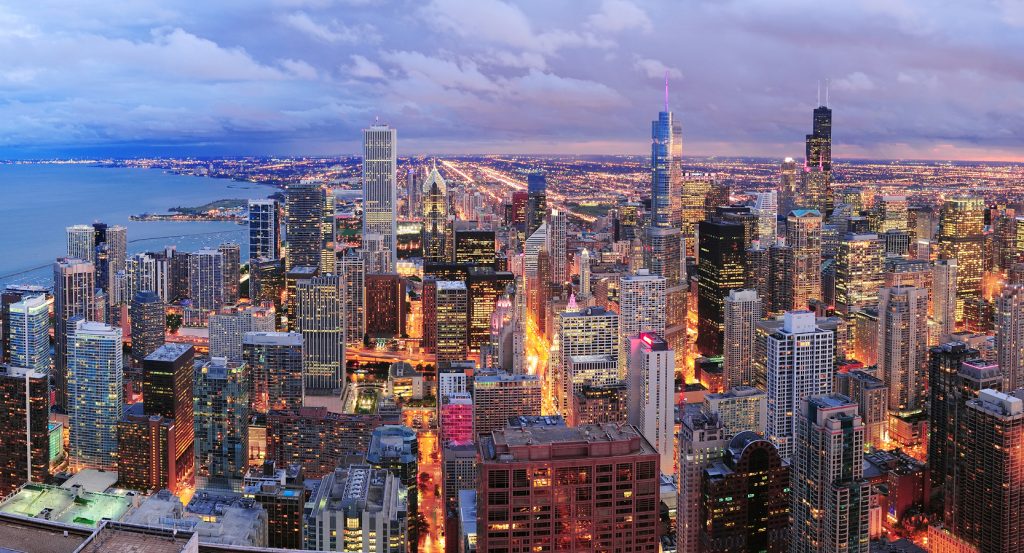
Set along East Wacker Drive near North Lake Shore Drive and just steps from the Chicago Riverwalk, the hotel occupies Lakeshore East's eastern edge between the river, Lake Michigan, Millennium Park and the commercial towers of the Loop. Three stacked stems rise through six shades of blue glass, creating a shifting skyline profile through faceted geometry. Arrival compresses the city's vertical scale into a sequence of lobby rooms, elevator journeys and elevated views across the river and lake. Miru, Tre Dita and Bar Tre Dita give the tower distinct culinary registers, from Japanese dishes and outdoor terraces to handmade Tuscan pasta and bistecca Fiorentina. The result is a hotel that makes Chicago's relationship with water, height and architectural experimentation part of daily movement through the building.
What defines The St. Regis Chicago.
The St. Regis Chicago is best known for bringing Studio Gang's structural and visual language into a hotel tower that shares its address with private residences. Jeanne Gang organized the building as three progressively taller stems whose repeated setbacks resemble rising signal bars. The form uses frustums, geometric solids created by cutting the point from a cone or pyramid, to produce an apparent undulation across the façades. Six shades of blue glass shift with daylight and reflect the river, lake and neighboring towers. The tallest stem reaches 1,198 feet, making the building Chicago's third-tallest upon completion in 2020. Perimeter columns step inward and outward across the exterior, giving the tower a changing structural cadence from street level to roofline. Wind engineering shaped the upper floors through blow-through openings that allow air to pass through the tallest stem. The design also includes mass-tuned dampers, large water systems that counteract movement generated by Chicago winds. More than 75 percent of construction waste was diverted into manufacturing processes during the project. The tower extends Lakeshore East toward the Chicago River and creates new pedestrian connections through a district previously separated from the surrounding city. Studio Gang's design received an AIA Chicago Design Excellence Award in the Architecture XL category in 2023. The hotel occupies lower and middle sections of a building whose height, structure and glass treatment make the address legible from across the central city.
Miru occupies the eleventh floor with Japanese dishes shaped through local ingredients, French technique and broad outdoor terraces. Hisanobu Osaka leads the restaurant's kitchen, where sushi, seafood, robata preparations and composed plates share a skyline setting. Tre Dita takes a different culinary direction through Tuscan food, handmade pasta, woodfire cooking and the work of chef Evan Funke. The restaurant's name refers to the three-finger measure associated with the ideal thickness of bistecca Fiorentina. Bar Tre Dita extends the Tuscan program through antipasti, cocktails and an all-Italian wine list. The 1871 Bloody Mary adapts the St. Regis signature cocktail to Chicago through local rye whiskey, smoked salt and a presentation tied to the Great Chicago Fire. Champagne sabering forms the hotel's evening ritual, turning a bottle, a blade and sunset into a daily ceremony. The St. Regis brand began with John Jacob Astor IV's 1904 hotel in New York, and Chicago carries the brand's Bloody Mary and sabering traditions into a new tower. Forbes Five-Star recognition extends to the St. Regis Spa, where hydrotherapy, treatments and quiet rooms occupy another layer of the vertical program. Miru, Tre Dita, Bar Tre Dita, the Bloody Mary and champagne sabering give the building a set of named rituals that connect Chicago's culinary culture to the wider St. Regis inheritance.
How The St. Regis Chicago fits.
The St. Regis Chicago works as a starting point for tracing Chicago's public realm from river engineering to civic architecture and contemporary park design.
Begin at Chicago Riverwalk, where a former working edge has become a continuous public promenade along the south bank of the main branch. The route extends from Lake Michigan westward toward Wolf Point through terraces, overlooks, docks and stepped seating. Heavy industry once dominated the river corridor, but the Riverwalk now joins downtown offices, residential towers, restaurants and architectural tours within a connected waterfront. The section east of Michigan Avenue links to the Lakefront Trail and accommodates river cruises departing near the Wrigley Building and Tribune Tower. Continue to Chicago Cultural Center, where a former public library and Civil War memorial occupies the corner of Michigan Avenue and Washington Street. Shepley, Rutan and Coolidge completed the building in 1897 with marble interiors, mosaics and two great stained-glass domes. The structure became a cultural centre in 1978 and now houses exhibitions, concerts, dance, theatre, lectures, films and family programs. Its rooms turn municipal architecture into a public arts venue. Conclude at Millennium Park, where a former rail yard and parking area became a 25-acre civic landscape beside Grant Park. Frank Gehry's Jay Pritzker Pavilion anchors the park with a stainless-steel bandshell and sweeping trellis, while Anish Kapoor's Cloud Gate reflects the skyline and surrounding crowds. Kathryn Gustafson's Lurie Garden, Jaume Plensa's Crown Fountain and the BP Bridge by Gehry add gardens, video, water and movement to the park's architectural field. Millennium Park's eastern edge opens toward Lake Michigan, while its western edge faces the Chicago Cultural Center across Michigan Avenue. The progression moves from an industrial river transformed into public space, through a library converted into a cultural forum, to a park where art and landscape reorganize the city's lakefront.
Where your story begins.
Foresyte Travel reveals places that feel extraordinary long before you arrive.
Enjoy editorial crafted for luxury travelers.
Foresyte may earn a commission when you book.