Why Uffizi Galleries matters.
Uffizi Galleries is an unparalleled art museum where Santa Croce's Renaissance heritage, Medici patronage, artistic genius, and Florentine scholarship illuminate one of the world's greatest collections of Western art.
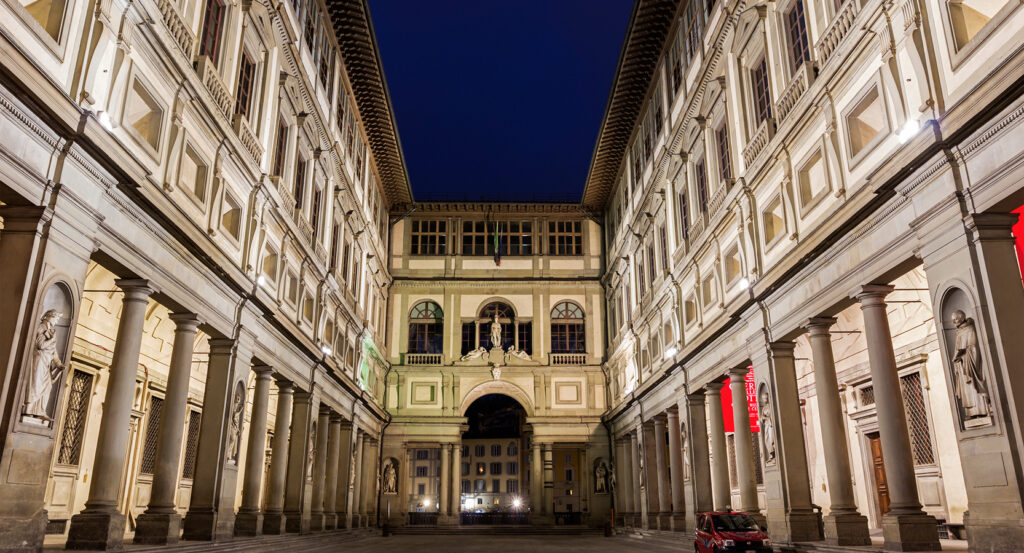
Set along Piazzale degli Uffizi near Piazza della Signoria and just steps from Ponte Vecchio, this extraordinary museum unfolds through elegant arcaded corridors, luminous galleries, frescoed ceilings, marble sculptures, and masterpieces that transformed a former government complex into the definitive chronicle of the Italian Renaissance. Every room reveals another milestone in the evolution of Western painting as Giotto, Botticelli, Leonardo da Vinci, Michelangelo, Raphael, Titian, Caravaggio, and countless other masters collectively narrate centuries of artistic innovation. Carefully curated exhibition spaces, panoramic Arno River views, and richly decorated interiors continually reinforce Florence's position at the heart of European cultural history. The experience ultimately unites artistic excellence, humanist scholarship, and Medici ambition into one of the world's most profound museum experiences.
What defines Uffizi Galleries.
Uffizi Galleries is best known for preserving the world's greatest collection of Italian Renaissance painting inside the administrative complex commissioned in 1560 by Cosimo I de' Medici and designed by Giorgio Vasari to consolidate Florence's principal magistracies, creating an architectural masterpiece whose upper floors were transformed into one of Europe's earliest public art museums after Grand Duke Francesco I established the Medici family's private galleries there in 1581. Conceived as the Uffizi, or “offices,” the building introduced one of Renaissance Europe's most sophisticated civic architectural compositions, with Vasari's elongated courtyard terminating dramatically at the Arno River while the elevated Vasari Corridor, completed in 1565, linked Palazzo Vecchio to Palazzo Pitti through the Uffizi and across Ponte Vecchio, allowing the Medici rulers to travel securely above the city. The galleries preserve Botticelli's The Birth of Venus and Primavera, Leonardo da Vinci's Annunciation and Adoration of the Magi, Michelangelo's Doni Tondo, Raphael's Madonna of the Goldfinch, Titian's Venus of Urbino, Caravaggio's Medusa and Bacchus, masterpieces by Giotto, Cimabue, Piero della Francesca, Filippo Lippi, Parmigianino, Albrecht Dürer, Rembrandt, and Artemisia Gentileschi, together tracing the development of European painting from the thirteenth through eighteenth centuries. Anna Maria Luisa de' Medici permanently secured the collection for Florence through the 1737 Family Pact, stipulating that the Medici treasures could never be removed from the city, establishing an enduring cultural legacy that allowed the museum to open progressively to the public during the eighteenth century. Today the Uffizi forms the centerpiece of Italy's Uffizi Galleries museum system, encompassing hundreds of thousands of drawings and prints, ancient Roman sculptures, classical antiquities, decorative arts, and one of the most important research collections in the history of Western art, while welcoming several million visitors annually as one of the world's most influential museums.
Every gallery documents the extraordinary transformation of European artistic thought as innovations in perspective, anatomy, composition, light, humanism, and scientific observation emerge through successive generations of painters whose works fundamentally reshaped Western civilization. Vasari's architectural rhythm, richly ornamented ceilings, antique sculpture displays, and chronological installation create an immersive narrative that allows visitors to witness the Renaissance unfold almost step by step. Continual conservation projects, scholarly research, carefully curated exhibitions, and sensitive gallery renovations ensure that masterpieces created more than seven centuries ago remain accessible within spaces that preserve their historical and intellectual context. Every corridor, cabinet, and exhibition room demonstrates how artistic genius, Medici patronage, architectural innovation, and humanist scholarship combined to establish one of the most influential museums ever created.
How Uffizi Galleries fits.
Uffizi Galleries works as the centerpiece of an exploration through Santa Croce's extraordinary artistic and civic heritage.
Begin at Piazza della Signoria, where Florence's historic political heart establishes the extraordinary civic context before entering Uffizi Galleries to experience the greatest achievements of Renaissance painting. Continue across Ponte Vecchio, whose centuries-old goldsmiths' shops and uninterrupted history naturally extend the story of Medici Florence along the Arno. Conclude at Santa Croce, where the tombs of Michelangelo, Galileo, Machiavelli, and Rossini provide a fitting finale celebrating the artists, scientists, and thinkers whose achievements transformed Florence into one of history's greatest cultural capitals. The progression moves naturally from civic power to artistic genius before concluding among the individuals who defined the Renaissance, revealing why Santa Croce remains inseparable from Florence's enduring intellectual legacy.
Where your story begins.
Foresyte Travel reveals places that feel extraordinary long before you arrive.
Enjoy editorial crafted for luxury travelers.
Foresyte may earn a commission when you book.