
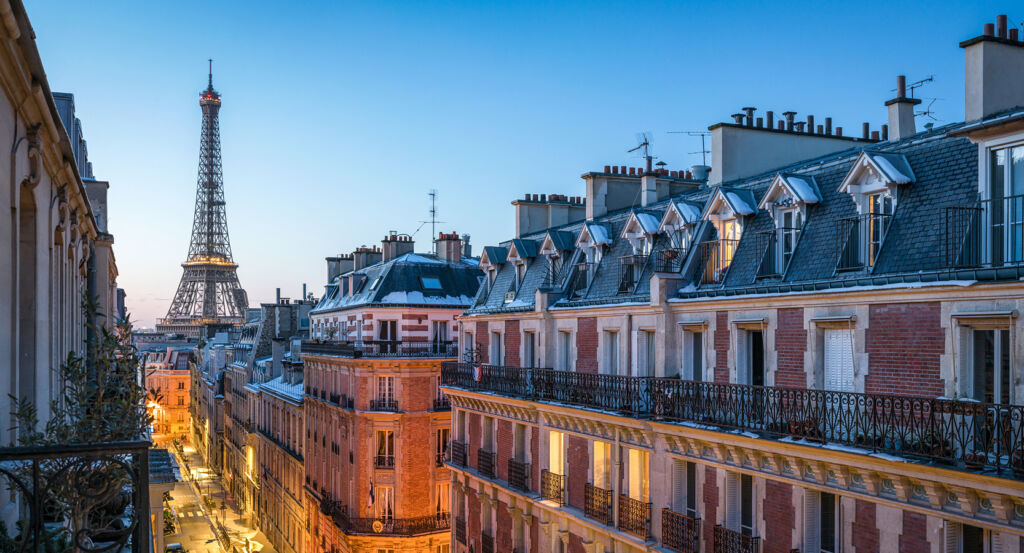
Why 6th Arrondissement matters.
6th Arrondissement is a storied Left Bank enclave where the Seine meets Saint-Germain-des-Prés through medieval streets, literary corridors, formal gardens and centuries of artistic and intellectual life concentrated within one of Central Paris's most intricate districts.
Positioned between the Latin Quarter, Montparnasse, and Invalides, the neighborhood occupies a broad Left Bank territory extending from the Seine and Quai de Conti through Saint-Germain-des-Prés and Odéon to the southern edge of the Jardin du Luxembourg. Narrow streets around Saint-Germain preserve medieval alignments and deep parcels before the urban fabric opens through Place Saint-Sulpice, Boulevard Saint-Germain and the long north-south corridors leading toward Montparnasse. Rue de Buci and the surrounding lanes establish the primary encounter through compact blocks where commercial frontages occupy ground developed between the medieval abbey and the river. Boulevard Saint-Germain introduces a second spatial mechanism through the nineteenth-century artery cut across older streets, placing broader Haussmann-era facades beside passages, courtyards and inherited routes that survived its construction. Farther south, the Luxembourg grounds transform the scale again through tree-lined walks, terraces and open garden geometry occupying territory that remained beyond the densest medieval settlement. The result is a neighborhood where monastic land, commercial streets, planned avenues and royal garden ground form successive urban layers, preparing a history that begins with one of the most powerful religious foundations of early Paris.
What you should know 6th Arrondissement.
6th Arrondissement is best known for developing from two early centers on the Left Bank whose eventual convergence produced the territory incorporated into the modern Arrondissement in 1860. Roman Lutetia extended into this area along the route toward Sèvres, and archaeological discoveries beneath the Luxembourg grounds have revealed substantial traces of prosperous Gallo-Roman occupation. A second center emerged farther west after Childebert I founded the monastery of Sainte-Croix and Saint-Vincent in 543, granting it extensive Left Bank territory and establishing a royal burial place beyond the settled city. Relics of Germain, bishop of Paris, arrived there in 576, strengthening a pilgrimage cult that eventually supplied Saint-Germain-des-Prés with its enduring name. Scandinavian attacks repeatedly damaged the abbey before Abbot Morard directed its revival around the turn of the eleventh century, returning the monastery to intellectual prominence as settlement expanded around it. A recognizable bourg had formed beside the abbey by the twelfth century, and an annual fair appears in surviving references 1175 as commerce increasingly connected the monastic settlement with Paris. Louis XI revived the Foire Saint-Germain in 1476, and its success produced a vast covered hall during the following century. Aristocratic households followed the district's growing prosperity, bringing artists and writers into the streets around the abbey as Saint-Germain developed into a major western extension of Left Bank Paris.
The twentieth century supplied a separate cultural mechanism as Saint-Germain-des-Prés became an international concentration of writers, philosophers, musicians, publishers and art dealers. Literary and philosophical circles gathered across cafés and bookshops during the interwar years, then the German occupation and Liberation brought a new generation of writers into the same compact territory. Jean-Paul Sartre and Simone de Beauvoir became closely associated with Saint-Germain, and postwar existentialism intersected with a jazz culture in which Juliette Gréco emerged as one of the district's defining performers. Cellars and clubs drew French musicians into contact with American jazz artists, carrying nightlife into a wider intellectual culture built around publishing, performance and debate. Visual art expanded through another channel after the Second World War as galleries established themselves throughout Saint-Germain-des-Prés, joining artists and collectors inside the same streets occupied by booksellers and publishing houses. The district remained an important gallery center through subsequent generations, with dealers including Hervé Loevenbruck, Kamel Mennour, Georges-Philippe Vallois and Nathalie Vallois extending that concentration into the late twentieth and early twenty-first centuries.
How 6th Arrondissement fits.
6th Arrondissement works as the anchor for a daytime exploration connecting a Romantic painter's final home, a royal garden created for Marie de Médicis and a seventeenth-century college transformed into the seat of France's five academies.
Begin at Musée national Eugène-Delacroix, occupying the apartment and purpose-built studio where Eugène Delacroix lived from 1857 until his death in 1863 after moving near Saint-Sulpice during his work on the church's Chapel of the Holy Angels. Delacroix had the garden studio constructed for his own use and worked there among paintings, thousands of sketches and drawings, and objects carried home from his Moroccan journey; the Société des Amis d'Eugène Delacroix, formed around painter Maurice Denis, later preserved the threatened premises and opened a museum in 1932, converting the artist's domestic and working environment into the nucleus of a collection spanning paintings, prints, drawings, correspondence and personal possessions. Continue to Jardin du Luxembourg, where Marie de Médicis acquired the Petit Luxembourg in 1612 and assembled surrounding land for the palace and garden she envisioned after the death of Henri IV. Salomon de Brosse designed the palace, and the queen entrusted Tommaso Francini and Jacques Boyceau de la Barauderie with waterworks and garden design influenced by the Florentine culture of her childhood; Louis XIII laid the first stone of the Médicis aqueduct in 1613, and water from Rungis reached the Left Bank ten years later to supply the estate and fourteen public fountains. Later reductions and Second Empire intervention altered the grounds substantially, with Boulevard Saint-Michel, Rue de Vaugirard and southern development helping establish the garden's present boundaries. Conclude at Institut de France, where Cardinal Mazarin's 1661 tribute devoted two million livres to a college educating forty students from Pignerol, Alsace, Artois and Roussillon, territories incorporated into France through the treaties of Westphalia and the Pyrenees. Louis Le Vau designed the Collège des Quatre-Nations opposite the Louvre, beginning construction in 1663 around a composition whose domed chapel was intended to contain Mazarin's tomb and whose institution also received his library of more than 40,000 volumes; after the Revolution, Napoleon transferred the Institut de France from the Louvre into the former college in 1805, eventually bringing the Académie française, Académie des inscriptions et belles-lettres, Académie des sciences, Académie des beaux-arts and Académie des sciences morales et politiques together within the complex. The progression moves from Delacroix constructing a private studio around nineteenth-century artistic production through Marie de Médicis reshaping peripheral Left Bank land through royal architecture and hydraulic engineering into Mazarin and Le Vau joining territorial politics, education and scholarship beside the Seine, revealing the artistic, royal and intellectual institutions that gave the 6th Arrondissement its exceptional cultural concentration.
Where your story begins.
Foresyte Travel reveals places that feel extraordinary long before you arrive.
Enjoy editorial crafted for luxury travelers.
Foresyte may earn a commission when you book.














































































































