Why you should experience Aloft Raleigh in Raleigh, North Carolina.
Aloft Raleigh is where the city's academic gravity, nightlife energy, and generational momentum intersect, offering a stay that feels social, compressed, and intentionally wired into Raleigh's youngest, fastest-moving layer.
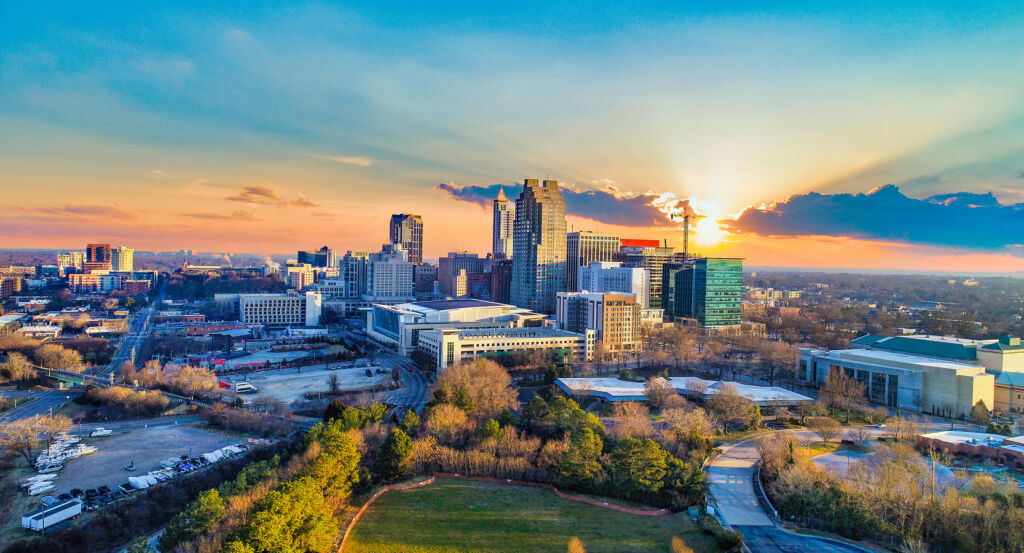
Raleigh contains multiple cities within itself, but few places capture its present-tense energy as clearly as Hillsborough Street. Aloft Raleigh sits directly inside that current. This is not a hotel designed to buffer you from the city or slow you down. It places you inside a zone defined by students, ideas, nightlife, and constant circulation, where days blur into nights and schedules remain flexible by design. Arrival establishes this tone. You are not stepping into quiet luxury or institutional polish. You are entering an environment that accepts noise, movement, and overlap as part of the experience. Inside, the atmosphere is compact, modern, and unapologetically social. Design emphasizes verticality, openness, and shared space, encouraging interaction. Public areas feel active rather than restful, with furniture arrangements that invite conversation, work sessions, or casual overlap rather than solitary retreat. Lighting, color, and materials lean contemporary and assertive, reinforcing a sense of immediacy. This is a hotel that belongs to now. Guest rooms continue this editorial clarity with a focus on efficiency and personality. Spaces are streamlined and intentionally sized, designed to function as reset points. Beds are comfortable and positioned to support real rest, but without theatrical framing. Lighting is modern and adjustable, allowing rooms to shift quickly from daytime productivity to nighttime recovery. Furnishings are functional and minimal, emphasizing open floor area, modular storage, and adaptability over layered comfort. Windows often look out onto Hillsborough Street or surrounding campus energy, reinforcing the sense that Raleigh here is alive and close. Bathrooms are sleek and efficient, prioritizing flow, cleanliness, and contemporary fixtures over indulgence. Sound behaves differently at Aloft Raleigh. The surrounding environment is active, particularly in the evenings, and the hotel does not pretend otherwise. Instead, it creates a contained interior experience that allows guests to participate when they want and disengage when they don't. This balance is central to the property's appeal. Service at Aloft Raleigh reflects this social-forward posture. Interactions are friendly, informal, and responsive. Staff engagement feels conversational rather than scripted, aligned with a guest profile that values ease and personality over formality. The location defines everything. Being directly adjacent to North Carolina State University places you inside a daily cycle of lectures, late-night food runs, performances, bars, and spontaneous gatherings. Returning to the hotel feels less like retreat and more like stepping sideways into a familiar extension of the street. Aloft Raleigh does not attempt to explain the city or slow it down. It plugs you directly into a version of Raleigh that is young, restless, and actively shaping what comes next.
What you should know about Aloft Raleigh.
Aloft Raleigh is best known for its proximity to one of the largest and most influential institutions in the city, and its character is inseparable from the rhythms of campus life and generational turnover.
Hotels near universities often struggle to define themselves, caught between serving parents, academics, and visitors while existing inside environments driven by youth and constant change. Aloft Raleigh resolves this tension by committing fully to the latter. The hotel's design, programming, and operational tone align with a demographic that values flexibility, informality, and shared experience. One lesser-known aspect of the property is how intentionally it embraces compression. Rooms are smaller by design, public spaces are activated deliberately, and overlap is encouraged. This creates a social density that mirrors campus life itself, where privacy is episodic and community is ambient. The result is an environment that feels energetic. Another defining element is the hotel's relationship with time. Aloft Raleigh operates on a late-shift rhythm. Evenings stretch, nights blur, and mornings often start slowly. Amenities, staffing patterns, and social spaces are calibrated to support this cycle. This makes the hotel particularly resonant with guests whose schedules are flexible or unconventional. The brand's broader design language supports this identity, but the Raleigh location sharpens it. Here, the hotel functions less as accommodation and more as infrastructure for social life. Music, events, and informal gatherings are not add-ons; they are part of the operating system. The building's vertical layout reinforces this dynamic, stacking energy. Movement through the hotel feels upward and outward, echoing the momentum of the surrounding neighborhood. Service culture mirrors this posture. Staff engagement emphasizes familiarity and adaptability. Guests are treated as participants rather than clients, reinforcing a sense of shared space rather than managed experience. Over time, this has attracted a clientele that values atmosphere and access over comfort and quiet. Students, visiting lecturers, creatives, and weekend travelers seeking nightlife gravitate here not because it softens Raleigh, but because it amplifies a specific version of it. In a city often described as balanced or measured, Aloft Raleigh represents something else entirely: velocity.
How to fold Aloft Raleigh into your trip.
Aloft Raleigh works best when you let it place you inside Raleigh's social bloodstream rather than using it as a base for distance or decompression.
Begin your days. Mornings near campus unfold gradually, and the hotel's environment supports late starts and flexible planning. Step out onto Hillsborough Street and let the neighborhood determine your pace. Coffee, food, and casual interaction are always close, and the density of the area rewards wandering. Midday is an ideal time to branch outward. Use the hotel's proximity to downtown and surrounding districts to explore museums, parks, or quieter neighborhoods, knowing that returning to campus energy will feel like re-entry. In the afternoon, allow downtime to be informal. The hotel's public spaces support working, socializing, or observing. This is not a place to disappear into solitude; it is a place to exist lightly among others. Evenings are where Aloft Raleigh fully asserts itself. The surrounding area becomes active, and the hotel's social energy rises in parallel. Choose whether to participate directly or hover at the edges. Either mode works here. Bars, music venues, performances, and spontaneous gatherings are part of the ecosystem, and returning to the hotel does not require disengagement. On longer stays, this rhythm becomes increasingly legible. Days feel modular rather than linear, shaped by overlap and repetition rather than itinerary. Raleigh reveals itself here as a city driven by youth, ideas, and constant renewal. When departure day arrives, leaving Aloft Raleigh feels like stepping out of a current. The experience does not linger quietly; it dissipates quickly, leaving behind an impression of motion. The hotel does not aim to ground you or restore you. It places you inside a living system, allowing Raleigh to be experienced as it moves, gathers, and regenerates itself in real time. Folded thoughtfully into a trip, Aloft Raleigh becomes less a place to stay and more a point of contact with the city's next iteration.
Where your story begins.
Foresyte Travel reveals places that feel extraordinary long before you arrive.
Experience premium editorial crafted for luxury travelers.