
Why Atelier matters.
Atelier is a two-MICHELIN-starred fine dining restaurant where Altstadt's grand-hotel heritage meets Munich's contemporary gastronomic ambitions, the artistic refinement of Belgian interior design and the culinary traditions that have established the Bavarian capital among Germany's leading destinations for haute cuisine.
Occupying an intimate dining space within Hotel Bayerischer Hof on Promenadeplatz, between Pacellistraße and Maffeistraße, the restaurant stands near Kardinal-Faulhaber-Straße, the historic Gunetzrhainerhaus and the commercial passages of Fünf Höfe, within Munich's Kreuzviertel and the surrounding Old Town. Its interior combines muted gray surfaces, restrained furnishings and carefully controlled lighting, establishing the atmosphere of a private artist's studio within the larger hospitality complex. Antique side tables and subtly textured decorative surfaces contribute warmth to the understated architectural composition, with individual dining tables arranged to preserve a sense of separation and privacy. A movable wall created by Belgian artist Dirk Vander Eecken conceals an intimate private dining area, extending the restaurant's artistic character through a substantial functional installation. The adjoining Silent Garden introduces an outdoor retreat planted with Amur maples, creating a sheltered landscape setting within the dense urban fabric. The result is a refined gastronomic environment whose restrained interior architecture, original artistic commissions and secluded garden establish a distinctive relationship between contemporary fine dining and historic Munich hospitality.
What defines Atelier.
Atelier is best known for its development into one of Germany's most distinguished fine dining restaurants through the culinary achievements of Jan Hartwig, Anton Gschwendtner and Kevin Romes, supported by the long-term hospitality ambitions of the Volkhardt family. Its institutional origins belong to Hotel Bayerischer Hof, the historic luxury establishment whose foundation followed King Ludwig I of Bavaria's desire to create a first-class hotel capable of accommodating the international visitors arriving in his capital. The hotel opened in 1841, establishing a substantial hospitality institution during Munich's transformation into a major European cultural center under the Wittelsbach monarchy. The property entered the ownership of the Volkhardt family in 1897, beginning an enduring relationship between private family stewardship and the development of the Bavarian capital's luxury hospitality industry. Successive generations expanded the establishment's accommodation, dining and entertainment facilities, connecting its commercial development to Munich's increasing importance as a destination for international business, diplomacy and cultural gatherings. Innegrit Volkhardt subsequently assumed a central leadership position, directing an extensive modernization program that incorporated internationally recognized architects and designers into the hotel's historic setting. Belgian designer Axel Vervoordt received his first hotel commission from the property in 2009, developing the interiors of Restaurant Garden and the newly established Atelier. Born in Antwerp in 1947, Vervoordt had developed an international reputation as an antiques dealer, art collector and interior designer through his distinctive treatment of historic objects, restrained colors and architectural proportion. His professional philosophy drew on the relationship between traditional craftsmanship, contemporary art and the natural aging of decorative surfaces, establishing a recognizable approach to sophisticated residential and hospitality interiors. The commission introduced a dining environment inspired by the working spaces of artists, connecting the restaurant's culinary ambitions to the creative traditions of European studio culture. Atelier received its first MICHELIN star during its inaugural year, establishing an immediate position within Munich's competitive fine dining landscape. The restaurant also earned seventeen Gault&Millau points, demonstrating the professional recognition achieved during its initial development. A significant change in culinary leadership followed in May 2014, when Jan Hartwig became chef de cuisine. Born in Lower Saxony, Hartwig had completed his culinary apprenticeship at Restaurant Dannenfeld in Braunschweig before pursuing professional positions at distinguished German gastronomic establishments. His early career included work under Christian Jürgens at Restaurant Kastell in Wernberg-Köblitz and Klaus Erfort at GästeHaus Erfort in Saarbrücken, developing his technical foundation through demanding classical and contemporary kitchens. In 2007, Hartwig joined Restaurant Aqua at The Ritz-Carlton Wolfsburg under chef Sven Elverfeld, whose kitchen subsequently achieved three MICHELIN stars. His responsibilities expanded from chef de partie to sous-chef, eventually placing him in charge of a substantial kitchen team within one of Germany's leading restaurants. Hartwig brought this professional background to Munich, developing a culinary approach characterized by technical precision, concentrated flavors and sophisticated interpretations of established European preparations. MICHELIN awarded Atelier its second star in November 2015, recognizing the restaurant's achievements eighteen months after his appointment. The distinction strengthened the hotel's gastronomic reputation and established Hartwig among the most influential chefs of his generation. His cooking continued to develop through carefully controlled preparations, innovative combinations and the disciplined treatment of distinguished ingredients. The restaurant achieved its third MICHELIN star in 2017, joining the highest category of the international guide and establishing one of the most significant distinctions in the history of Hotel Bayerischer Hof. Hartwig's achievement represented an important milestone for Munich's contemporary restaurant culture, reinforcing the city's growing concentration of internationally recognized culinary institutions. His departure initiated another period of transition, with Anton Gschwendtner subsequently assuming responsibility for the kitchen. Gschwendtner had developed his professional background through German and European fine dining establishments, establishing a culinary approach grounded in French technique and the incorporation of carefully selected international influences. His cooking emphasized the character of seasonal ingredients, precise temperature control and the integration of contrasting aromatic elements into sophisticated compositions. The restaurant maintained two MICHELIN stars during his tenure, preserving its position among Germany's leading gastronomic establishments through a substantial change in culinary direction. Gschwendtner concluded his appointment in January 2026, establishing the beginning of another important chapter in the restaurant's development. Kevin Romes assumed executive culinary leadership in April 2026, bringing experience from distinguished gastronomic kitchens in Germany and Switzerland. His previous appointment included Restaurant Skin's in Lenzburg, where he developed a professional reputation through contemporary fine dining and the technical requirements of sophisticated tasting menus. The transition preserved the restaurant's established commitment to haute cuisine and introduced a culinary philosophy emphasizing carefully selected ingredients, minimalist presentation and clearly developed flavor combinations. The 2026 MICHELIN Guide retained Atelier's two-star distinction, confirming its continued standing within Munich's leading gastronomic institutions. The restaurant also received nine Gusto pans and four Feinschmecker distinctions, reflecting recognition across several influential German culinary publications. Atelier's significance derives from its sustained development under successive accomplished chefs, its relationship with an internationally recognized luxury hotel and the artistic environment established through Vervoordt's influential design.
Kevin Romes's culinary approach develops through the foundations of contemporary European haute cuisine, emphasizing carefully selected seasonal ingredients, precise cooking techniques and the concentration of individual flavors within restrained compositions. His professional background incorporates the demanding standards of MICHELIN-starred kitchens in Germany and Switzerland, establishing a technical foundation suited to the preparation of sophisticated multi-course menus. The kitchen's philosophy places substantial importance on the natural character of its principal ingredients, allowing individual preparations to develop through controlled heat, carefully balanced seasoning and complementary aromatic elements. Seafood preparations depend on precise temperature management, preserving the delicate structure of individual species and establishing a foundation for sauces whose acidity and concentration support the character of the fish. Shellfish contributes another important culinary dimension through its natural sweetness, substantial texture and compatibility with aromatic preparations influenced by international cooking traditions. The kitchen's treatment of meat develops through carefully controlled roasting and the preparation of concentrated reductions, establishing a relationship between the principal protein and the structural depth of its accompanying sauce. Seasonal vegetables contribute complementary flavors through their natural sweetness, acidity and aromatic character, extending the composition of individual courses through carefully selected agricultural products. Romes's emphasis on minimalist presentation establishes a visual discipline through which the placement, proportion and color of individual components support the culinary composition. The tasting-menu format provides a structured sequence beginning with small introductory preparations, followed by increasingly substantial courses that develop the kitchen's technical and creative direction. Individual courses connect through carefully considered changes in temperature, texture and flavor concentration, preserving the coherence of an extended gastronomic meal. The principal menu incorporates the restaurant's established commitment to seasonal European ingredients, supported by international influences that contribute aromatic complexity and distinctive combinations. Vegetarian dining forms a complementary component of the culinary program through advance arrangements, allowing the kitchen to develop preparations centered on vegetables and other suitable ingredients. The restaurant's approach to dietary requirements incorporates advance consultation, establishing the technical preparation necessary for substantial modifications to individual courses. Pastry contributes another important dimension through carefully balanced sweetness, fruit acidity and contrasting textures, completing the meal through a refined sequence of desserts and small confectionery preparations. The kitchen's culinary program is supported by a professional dining-room team whose responsibilities extend across the presentation of individual courses, the coordination of service and the detailed explanation of ingredients and preparation techniques. Restaurant manager Daniela Heizmann directs the hospitality program, preserving the professional standards associated with the establishment's MICHELIN distinction. Her responsibilities encompass the coordination of the dining-room team, the pacing of the tasting menu and the individualized requirements of formal gastronomic service. Head sommelier Shahzad Talukder oversees the wine program, connecting the restaurant's culinary direction to a substantial selection of distinguished European and international producers. The wine collection encompasses three hundred labels, providing a foundation for carefully developed pairings across the principal tasting menu. Burgundy contributes an important reference through its established traditions of Chardonnay and Pinot Noir, whose regional variations provide substantial opportunities for matching acidity, texture and aromatic concentration to individual preparations. Champagne introduces another dimension through the relationship between acidity, effervescence and the delicate character of seafood and introductory courses. The collection extends across other major European wine regions, supporting a sophisticated approach to the relationship between cuisine and viticulture. Carefully selected wines served by the glass provide an additional means of developing the dining program through individual pairings, connecting the sequence of the meal to the distinctive character of successive vintages and producers. The restaurant's intimate architectural arrangement contributes to the precision of service through a carefully controlled relationship between the kitchen, dining room and professional hospitality team. Its limited number of tables supports the individualized attention associated with international fine dining, allowing the service team to coordinate the arrival of successive courses with the preparation and presentation of accompanying wines. The private dining area extends the establishment's capacity for small gatherings, preserving the same architectural character and culinary standards within a more secluded setting. Seasonal service on the garden terrace introduces a complementary setting during suitable weather, connecting the restaurant's refined interior character to the quieter spaces of the surrounding hotel complex. Atelier's culinary distinction emerges from the integration of precise contemporary cooking, sophisticated wine service and carefully coordinated hospitality within an architectural environment developed specifically for the traditions of high-level European gastronomy.
How Atelier fits.
Atelier works as the starting point for an exploration connecting Munich's late medieval religious architecture, the ceremonial ambitions of the Bavarian electorate and the Renaissance collecting traditions of the Wittelsbach dynasty.
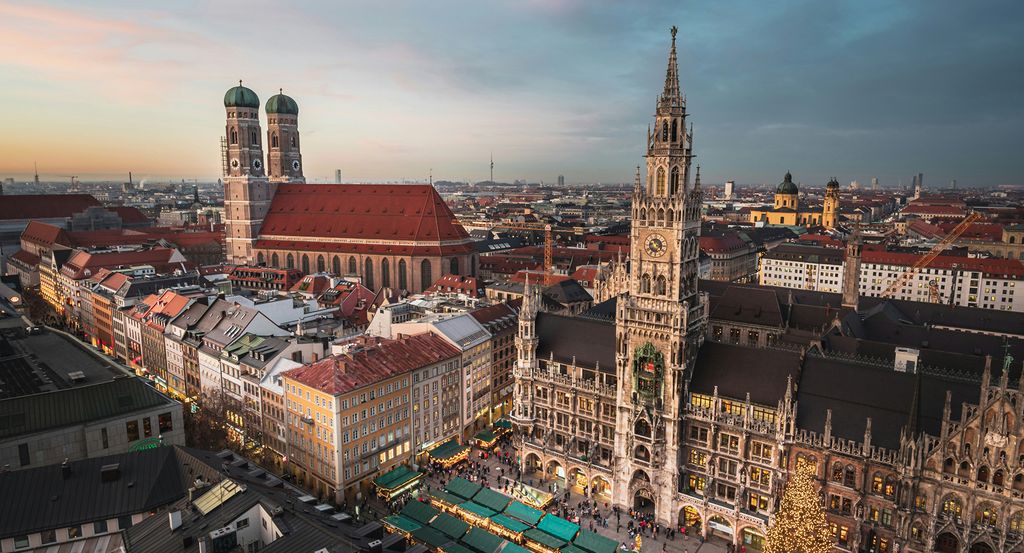
Begin at Frauenkirche, the expansive Late Gothic cathedral whose construction began in 1468 under master builder Jörg von Halspach. Duke Sigismund laid the foundation stone, establishing a substantial rebuilding project intended to replace the earlier Romanesque parish church with a religious building suited to Munich's expanding population and political importance. The principal brick structure reached completion in 1488, and its consecration followed in 1494, creating one of southern Germany's most substantial medieval hall churches. The twin towers acquired their distinctive copper-covered domes in 1525, establishing the architectural silhouette that became inseparable from Munich's historic skyline. Its interior incorporates substantial octagonal columns, ribbed vaulting and an extensive ambulatory, preserving the architectural character of late medieval Bavarian religious construction. Continue to Theatinerkirche, the Baroque court church commissioned by Elector Ferdinand Maria and Henriette Adelaide of Savoy following the birth of their son Maximilian Emanuel in 1662. Italian architect Agostino Barelli began construction in April 1663, introducing the architectural principles of the Roman Baroque into the ceremonial environment of the Bavarian capital. Enrico Zuccalli subsequently directed the project, developing its substantial dome and towers through an architectural composition inspired by the Theatine church of Sant'Andrea della Valle in Rome. The building received its ceremonial consecration in 1675, and François de Cuvilliés the Younger completed its Rococo façade in 1768. Its princely crypt contains the remains of forty-nine members of the Wittelsbach dynasty, establishing an important religious and dynastic institution within the historic city. Conclude at Munich Residenz, the former royal residential complex whose development transformed a medieval fortified residence into one of Europe's most extensive princely palaces. The Wittelsbach rulers established their principal Munich residence within the Neuveste during the late fourteenth century, initiating successive architectural expansions that continued through the nineteenth century. Duke Albrecht V commissioned the Antiquarium between 1568 and 1571 to accommodate his collection of classical sculptures, creating a sixty-six-meter Renaissance hall whose substantial proportions established a major achievement in northern European palace architecture. Duke Wilhelm V and his successor Maximilian I subsequently transformed the space into a ceremonial banquet hall, incorporating elaborate painted decoration and substantial architectural ornament. The surrounding residential complex preserves successive Baroque, Rococo and Neoclassical interiors, connecting the artistic ambitions of the Bavarian court to the political development of the Wittelsbach monarchy. The progression moves from Frauenkirche's medieval religious architecture through Theatinerkirche's Baroque dynastic patronage and culminates in Munich Residenz's extensive royal collections, connecting the religious institutions and princely ambitions that shaped Central Munich.
Where your story begins.
Foresyte Travel reveals places that feel extraordinary long before you arrive.
Enjoy editorial crafted for luxury travelers.
Foresyte may earn a commission when you book.




















































































































