Why Bayview by Danny Khezzar matters.
Bayview by Danny Khezzar is a MICHELIN-starred French restaurant where Pâquis' distinguished lakeside hospitality meets the culinary imagination of a Paris-trained chef whose career connects the Ritz Paris, Michel Roth's gastronomic legacy, and Geneva's contemporary fine-dining culture.
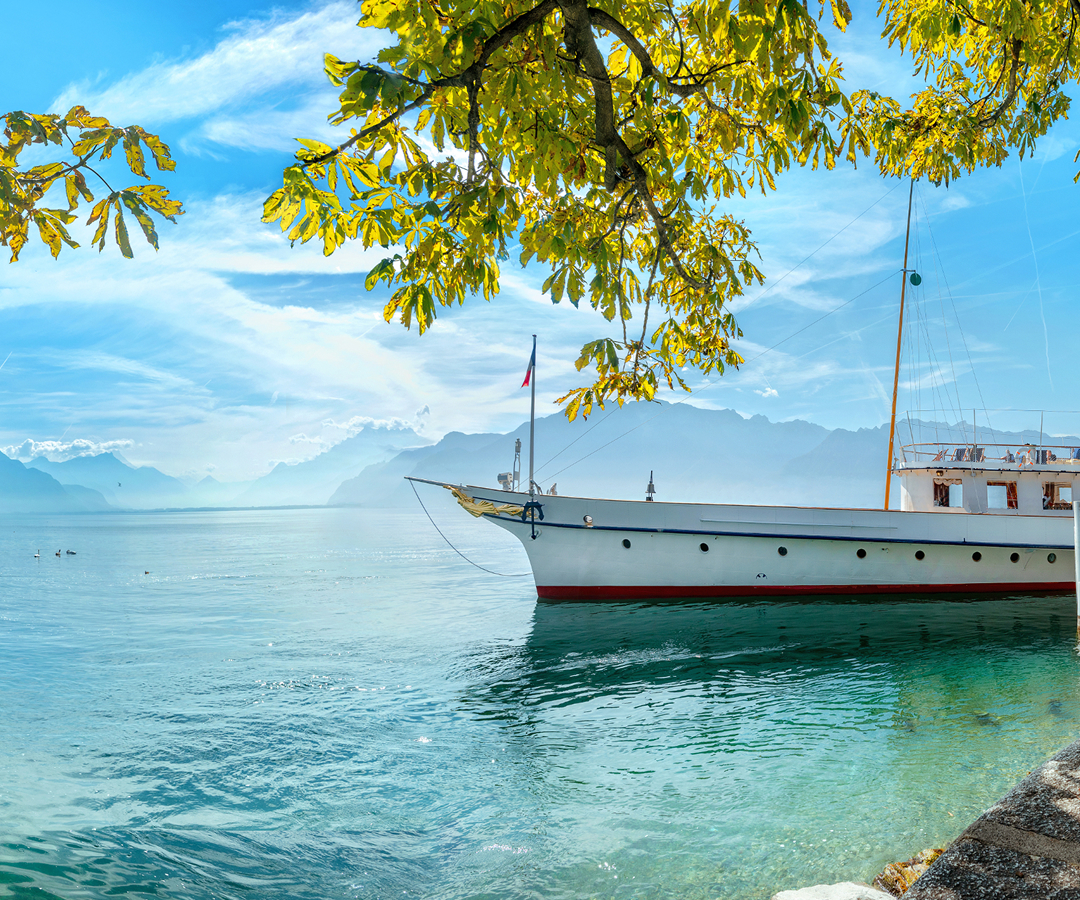
Set within the Hotel President Wilson along Quai Wilson, the restaurant overlooks Lake Geneva from the northern waterfront, with the Jet d'Eau rising across the Rade, the Alps extending beyond the southern shore, and the historic Pâquis district unfolding behind the lakeside promenade. Expansive windows establish an uninterrupted relationship between the dining room and the lake, giving the restaurant its defining panorama of open water, distant mountains, and Geneva's expansive harbor. Luxurious mahogany furnishings and a blue-and-gold decorative palette introduce the warmth and refinement of French hotel gastronomy, organizing the interior around the surrounding views. A suspended installation of Saint-Louis Amadeus crystal provides the room's most distinctive decorative centerpiece, complemented by carefully arranged tables and an elegant contemporary interior. The result is a lakeside dining room whose panoramic setting, French decorative craftsmanship, and architectural refinement establish an exceptional environment for Danny Khezzar's contemporary haute cuisine.
What defines Bayview by Danny Khezzar.
Bayview by Danny Khezzar is distinguished by an extraordinary professional relationship between Michel Roth and Danny Khezzar, connecting two generations of French gastronomy through a chance encounter at the Ritz Paris and a decade of culinary development in Geneva. Roth entered the highest ranks of French cooking in 1991, winning both the Bocuse d'Or and the Meilleur Ouvrier de France distinction, an exceptional combination of achievements that established his technical authority within the country's gastronomic profession. His subsequent leadership of L'Espadon at the Ritz Paris placed him at the center of one of France's most prestigious hotel kitchens, where classical French preparations and exacting professional discipline shaped the development of younger chefs. The Ritz's closure for renovation in 2012 brought Roth to Geneva, where hotel owner Charles Tamman entrusted him with the culinary direction of the Hotel President Wilson and the transformation of its gastronomic restaurant. Bayview reopened in September 2012 with Roth overseeing the kitchens and chef David Devel directing the restaurant's daily culinary operations, supported by pastry chef Didier Steudler. The restaurant earned a MICHELIN star in 2014, establishing its position among Geneva's distinguished fine-dining establishments and reinforcing Roth's influence beyond Paris. Danny Khezzar's connection with this culinary lineage began during adolescence, when a family celebration at the Ritz introduced him to Roth and the professional world of grand-hotel gastronomy. Born in Rosny-sous-Bois, east of Paris, Khezzar had developed an early attachment to cooking through his grandfather, a professional cook whose influence introduced him to the practical discipline and resonant significance of preparing food. His encounter with Roth at fifteen became a formative moment, giving the aspiring chef direct access to a professional kitchen whose standards would shape his subsequent ambitions. Formal culinary education in Paris established his technical foundation, followed by professional training in demanding French restaurants, including Pierre Gagnaire's Gaya, where contemporary creativity complemented the classical techniques of his earlier development. Khezzar joined Bayview in Geneva in 2015, beginning an extended apprenticeship under Roth that carried him through successive kitchen responsibilities. His progression from junior positions into the preparation of vegetables, meat, and fish developed an unusually comprehensive understanding of the restaurant's culinary organization, connecting individual cooking techniques with the coordination required for elaborate gastronomic service. Chef David Devel became another important figure in this professional development, supervising the younger chef as he advanced toward the sous-chef position. The relationship between Roth's classical discipline and Khezzar's increasingly imaginative approach established the foundation for a generational transition within the restaurant. A dramatic expansion of Khezzar's public reputation arrived in 2023 through the fourteenth season of Top Chef, the French television competition broadcast on M6. His appearance introduced a national audience to a chef whose culinary creativity developed alongside an established career in rap music, an artistic pursuit rooted in his adolescence and maintained throughout his professional advancement. Khezzar reached the competition's final, attracting substantial attention through inventive culinary presentations and an unconventional personal style that distinguished him within the French gastronomic profession. Roth appointed him head chef of Bayview on May 1, 2023, completing the transformation of their early encounter at the Ritz into a professional relationship that placed the younger chef at the head of a MICHELIN-starred kitchen. The appointment preserved Roth's involvement as executive chef and mentor, creating a leadership arrangement that combined his exceptional technical authority with Khezzar's creative direction. Bayview retained its MICHELIN distinction under the new arrangement, and Khezzar subsequently received La Liste's Talent of the Year recognition for 2026, extending his professional standing beyond the audience established through television. His ambitions also expanded into Geneva's wider restaurant industry, including the opening of Sheesh!, a contemporary street-food concept specializing in Japanese-inspired katsu sandwiches, and Izakaya by Danny Khezzar, which introduced another expression of his culinary interests. These projects broadened his professional activities beyond French fine dining, connecting the discipline of MICHELIN-starred cooking with informal international restaurant formats. Bayview occupies a distinctive position within European gastronomy as the culmination of a relationship that began in one of Paris's most celebrated kitchens and developed into a successful transfer of culinary leadership across generations.
Danny Khezzar's cooking develops classical French technique through a contemporary interpretation of Geneva's regional produce, using precise preparation, contrasting textures, and unexpected presentations to reveal new dimensions of familiar ingredients. Vegetables, grains, fruits, freshwater fish, and Swiss meats form the foundation of a seasonal culinary program shaped by relationships with regional farmers and producers. The kitchen incorporates ingredients bearing the Genève Région - Terre Avenir designation, connecting its gastronomic ambitions with the agricultural traditions of the surrounding canton. Khezzar approaches these ingredients through a combination of technical discipline and creative transformation, preserving their recognizable flavors as their physical presentation becomes increasingly inventive. His toasted-bread cappuccino exemplifies this method, translating the familiar aroma of browned bread into a savory preparation whose liquid texture and aerated surface evoke the structure of a coffee drink. The preparation establishes an immediate relationship between memory, aroma, and texture, introducing the chef's interest in altering the presentation of recognizable flavors. That same attention to physical contrast informs the treatment of regional vegetables, whose natural sweetness and vegetal bitterness develop through roasting, controlled cooking, and carefully balanced acidity. Seasonal ingredients acquire additional complexity through concentrated sauces and aromatic accompaniments that extend their flavor while preserving the character of the principal product. Freshwater fish introduces another expression of this approach, requiring delicate temperature control to preserve the texture of the flesh and maintain balance with accompanying vegetables and sauces. The kitchen's treatment of meat develops greater intensity through roasting, the concentration of cooking juices, and the relationship between savory richness and the acidity of seasonal produce. Khezzar organizes these preparations into elaborate tasting sequences, allowing changes in texture, temperature, and aromatic concentration to create continuity across successive courses. La Mélodie des Sens presents the kitchen's culinary direction through seven courses, establishing a sequence of increasingly developed preparations within a substantial gastronomic meal. Le Grand Voyage extends the format to ten courses, allowing additional room for the chef's technical creativity and the sequence of contrasting flavors. Pastry introduces another dimension of the restaurant's craftsmanship, with Didier Steudler contributing the precision and creative development of French dessert traditions to the broader culinary program. Geoffrey Bentrari directs the wine service, bringing the expertise of Switzerland's best sommelier in 2011 to a cellar encompassing 800 carefully selected bottles. Prestigious Bordeaux producers including Pétrus and Château Cheval Blanc occupy a place within the collection, complemented by wines selected for their relationship with the kitchen's seasonal preparations. The pairing program develops connections between the structure of individual wines and the acidity, richness, and aromatic complexity of successive courses. Bayview's culinary distinction emerges through this integration of regional Swiss agriculture, rigorous French technique, imaginative presentation, and expert wine stewardship, giving Khezzar's cooking a coherent character grounded in both his apprenticeship and his independent creative ambitions.
How Bayview by Danny Khezzar fits.
Bayview by Danny Khezzar anchors a Geneva waterfront exploration connecting the historic public bathing culture of the Rive Droite, an extraordinary nineteenth-century funerary monument, and the landscaped civic gardens surrounding the city's principal harbor.
Begin at Bains des Pâquis, the historic bathing complex extending into Lake Geneva from the northern shore of the Rade. Established in 1872, the baths originated as a wooden installation during a period when Geneva's waterfront was developing into an important public recreational landscape. An expansion in 1889 introduced additional structures supported by piles, strengthening the bathing facility's physical connection with the lake. Geneva's municipal authorities assumed responsibility for the complex in 1890, establishing its lasting role as a public institution. A major reconstruction followed in 1931 and 1932 under architect Henry Roche and engineer Louis Archinard, replacing the earlier wooden structures with an extensive reinforced-concrete complex. The modernist installation incorporated hundreds of supporting piles, broad bathing terraces, and facilities designed around direct access to the lake. Its subsequent development introduced winter bathing, saunas, and a restaurant associated with traditional Swiss fondue, extending the institution's importance across Geneva's seasonal recreational culture. Continue toward the Brunswick Monument, the elaborate neo-Gothic mausoleum occupying a landscaped square near the Hôtel Beau-Rivage. The monument commemorates Charles II, Duke of Brunswick, whose political exile brought him to Geneva before his death in 1873. His extraordinary bequest of twenty-four million gold francs to the city carried the condition that Geneva construct a grand funerary monument in his honor. Inspired by the medieval Scaliger tombs in Verona, the structure introduced an elaborate Italian Gothic architectural composition into Geneva's nineteenth-century waterfront. Architect Jean Franel developed the monument with sculptural contributions from Vincenzo Vela, Auguste Caïn, and Charles Iguel, incorporating Carrara marble and pink Verona stone into its richly ornamented design. Inaugurated in 1879, the mausoleum preserves an exceptional relationship between personal commemoration, architectural ambition, and the financial development of the city. The duke's bequest also contributed to major civic projects, including the construction of the Grand Théâtre de Genève. Conclude at Jardin Anglais, the landscaped public garden occupying the southern shore of the harbor near the Mont-Blanc Bridge. Developed during the nineteenth century, the garden introduced curved pathways, mature trees, and ornamental planting into Geneva's expanding waterfront landscape. The opening of the Mont-Blanc Bridge in 1862 strengthened the connection between the city's two lakeshores, establishing a major crossing at the western edge of the Rade. The Monument National followed in 1869, commemorating Geneva's entry into the Swiss Confederation through two sculpted female figures representing Geneva and Helvetia. The garden's historic landscape preserves a substantial public setting for the city's waterfront monuments, with broad views toward the northern shore and the surrounding mountain ranges. The progression moves from Bains des Pâquis' historic bathing culture through the Brunswick Monument's extraordinary nineteenth-century legacy and culminates at Jardin Anglais, where Geneva's landscaped waterfront captures the civic ambitions of its great period of urban expansion.
Where your story begins.
Foresyte Travel reveals places that feel extraordinary long before you arrive.
Enjoy editorial crafted for luxury travelers.
Foresyte may earn a commission when you book.