
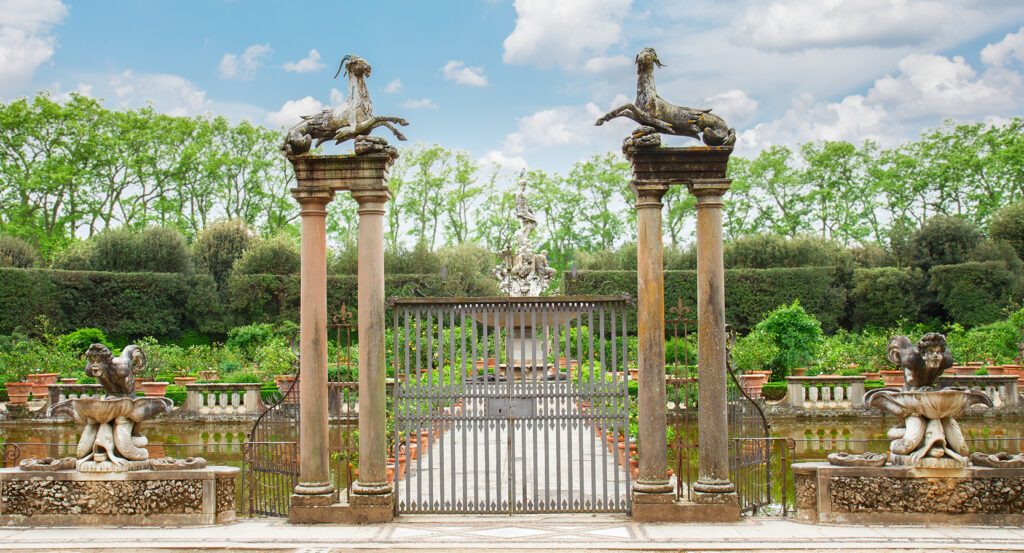
Why you should experience Fontana del Forcone in Florence, Italy.
Fontana del Forcone, or Fountain of Neptune, at Boboli Gardens in Florence is a triumph of myth, artistry, and engineering, a shimmering centerpiece where sculpture and water meet in perfect Renaissance harmony.
Set on the upper terrace above the Viottolone Avenue, this striking fountain features Neptune, the Roman god of the sea, standing poised with his trident as if ready to command the elements. Locals once called it “the Fork Fountain” for that very reason. Designed in the mid-16th century by Stoldo Lorenzi, the fountain was part of the Medici family's grand vision to transform Boboli into a living expression of their power and cultural refinement. The basin below reflects both sky and stone, casting ripples of light across Neptune's marble form, while the surrounding terraces frame him against the open Tuscan horizon. To stand before it is to feel Florence itself breathe, water murmuring through ancient channels, sunlight flickering off the marble, and the spirit of the Renaissance alive in every detail.
What you should know about Fontana del Forcone.
Fontana del Forcone wasn't built merely for decoration, it was a political symbol disguised as art.
Commissioned by Cosimo I de' Medici in the late 1560s, Neptune's commanding figure represented the duke's control over Florence and its waterways, echoing the message of Baccio Bandinelli's Fontana del Forcone in Piazza della Signoria. The marble used for the sculpture was quarried from the Seravezza region, a site under direct Medici patronage, further emphasizing their reach across Tuscany. Ingeniously engineered by the court architect Bernardo Buontalenti, the fountain was fed by a sophisticated hydraulic system that drew water from underground cisterns, a feat of innovation for its time. Surrounding statues of river gods and water nymphs once enhanced the sense of divine dominion, while the fountain's strategic placement atop the hill created a visual and symbolic axis through the gardens. The Neptune Fountain's enduring nickname, “Fontana del Forcone” or “the Trident Fountain”, speaks to its power and immediacy, an emblem of both natural and political force.
How to fold Fontana del Forcone into your trip.
When exploring the Boboli Gardens, make Fontana del Forcone one of your first stops after entering through Palazzo Pitti.
Follow the main avenue upward toward the open terrace, the fountain emerges suddenly, gleaming white against the deep green of the cypress-lined slopes. Visit in the morning for soft light and calm reflections, or near sunset when the marble glows gold and the surrounding terraces empty out. Take time to walk the perimeter, noting how the perspective shifts with every step; the Medici designed the space to be experienced dynamically, not statically. From here, you can look down toward the Viottolone Avenue and beyond to the Isolotto Basin, both aligned with the fountain in deliberate harmony. Sit on the nearby steps, listen to the sound of water echoing against the stone, and feel the balance between human ambition and natural grace. Fontana del Forcone is more than a landmark, it's a declaration of the Renaissance spirit itself: confident, creative, and eternally in motion.
Where your story begins.
Foresyte Travel reveals places that feel extraordinary long before you arrive.
Experience premium editorial crafted for luxury travelers.




















































































































