Why Fountain of Neptune matters.
Fountain of Neptune in Florence stands as a bold declaration of beauty and power, a masterpiece that fuses myth, politics, and water into pure theatrical grandeur.
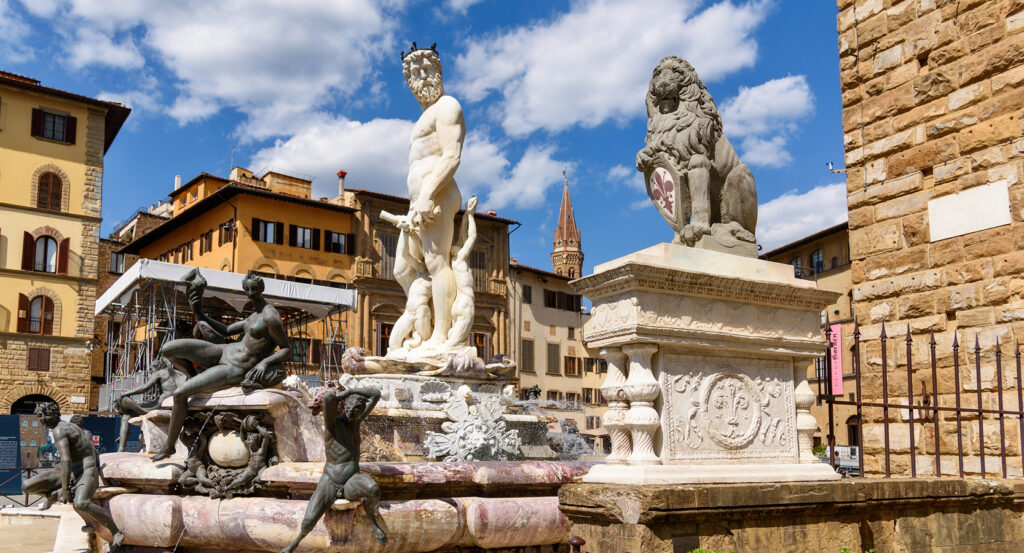
Rising from the corner of Piazza della Signoria, the fountain commands attention the way only Florence can: with grace that masks ambition. At its center, Neptune, the Roman god of the sea, towers over a marble chariot drawn by sea horses, surrounded by nereids, satyrs, and dolphins that glisten in the Tuscan sun. The water shimmers like liquid glass, reflecting the pale stone of Palazzo Vecchio behind it. Designed by Bartolomeo Ammannati in the 16th century, the sculpture was commissioned to celebrate Florence's maritime ambitions under Medici rule. Locals nicknamed the statue Il Biancone (“the white giant”), a figure both admired and teased, but time has transformed it into one of the city's most iconic emblems. Standing beside it, you can feel both the calm of myth and the pulse of politics, frozen together in marble and spray.
What defines Fountain of Neptune.
Fountain of Neptune was Florence's first public fountain, and one of its most misunderstood.
Commissioned by Cosimo I de' Medici to mark the opening of a new aqueduct and to assert Florence's naval ambitions, the fountain was completed in 1574 by Ammannati and his team of sculptors, including Giambologna. The likeness of Neptune was said to be modeled after Cosimo himself, a deliberate act of self-deification linking the ruler to a god of dominion and control. Yet from its unveiling, Florentines had mixed feelings, many mocked its proportions, calling Neptune's expression too severe, too human. What critics missed was Ammannati's genius: the blend of classical restraint and mannerist tension. The surrounding figures, sea nymphs with rippling hair, tritons blowing conch shells, marble horses pawing the basin, create a choreography of motion around the still god, symbolizing mastery over chaos. The fountain also marked a technological triumph: its hydraulic system drew water from miles away, a feat of engineering that turned Florence's heart into a living performance of power.
How Fountain of Neptune fits.
Fountain of Neptune works as both art and atmosphere, a living landmark that changes with every hour of the day.
Visit early in the morning to see its marble glow in soft gold, the square quiet enough to hear the faint burble of water echoing off the stone. Return again at sunset, when street performers and musicians fill Piazza della Signoria and the fountain takes on an almost cinematic glow. Stand near the western edge of the basin to catch the reflection of Palazzo Vecchio in the water, the same view that has inspired painters for centuries. If you look closely at the base, you'll find subtle details: nereids with mischievous smiles, shells curling like waves, and tiny satyrs that seem to dance in the shadows. At night, under the lamplight, the figures appear to move, the god of the sea presiding over a city of stone and flame. Fountain of Neptune in Florence isn't just a monument; it's Florence's most eloquent metaphor, beauty reigning over power, serenity conquering chaos.
Where your story begins.
Foresyte Travel reveals places that feel extraordinary long before you arrive.
Enjoy editorial crafted for luxury travelers.
Foresyte may earn a commission when you book.