Why Bread & Butterfly matters.
Bread & Butterfly is a French-inspired neighborhood bistro where Inman Park's historic residential character meets chef Demetrius Brown's Trinidadian and Jamaican culinary heritage, the traditions of European café dining, and the evolving influence of the African diaspora on Atlanta's restaurant culture.
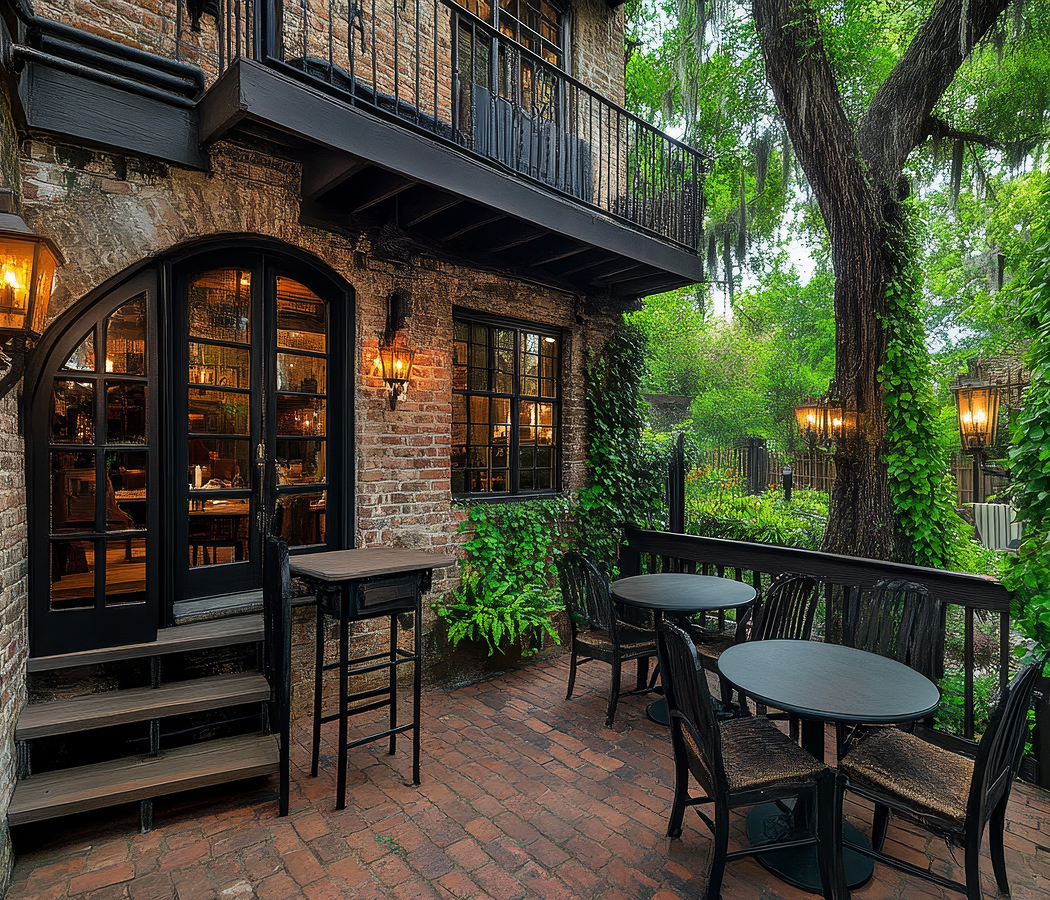
Set along Elizabeth Street near North Highland Avenue and the commercial heart of Inman Quarter, the restaurant occupies a prominent corner of the neighborhood's pedestrian-oriented retail district, where restored residential streets approach the former industrial corridor extending toward the Atlanta BeltLine. A covered sidewalk terrace connects the dining room to Elizabeth Street, with café tables positioned beneath a sheltered porch and large steel-framed openings extending the interior toward the surrounding pedestrian environment. Inside, jade-green subway tiles, marble tabletops, a decorative copper ceiling, and leather-upholstered stools establish the architectural character of a traditional European neighborhood café. Natural wood finishes, closely arranged dining tables, and a compact bar create an intimate setting organized around the relationship between the main dining room and its outdoor seating. The result is a carefully proportioned restaurant whose French café architecture, neighborhood-facing terrace, and intimate dining spaces provide a distinctive setting for one of Atlanta's most consequential contemporary culinary partnerships.
What defines Bread & Butterfly.
Bread & Butterfly is best known for its transformation from a French-inspired neighborhood café into a nationally recognized restaurant under chef Demetrius Brown and hospitality partner Brandon Blanchard, whose culinary program connects classical European preparations with the food traditions of the African diaspora. Chef Billy Allin, previously recognized for his work at Cakes & Ale in Decatur, established the restaurant in December 2015 as part of the Inman Quarter development. Allin developed the original concept around the informal dining culture of European cafés, emphasizing breakfast, lunch, coffee, pastries, and carefully prepared bistro dishes. Chef Bryan Stoffelen directed the opening kitchen, developing a Continental menu that incorporated traditional French preparations and seasonal ingredients. The restaurant's name originated with the bread-and-butterfly creature in Lewis Carroll's Through the Looking-Glass, connecting its character to the literary imagination of the nineteenth-century English author. Allin's earlier restaurant, Cakes & Ale, had established his reputation for ingredient-focused cooking and relationships with regional agricultural producers, creating a foundation for the café's original culinary direction. Bread & Butterfly subsequently developed a substantial following for its soft French omelets, croque madame, pastries, and carefully prepared coffee, establishing a recognizable presence within Atlanta's growing neighborhood restaurant community. The restaurant's next major chapter emerged through Demetrius Brown, whose family background connected Trinidadian and Jamaican cooking traditions with his upbringing in Providence, Rhode Island, and Atlanta. Brown attended Johnson & Wales University, pursuing professional culinary training before returning to Georgia and developing his career in several Atlanta kitchens. His professional development included work at The Hill at Serenbe and a leadership position at The Pinewood in Decatur, where his cooking attracted an Eater Young Guns nomination in 2020. During the pandemic, Brown established Heritage Supper Club in 2021, developing a series of pop-up dinners exploring the culinary connections among African, Caribbean, and African American communities. The project earned Atlanta magazine's Best Food Pop-Up recognition, establishing an independent platform for Brown's investigation of regional ingredients and historical cooking traditions. Brown and Blanchard subsequently brought Heritage Supper Club to Bread & Butterfly for evening events in early 2023, developing a professional relationship with the restaurant's existing ownership. The success of those dinners led to their acquisition of Bread & Butterfly in August 2023 and the establishment of Bellevue Hospitality Group as their operating partnership. Brown retained the restaurant's established daytime character and developed an evening program centered on French cooking and the historical connections between France, Africa, and the Caribbean. The New York Times selected Bread & Butterfly for its 2024 list of America's Best Restaurants, bringing national attention to the restaurant's transformation under its new ownership. The partnership expanded further in September 2026 with the opening of Heritage in Atlanta's Summerhill neighborhood, establishing a permanent home for the supper club that had helped initiate Brown and Blanchard's collaboration.
Demetrius Brown's culinary program develops through the historical movement of ingredients, cooking techniques, and food traditions between West Africa, the Caribbean, Europe, and the American South. The restaurant preserves a recognizable French café structure during breakfast and lunch, incorporating omelets, croissants, tartines, and other preparations associated with European neighborhood dining. Its soft-scrambled eggs emphasize careful temperature control, producing delicate curds enriched with butter and accompanied by carefully selected garnishes. The croque madame combines toasted bread, ham, cheese, and béchamel beneath a fried egg, drawing on the layered preparation associated with traditional Parisian café cooking. Seasonal quiche incorporates a custard of eggs and dairy within a pastry shell, with changing vegetable and cheese combinations reflecting the kitchen's relationships with regional farms. The daytime pastry selection includes laminated croissants, seasonal baked goods, and desserts that preserve the restaurant's original connection to French baking. Evening service develops a separate culinary direction through dishes drawing on the cooking traditions of Haiti, Trinidad, Jamaica, and other communities shaped by the African diaspora. Cassava frites transform the starchy tropical root into crisp fried pieces accompanied by black garlic aioli and caviar, combining a Caribbean staple with the presentation techniques of contemporary fine dining. Tasso, a traditional Haitian preparation of seasoned and fried meat, appears alongside epis, the aromatic herb-and-pepper seasoning central to Haitian cooking, and pikliz, a sharply acidic condiment made from pickled vegetables and Scotch bonnet peppers. Plantains contribute sweetness and starch to the composition, balancing the intensity of the seasoned meat and fermented or pickled accompaniments. Octopus preparations incorporate carefully controlled cooking and fresh vegetable garnishes, developing a relationship between Mediterranean seafood technique and the acidity associated with Caribbean condiments. The kitchen's treatment of chicken and other proteins draws on layered marinades, aromatic spices, and concentrated sauces, incorporating influences from the African Atlantic into the structure of a contemporary bistro menu. Brown's relationships with small Georgia farms contribute seasonal produce to both daytime and evening service, connecting the restaurant's international culinary references with the agricultural production of the surrounding region. Beverage director Jessica White oversees the drinks program, developing cocktails and wine selections suited to the restaurant's contrasting daytime and evening menus. The bar incorporates classic European aperitifs, contemporary mixed drinks, and spirits associated with the Caribbean, extending the kitchen's geographic range into the beverage selection. The resulting culinary program connects the discipline of French bistro cooking with the ingredients and techniques of African diaspora cuisines, preserving the restaurant's neighborhood café character through a substantial expansion of its cultural and culinary scope.
How Bread & Butterfly fits.
Bread & Butterfly works as the culinary centerpiece for an outing connecting Inman Park's historic residential architecture, the transformation of Atlanta's former railroad infrastructure, and the public landscapes developed along the city's eastern neighborhoods.
Begin at Inman Park Historic District, the residential neighborhood developed during the late nineteenth century as Atlanta's first planned streetcar suburb. Entrepreneur Joel Hurt established the community beginning in 1889, acquiring land east of Downtown and developing a residential district connected to the city's commercial center through an electric streetcar system. The neighborhood's original planning incorporated curving streets, landscaped public spaces, and substantial residential lots intended for Atlanta's expanding professional and business communities. Its surviving architecture includes Queen Anne residences, Victorian cottages, Classical Revival houses, and substantial homes associated with prominent figures in the city's commercial development. The neighborhood's preservation movement emerged during the 1970s, when residents organized to protect historic buildings and resist the demolition pressures associated with proposed highway construction. Continue to Atlanta BeltLine Eastside Trail, the pedestrian and bicycle corridor developed along former railroad rights-of-way connecting several of Atlanta's eastern neighborhoods. The BeltLine originated from a 1999 master's thesis by Georgia Institute of Technology graduate student Ryan Gravel, who proposed converting disused railway corridors into a continuous network of public trails and transit infrastructure. The Eastside Trail opened its first substantial section in 2012, extending through former industrial districts and creating a major recreational connection between Piedmont Park, Poncey-Highland, Old Fourth Ward, and Inman Park. Its route passes restored warehouses, former factories, public art installations, and contemporary residential developments, preserving the linear geography of the rail infrastructure that once supported Atlanta's industrial economy. The trail's extensive pedestrian connections have strengthened the relationship between the surrounding residential neighborhoods and the city's expanding network of public recreational spaces. Conclude at Historic Fourth Ward Park, the landscaped public space developed on former industrial and underutilized land near the BeltLine corridor. The park's first phase opened in 2011, introducing a major stormwater retention pond designed to manage runoff from surrounding neighborhoods and reduce flooding within the Clear Creek watershed. Landscape architects incorporated terraced lawns, pedestrian bridges, native plantings, and recreational spaces around the central water feature, creating a public landscape that combines environmental engineering with neighborhood recreation. The park's design responds to the steep topography of Old Fourth Ward, using changes in elevation to organize circulation routes and frame views across the surrounding urban landscape. Its development became an important component of the neighborhood's broader revitalization, connecting public infrastructure improvements with the transformation of former industrial properties. The progression moves from Inman Park Historic District's nineteenth-century residential architecture through Atlanta BeltLine Eastside Trail's converted railroad corridor and culminates at Historic Fourth Ward Park's engineered public landscape, connecting Bread & Butterfly to the architectural preservation and urban redevelopment that distinguish Atlanta's eastern neighborhoods.
Where your story begins.
Foresyte Travel reveals places that feel extraordinary long before you arrive.
Enjoy editorial crafted for luxury travelers.
Foresyte may earn a commission when you book.