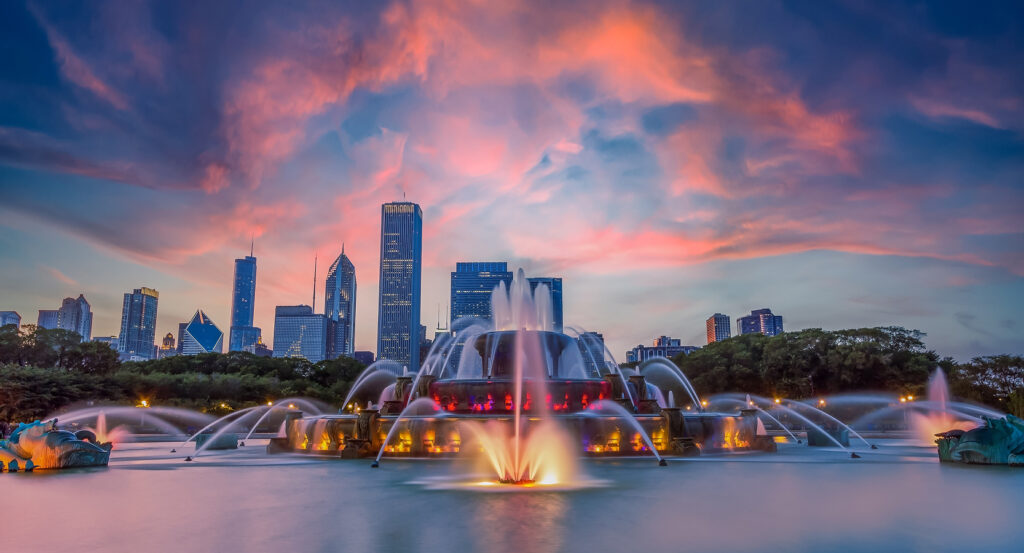
Why you should experience Clarence F. Buckingham Memorial Fountain in Chicago, Illinois.
Clarence F. Buckingham Memorial Fountain, or Buckingham Fountain, in Chicago is a living symphony of water, light, and rhythm, pulsing in harmony with the heart of Grant Park.
Built in 1927 as one of the world's largest fountains, its four basins symbolize Lake Michigan, while seahorse sculptures represent the surrounding states. As jets soar nearly 150 feet into the sky, the fountain feels alive, a daily performance where architecture meets emotion. Inspired by the Latona Fountain at Versailles, this Art Deco marvel blends European grandeur with Midwestern optimism, offering a front-row seat to the city's skyline. By day, sunlight refracts across shimmering plumes; by night, it transforms into an illuminated ballet of color and sound, drawing crowds that gather in quiet awe. Buckingham Fountain doesn't simply decorate Chicago, it defines it. Every hour, on the hour, the fountain erupts in a stunning water display that captures the city's spirit: ambitious, bold, and endlessly moving. Set against the backdrop of skyscrapers and the vastness of Lake Michigan, it creates a rare discussion between natural and manmade beauty. The park's energy shifts around it, joggers pause, newlyweds pose, street musicians play, and locals find a moment of stillness. The fountain serves as both anchor and escape, a reminder that beauty can be both grand and communal.
What you should know about Clarence F. Buckingham Memorial Fountain.
More than a century-old icon, Buckingham Fountain carries stories as deep as the water it sprays.
Gifted to the city by philanthropist Kate Sturges Buckingham in memory of her brother Clarence, the fountain was designed by Edward H. Bennett with sculptures by Marcel Loyau of Paris. Its Rococo-inspired design reflects both grace and grandeur, yet its operation is powered by surprisingly modern mechanics, a subterranean pump room capable of cycling 14,000 gallons of water per minute. Each summer evening, the fountain performs an orchestrated light and music show, its jets choreographed to classical scores and contemporary themes alike. Few realize that the fountain marks the symbolic center of Grant Park, positioned precisely along the city's historic boulevard system, echoing Daniel Burnham's vision of a “Paris on the Prairie.” Even the mist carries legacy, a celebration of Chicago's ambition, resilience, and artistry. Beneath its beauty lies a deeper layer of symbolism. The fountain's seahorses, representing the four states that touch Lake Michigan, stand as guardians of the city's relationship with water, a motif that runs through Chicago's very DNA. The design also incorporates 134 jets arranged in precise harmony, creating the illusion of a living lake. During World War II, the fountain's nightly displays were paused to conserve energy, only to return later as a symbol of postwar optimism. In 1994, a major restoration returned the fountain to its original splendor, ensuring that every drop once again shined in rhythm with the city's pulse. Even today, engineers fine-tune its performances with digital precision, honoring a century-old mechanism that still beats with analog heart. For many Chicagoans, Buckingham Fountain isn't just a tourist stop, it's a memory anchor. Generations have watched it erupt on warm nights, its spray misting the air as the skyline blushes with sunset. It's where proposals are made, concerts echo nearby, and countless festivals unfold. When winter arrives and the water stills, its stone sculptures stand sentinel, silent, waiting for spring to bring the music back.
How to fold Clarence F. Buckingham Memorial Fountain into your trip.
Experiencing Buckingham Fountain is one of those rare Chicago moments where time slows, and beauty takes center stage.
Visit in the late afternoon, when the sun casts golden light across the skyline and Lake Michigan breeze cools the air. As dusk settles, stay for the nightly show, a twenty-minute performance of synchronized water and light that begins every hour. Walk the surrounding pathways of Grant Park, where you'll find panoramic views of the cityscape, then wander toward the lakefront for a twilight stroll. If visiting in summer, pair your stop with a Millennium Park concert or a picnic by the gardens nearby. Whether you're sipping coffee at sunrise or watching the final spray shine against the night, Buckingham Fountain is more than a landmark, it's Chicago's open-air heartbeat, still dancing a century after its first splash. To deepen the experience, explore the connected ecosystem that makes the fountain so iconic. Begin at the Art Institute of Chicago, just a short walk away, where masterpieces of Monet and Hopper prepare you for the visual theater outdoors. Then drift south through the park's walking trails toward the fountain's wide esplanade. Sit on the low steps and let the sound of cascading water drown out the city's noise. When evening arrives, watch as skyscrapers ignite in glass reflections, the Willis Tower glowing to the west, Navy Pier's Ferris wheel to the east. From here, Chicago feels eternal, suspended between lake and sky. Before you leave, linger one last time. Stand close enough to feel the mist on your face and the hum beneath your feet as the pumps roar to life. That vibration, half mechanical, half mystical, connects you to every soul who has ever stood here before you, spellbound by beauty and motion. Buckingham Fountain isn't simply part of Chicago's story; it is the story, a cascade of light, water, and wonder that has never stopped flowing.
Where your story begins.
Foresyte Travel reveals places that feel extraordinary long before you arrive.
Experience premium editorial crafted for luxury travelers.